How to Start NEET PG Prep: A Study Plan Built on Actual Weightage
Reflex · 28 Jul 2026 · 5 min read
On this page
NEET PG 2026 registration closed on July 21; the exam is August 30. If you’re reading this before that date, the calendar isn’t the hard part anymore — how you spend the weeks left is. If you’re reading this ahead of a future cycle, the system below still applies: it’s built to work backward from whatever exam date you’re targeting, not around a specific registration deadline.
Start With a Baseline, Not a Textbook
Take one full-length, section-timed mock before you touch a single subject seriously. Not to feel good or bad about the score — to find out which subjects are actually weak versus which ones just feel weak. Students consistently misjudge this without data; a subject you "hate" is often a subject you’ve simply never tested yourself on properly, and a subject you feel confident in can quietly be costing you marks through careless errors rather than knowledge gaps.
Write down three numbers after this baseline test: your overall percentage, your weakest two subjects by accuracy, and your average time per question. You’ll use all three to build the plan below.
Prioritize by Weightage, Not Alphabetical Order
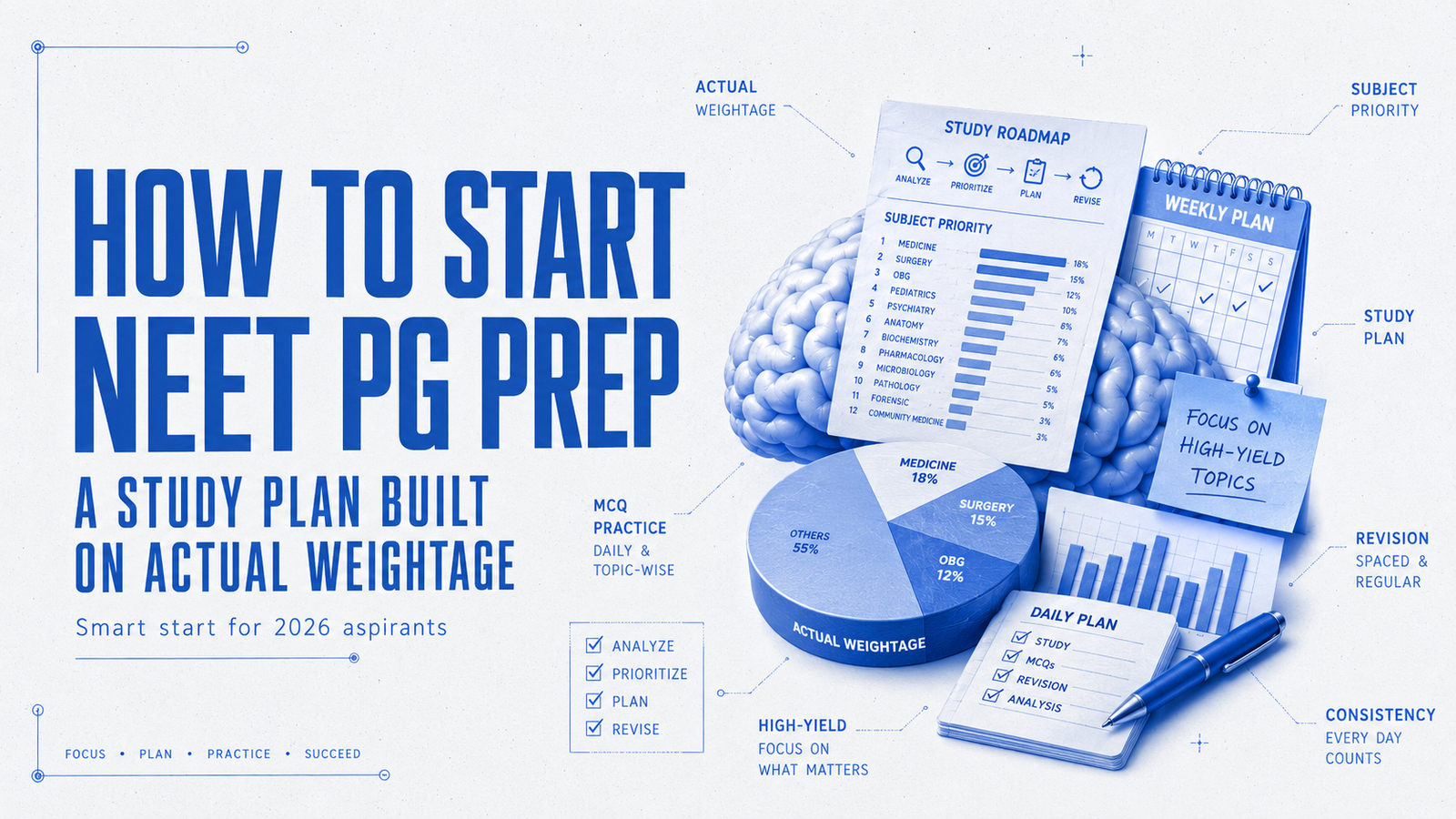
NEET PG doesn’t test all subjects equally. General Medicine and General Surgery alone account for a large share of total marks, with Pathology, Pharmacology, and Obstetrics & Gynaecology close behind. Scoring 100% in a 15-mark subject while your 150-mark subject sits at 60% is a losing trade.
A simple way to translate this into a schedule: split your available study hours roughly in proportion to weightage rather than evenly across subjects. If Medicine and Surgery together make up close to a third of the paper, they should get close to a third of your calendar — not the same three hours a week as Forensic Medicine gets.
Pick One Primary Source Per Subject and Stop Shopping
Resource-hopping is one of the most common ways students lose months without gaining marks. Pick a single primary resource per subject and a QBank to pair with it, then stop shopping. Switching sources mid-preparation because a senior recommended something different resets your mental map of that subject — you re-learn structure and terminology you’d already internalized, for a marginal content difference that rarely justifies the cost.
This applies doubly to repeaters: if you’ve already been through a full cycle with one set of resources, switching everything for attempt two is usually the wrong instinct. Diagnose what specifically went wrong — weak subjects, poor time management, panic under exam conditions — before assuming the resource was the problem.
Daily MCQ Practice Beats Marathon Reading
Passive reading feels productive; active recall is what actually sticks under exam pressure. A daily habit of subject-wise MCQs — reviewing not just what you got wrong, but why — builds the pattern recognition NEET PG rewards far faster than re-reading the same chapter a third time.
Keep an error log from day one. Every question you get wrong goes into it, tagged by subject and by reason — knowledge gap, careless reading, or wrong elimination logic. By the final revision phase, this log becomes the single most valuable document you own, because it’s built entirely from your actual mistakes rather than someone else’s idea of what’s high-yield.
Build Your Mock Test Cadence in Stages
Your mock frequency shouldn’t be flat across your whole prep timeline — it should ramp up as the exam approaches:
- Early phase: subject-wise tests as you finish each topic, to catch gaps immediately rather than months later.
- Middle phase: mixed-subject tests every one to two weeks, to force retrieval across topics the way the real exam will.
- Final 8–10 weeks: full-length, section-timed mocks weekly, mirroring the actual locked-section format — five groups, 36 questions, 42 minutes each, no going back.
The final-phase mocks aren’t just content revision — they’re building the pacing instinct the real exam demands under its section-locked constraint.
The Final Revision Loop
In the last four to six weeks, stop adding new topics. Shift entirely to:
- Reviewing your personal error log, subject by subject
- Drilling high-yield one-liners and frequently tested facts
- Re-attempting weak-subject MCQs from scratch, without looking at explanations first
- One full-length mock per week, timed exactly like exam day
New content this close to the exam has a worse marks-per-hour return than tightening what you already know. This is also the phase where sleep and exam-day logistics — admit card, ID, centre location — deserve real attention. A strong prep plan undone by a bad night’s sleep or a scramble to find the exam centre is a genuinely common and avoidable failure mode.
If You’re a Repeater
The advice above applies, but with one addition: your error log from the previous attempt is your most valuable asset, if you kept one. If you didn’t, reconstruct it as best you can from memory and any saved test results — knowing exactly what went wrong last time, whether it was content gaps, time management, or exam-day panic, should shape where your extra months go, not a generic restart from chapter one.
Consistency is what actually makes a study plan work — daily practice, not weekend cramming. Reflex’s daily TROCAR quiz and weekly HAMMER grand test are built around exactly this rhythm: subject-wise daily reps, full-length weekly simulation.
Practise this on Reflex
Turn what you just read into recall with 14 years of tagged PYQs.
FAQ
Frequently asked questions
The questions aspirants ask most about this topic.
There’s no single correct start date — what matters is working backward from your target exam date with the weightage-based system above. Earlier starts allow a longer foundation phase; later starts should compress straight into high-yield, weightage-driven revision.
This varies by where you are in the timeline and your baseline. What matters more than raw hours is whether your practice-to-reading ratio favors active recall — MCQs, error log review — over passive reading, especially in the final weeks.
Yes, at least one, to get an honest baseline. But don’t over-rely on full-length mocks early on — subject-wise tests are more efficient for catching gaps while you’re still building foundational knowledge.
Don’t avoid it — that’s exactly the subject where improvement moves your score the most. Break it into smaller sub-topics and track accuracy per sub-topic rather than treating "Medicine" as one intimidating block.
Stay ahead in your preparation
Get expert tips, exam updates, and high-yield insights delivered straight to your inbox.
No spam. Unsubscribe anytime.
More in Exam Guide
View all → Exam Guide
NEET PG 2026 Study Plan: 3 Months, Subject by Subject
Three months before NEET PG 2026 is not a lot of time. It is enough time, if you use it correctly. This is a week-by-week plan built around the August 30 exam date, subject weightage, and the five-section locked format.
 Exam Guide
How to Prepare for NEET PG 2026: A Complete Strategy Guide
NEET PG preparation comes down to three things: which subjects to prioritise, how to structure daily practice, and how to simulate the actual exam before you sit it. Here is a strategy built on what actually moves ranks.
 Exam Guide
Best App for NEET PG Preparation in 2026: Video Lectures vs PYQ-First Apps
Choosing the best app for NEET PG preparation comes down to one question: do you need more content, or more practice? The answer changes which app you should be using — and when.
 Exam Guide
NEET PG 2026 Exam Pattern and Marking Scheme, Explained
180 questions, 720 marks, and five locked 42-minute sections — the exact 2026 pattern, the marking maths, and what changed.