Best App for NEET PG Preparation in 2026: Video Lectures vs PYQ-First Apps
By Dr. Utsav Bhattacherjee, MBBS, MBA · 30 Jul 2026 · 7 min read
Last updated: 23 Sept 2026
On this page
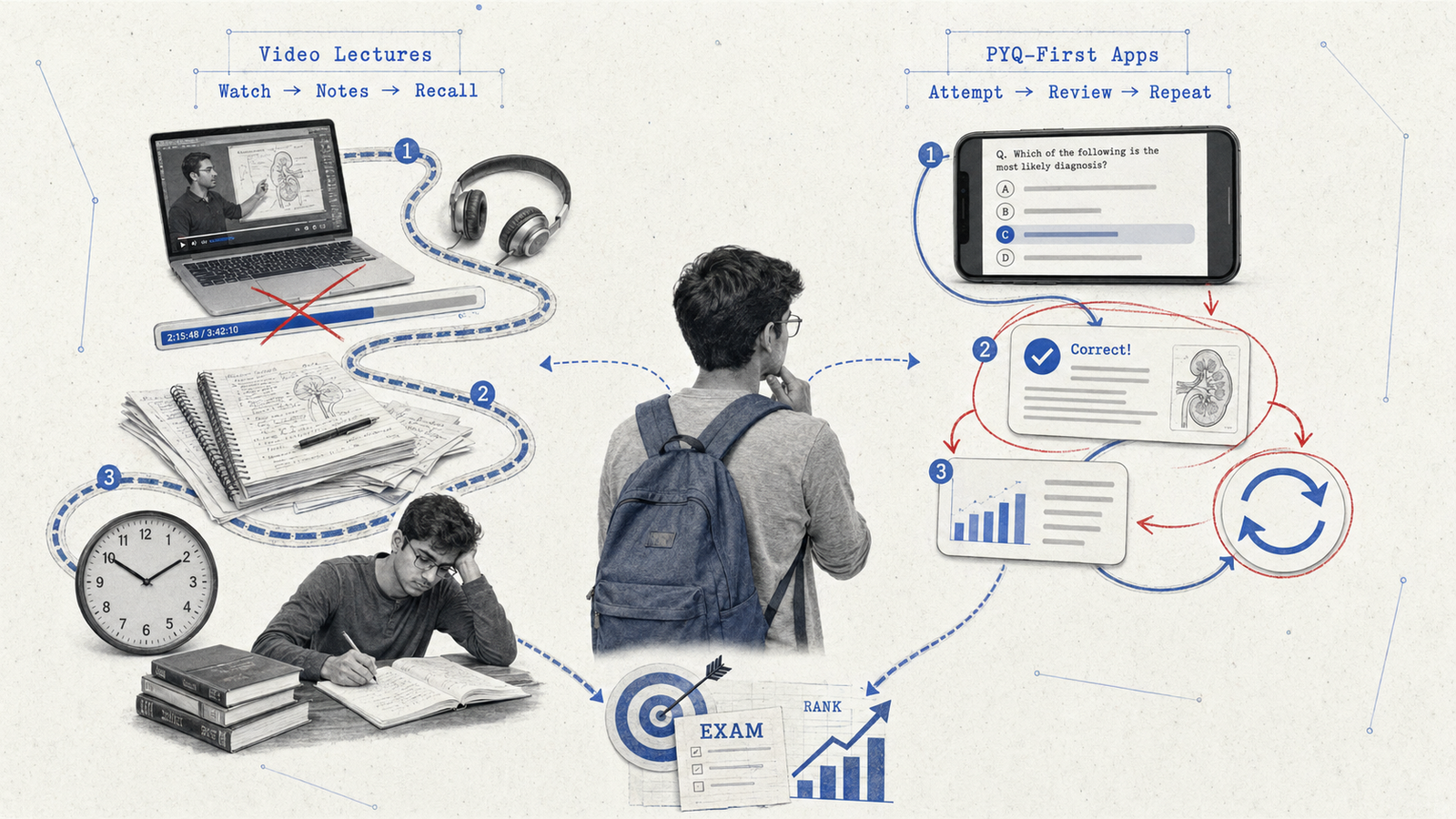
There are two broad categories of NEET PG preparation apps in India right now. The first is built around video lectures — long-form recorded content from faculty, covering each topic in depth. The second is built around previous year questions — daily practice, timed tests, and performance analytics.
Both work. Both have helped students clear NEET PG. But they are solving different problems at different stages of preparation. Using the wrong one at the wrong time is one of the more common reasons students feel busy but not improving.
This post breaks down exactly what each type of app does well, what it does not, and how to decide which one belongs in your prep right now.
What Video Lecture Apps Do Well
Video lecture apps are built for one thing: explaining concepts you do not yet understand.
If you are early in MBBS — second or third year — and you have not yet covered a subject clinically, a structured video lecture is often the right way to build the foundation. A good faculty member walking through the pathophysiology of a disease, the mechanism of a drug, or the anatomy of a surgical field can compress weeks of textbook reading into a few hours of focused watching.
The other thing video lecture apps do well is completeness. A well-produced lecture series covers a subject systematically, from basics to high-yield exam points, without gaps. For students who feel their MBBS teaching was incomplete — limited clinical exposure, poor faculty, rushed posting — video content fills that gap in a way flashcards and question banks cannot.
Where video lectures fall short
The problem is what happens after you finish watching.
Watching a lecture does not build the recall you need to answer questions under exam pressure. Passive consumption — watching, following along, taking notes — creates a feeling of understanding that does not always hold up when a NEET PG question puts that concept in a clinical scenario you have not seen before.
The second issue is time. A comprehensive video lecture series for NEET PG can run to hundreds of hours of content. Students who watch videos as their primary prep method often run out of time before they have practiced enough questions. The exam tests recall and application, not how thoroughly you understood a concept during passive learning.
There is also no feedback loop. A video does not tell you which concepts you are actually recalling versus which ones you just think you recall.
What PYQ-First Apps Do Well
Previous year question apps are built around one observation: the NEET PG exam repeats concepts, repeatedly, across cycles. The specific question changes. The underlying concept does not.
A student who has worked through 10 to 12 years of PYQs across all subjects has seen the exam's favourite topics, the clinical scenarios that keep appearing, and the specific phrasings that signal a particular answer. That pattern recognition is something no amount of lecture watching can replicate.
PYQ-first apps also create a feedback loop. Every question answered tells you something — you got it right immediately, you got it right after hesitating, you guessed and were wrong, or you had no idea. That information, tracked over time and across subjects, shows you exactly where your preparation is strong and where it is not. Rank prediction after a full-length test gives you a number that is grounded in real performance, not self-assessment.
The daily cadence matters too. Short daily practice sessions — 15 to 20 questions in a subject, every day — build subject recall through spaced repetition in a way that a single marathon study session does not. Students who practice consistently for six months almost always outperform students who study intensively for two months before the exam.
Where PYQ-first apps fall short
If you have a genuine conceptual gap — a subject you simply do not understand at a foundational level — working through PYQs without that foundation is inefficient. You can memorise that "option C" is correct for a particular question type without ever understanding why. That breaks down the moment the exam presents the same concept in a slightly different clinical scenario.
Which One You Need Right Now
The honest answer is that most NEET PG aspirants need both, at different times and in different proportions.
If you are in MBBS Year 2 or 3: PYQ practice should already be part of your routine, even if you have not finished your subject postings. Even 10 questions a day in a subject you are currently studying builds exam familiarity that compounds over years. Video content fills conceptual gaps as they appear.
If you are in final year or internship with 6 to 12 months to the exam: The proportion shifts. By this point, the goal is not to learn new concepts — it is to convert what you already know into reliable exam performance. PYQ practice, full-length mock tests, and performance analytics should be the primary activity. Video content becomes a targeted resource for specific weak areas, not the main study method.
If you are 1 to 3 months out from the exam: This is revision and consolidation time. Mock tests, section-wise practice calibrated to the 42-minute section format, and working through your weak subjects using short targeted content. A full lecture series at this stage is a poor use of time.
What to Look for in a NEET PG Preparation App
Regardless of which type you are using, these are the markers of a well-built app:
Question quality and source. PYQs should be tagged by subject, topic, and exam year. Explanations should be concise and exam-focused — the reasoning behind the answer, not a textbook chapter. Low-quality apps pad question banks with made-up questions that do not reflect actual exam patterns.
Performance analytics. A good app tells you your accuracy by subject, your speed per question, and how your predicted rank is trending. Without this, you have no way to know if your preparation is actually moving.
Exam-accurate test format. For NEET PG 2026, this means tests structured around the five-section, 42-minute-per-section format. An app that serves questions without time pressure is not preparing you for the actual exam constraint.
Daily structure. The best apps build a daily practice habit — a short, focused session that keeps all subjects rotating rather than letting earlier subjects go cold while you cover later ones.
Price relative to coverage. Full access to a well-built NEET PG app with 10,000 or more questions, mock tests, and analytics should cost significantly less per month than a coaching class or a video lecture subscription. If an app is priced like a coaching class, check whether it is actually delivering more than one.
The Bottom Line
The best app for NEET PG preparation in 2026 is the one that matches where you actually are in your preparation. If you have significant conceptual gaps, video content is the right primary tool. If you have the foundation but lack exam-level recall and pacing, a PYQ-first daily practice app is what moves your rank.
Most students who clear NEET PG in their first attempt used both — video content to build understanding early, PYQ practice as the primary daily activity in the final year and a half. The mistake most people make is staying too long in passive learning mode and not switching to active practice early enough.
The NEET PG 2026 score calculator can help you estimate where your current practice level puts you — useful for deciding whether to push more on content or more on test performance.
If you are looking for a PYQ-first daily practice app built specifically around the 2026 exam format, Reflex covers NEET PG and INI-CET with 12,400 tagged PYQs, daily TROCAR quizzes, and weekly full-length HAMMER tests structured to the five-section 42-minute format.
Practise this on Reflex
Turn what you just read into recall with 14 years of tagged PYQs.
FAQ
Frequently asked questions
The questions aspirants ask most about this topic.
The best app depends on your stage of preparation. If you need to build conceptual foundations, a video lecture app is more useful. If you have the foundation and need exam-level recall and pacing, a PYQ-first practice app with mock tests and analytics is the right primary tool for most aspirants in the 6 to 12 months before the exam.
Covering 10 to 12 years of PYQs across all 19 subjects is the standard target. This gives you enough exposure to the exam’s repeated concepts and clinical scenario patterns to develop reliable recognition. More important than the total count is daily consistency — 15 to 20 questions every day compounds significantly over months.
No, not on its own. Video lectures build understanding but do not build the exam-level recall and pacing that NEET PG tests. Aspirants who rely primarily on passive video watching without sufficient PYQ practice consistently underperform their expected rank. Practice and testing must be the majority of your preparation time in the final year before the exam.
Free apps typically offer a small subset of questions and limited analytics. For a high-stakes exam like NEET PG, the marginal cost of a well-built paid app — often under ₹150 per month annually — is small relative to the cost of an additional exam attempt or a weaker specialty placement.
As early as MBBS Year 2. Students who start PYQ practice in second year build subject recall over two to three years rather than six months. Even 10 questions a day in a subject you are currently posting through creates exam familiarity that compounds significantly by the time you sit the actual exam.
About the author
Stay ahead in your preparation
Get expert tips, exam updates, and high-yield insights delivered straight to your inbox.
No spam. Unsubscribe anytime.
More in Exam Guide
View all → Exam Guide
UPSC CMS Exam: Eligibility, Pattern, Syllabus, and How Selection Works
UPSC CMS recruits medical officers for central and Delhi civic services. Here are the eligibility rules, age limit, exam pattern, syllabus, selection stages and how it compares with NEET PG.
 Exam Guide
DNB Full Form in Medical: Course, Admission, and How It Compares With MD/MS
DNB stands for Diplomate of National Board, a postgraduate qualification from NBEMS. Here is how admission, training and the exit exam work, and how DNB compares with MD/MS.
 Exam Guide
INI-CET November 2026: How to Use Your Last 30 Days, Week by Week
 Exam Guide