INI-CET November 2026: How to Use Your Last 30 Days, Week by Week
By Dr. Utsav Bhattacherjee, MBBS, MBA · 5 Oct 2026 · 9 min read
Last updated: 8 Oct 2026
On this page
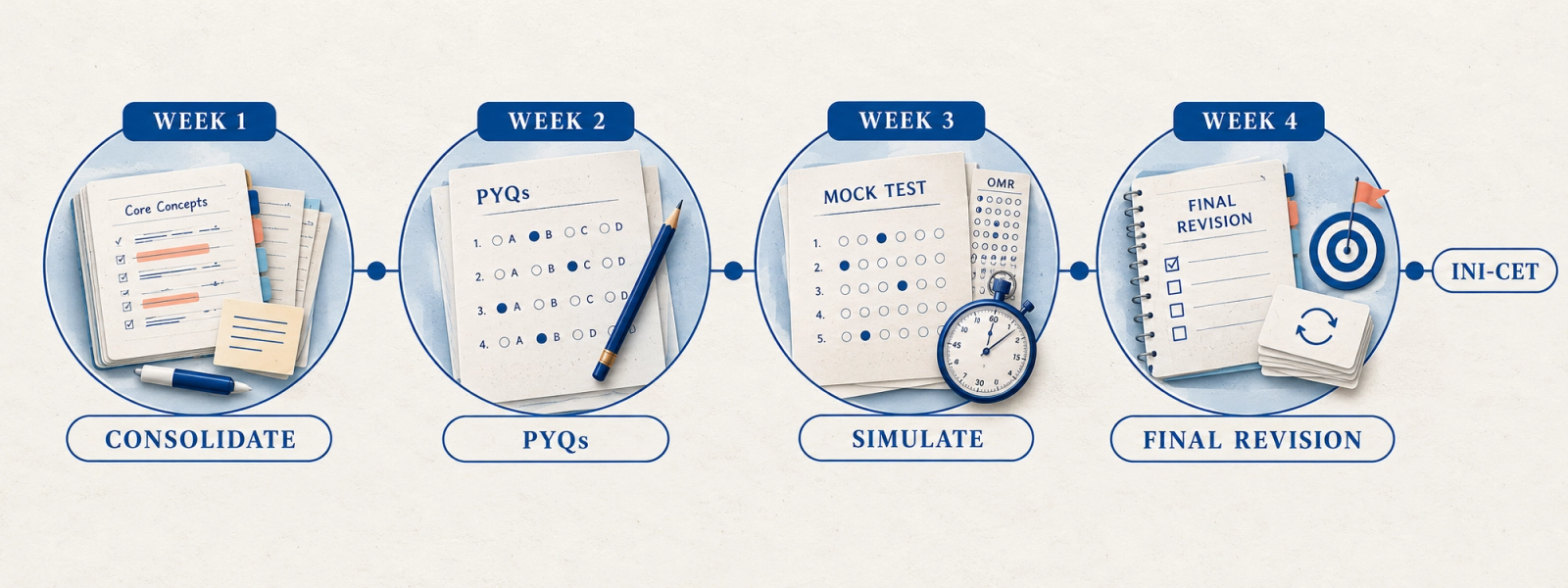
INI-CET is on Sunday 1 November 2026, which leaves you about a month. How you spend it matters more than how many hours you put in. Thirty days is not enough to relearn the syllabus, but it is enough to find out where you lose marks, repair the biggest leaks and rehearse the exact format you will face. This plan is built on that idea: the first thirteen days diagnose and repair, and the last seventeen follow the day-by-day plan we have already published.
The Exam in Four Facts
INI-CET is a computer-based test of 200 multiple-choice questions to be finished in 180 minutes. The paper is divided into four sections of 50 questions, and coverage reports describe each section as locked to its own 45-minute window: when the time ends the section submits automatically, and you cannot return to it or carry unused minutes forward. Marking is +1 for a correct answer, −1/3 for a wrong answer and 0 for an unattempted question. A few pages still describe the paper without sectional limits, so confirm the rule in the official brochure on aiimsexams.ac.in, but practise with locked sections either way. It costs nothing and protects you if the rule applies.
Two numbers follow from this structure, and both should shape your month. The first is pace: 45 minutes for 50 questions is 54 seconds per question, including reading the stem, so a question you cannot resolve in about a minute has to be parked and revisited within the same section. The second is the penalty: a wrong answer costs a third of a mark, so an uncertain answer is only worth marking when you have narrowed the options.
The Guessing Arithmetic, Worked Out
With four options and one correct answer, a blind guess has an expected value of zero: a one-in-four chance of gaining 1 mark and a three-in-four chance of losing a third of a mark cancel exactly. Once you can eliminate one option, the expected gain turns positive, at about +0.11 marks per question, and with two options eliminated it rises to about +0.33. The working rule is simple. Never guess blind, always guess when you can strike out at least one option, and do not leave blank a question you have narrowed to two. Practise this in mocks so it is a habit by exam day instead of a decision made under pressure.
The Calendar That Frames Your Month
| Date | What happens | Status |
|---|---|---|
| 3 Oct (Sat) | Day 1 of your last 30 days | Plan starts |
| 13 Oct (Tue), 5 PM | Registration closes | Confirmed |
| 16 Oct (Fri) | Switch to the 17-day plan | Plan |
| 17 to 19 Oct | Registration status check window | Reported |
| 26 Oct (Mon) | Admit card release | Expected, not yet confirmed |
| 1 Nov (Sun) | INI-CET, computer-based | Confirmed |
Treat the registration deadline as a task, not background noise. If you have not submitted yet, do it this week rather than on 13 October, and use the 17 to 19 October window to confirm the application was accepted. The documents, the two-stage process and the usual rejection reasons are covered in our registration guide.
If you are reading this after 3 October, do not try to catch up. Join the plan at the matching date and skip the days that have already passed. The order of the phases matters more than the exact dates.
Days 1 to 7 (3 to 9 October): Audit Before You Revise
Begin with a baseline mock, taken the way you will take the real paper: four blocks of 50 questions, 45 minutes each, no pausing and no looking things up. The score is the least useful output. What you want is a map of where the marks went: which block you rushed, which subjects produced the wrong answers, and how many questions you skipped that you could have answered.
Then start an error log from that mock and keep it for the whole month. Use one row for each missed question, with five fields: subject, topic, why you missed it, the correct reasoning in a single line, and the date you will retest it. The 'why' column is the one that matters, and it works best with a fixed set of labels so that patterns become visible.
Why You Lost the Mark: Five Error Types
| Error type | What it looks like | What to do about it |
|---|---|---|
| Knowledge gap | You never knew it | Add it to the revision list and learn it from one source, not three |
| Recall failure | You knew it once and it slipped | Short spaced recall sessions on the topic |
| Misread | Missed 'except', 'not' or a unit | Underline the qualifier before reading the options |
| Time pressure | Rushed or left blanks | Practise the 54-second rule and park-and-return |
| Bad guess | Guessed with no elimination | Apply the elimination rule above |
After the first mock, sort your subjects into three lists. Secure subjects are the ones where you got nearly everything right, so they get light maintenance. Fixable subjects are the ones where you lost marks on specific topics you have seen before, and this is where the next two weeks go. Skip for now covers broad areas where repeated effort has produced little return and the exam weight is modest. Be strict about the third list, because it is what frees the time for the second.
Spend the rest of the week on previous-year questions, done in timed blocks rather than read casually, concentrating on the fixable list. Past papers show you how the exam words things, which distractors it likes and which concepts keep returning. Review every block the same day, while the reasoning is fresh. Spending at least as long reviewing a mock as you spent taking it is widely recommended, and it is worth adopting here.
Days 8 to 13 (10 to 15 October): Build Speed and Close the Gaps
Week two shifts from diagnosis to repair. On most days, run one or two timed sets of 50 questions in 45 minutes so that the pace becomes automatic, and spend the rest of the day on the fixable list, using your error log as the syllabus. For each topic, aim to explain it from memory in two minutes and then answer questions on it. Reading it a fourth time is the weakest form of revision.
Take a second full mock on Sunday 11 October, to match the real exam day, and compare it with the first. Look at time use in each block before you look at the score. If the third and fourth blocks fall apart, the problem is stamina and pacing, not knowledge, and the fix is more full-length practice rather than more reading.
Short subjects deserve a fixed slot too. Psychiatry, Forensic Medicine, ENT, Ophthalmology, Dermatology, Radiology and Anaesthesia are comparatively small, and one structured pass through their high-yield topics usually pays back faster than another round of a large subject. The 17-day plan sets fixed targets for them, so use this fortnight to find out which of them you are weakest in.
A Daily Rhythm for the Build Phase
- Morning: one timed block of 50 questions in 45 minutes, reviewed straight away.
- Late morning: two topics from the fixable list, studied by recalling first and checking afterwards.
- Afternoon: a second timed block from a different set of subjects, also reviewed the same day.
- Evening: a short pass through one small subject, then 20 minutes skimming the error log.
- Night: protect about seven hours of sleep, because recall and care with wording both suffer without it.
From 16 October: Switch to the 17-Day Plan
From 16 October, stop planning and start executing the final stretch. Our 17-day last-minute plan covers subject-by-subject priorities, the day-by-day schedule and exam-day strategy. If you have followed this plan up to this point, you arrive with an error log, a known weak list and two full mocks behind you, which is the starting point that plan assumes.
A Mock Schedule for the Month
| Window | Full-length mocks | Purpose |
|---|---|---|
| 3 to 9 Oct | 1 (baseline) | Map your errors and set your pace |
| 10 to 15 Oct | 1 (Sunday 11 Oct) | Check whether the repair work is paying off |
| 16 Oct onward | As scheduled in the 17-day plan | Stamina and exam temperament; add one on Sunday 18 Oct if pacing is still your main problem |
What Not to Do This Month
- Do not start a new question bank or a second set of notes. Switching resources costs more than it adds.
- Do not chase rare topics. If something has appeared once in several years, it can wait.
- Do not judge yourself on a single mock score. Compare trends across mocks and across blocks.
- Do not compare marks with other candidates online. It distorts decisions and costs focus.
- Do not cut sleep to add study hours. Tired recall and careless reading cost more marks than the extra hour earns.
Keeping Perspective
Thirty days will not change what you know about every subject, but it can change how many of the marks you already earn actually reach the answer sheet. Pace, option elimination, careful reading and a focused weak list can all be trained in a month. Candidates sometimes lose more to a rushed fourth block than to any single topic they never studied, so the most valuable thing you can do now is practise the format until the clock stops being a surprise.
Related reading: the INI-CET exam tips and pattern shifts guide, how INI-CET differs from NEET PG in our comparison, and short-subject notes on schizophrenia, epistaxis, red eye and rigor mortis.
Practise this on Reflex
Turn what you just read into recall with 14 years of tagged PYQs.
FAQ
Frequently asked questions
The questions aspirants ask most about this topic.
It is enough to raise your score, not to relearn the syllabus. Use the month to find and fix your biggest leaks and to rehearse the format, rather than starting new material.
At least two before the exam is the usual minimum. This plan builds in a baseline mock, a second one on 11 October, and the mocks scheduled in the 17-day plan after 16 October. How thoroughly you review each one matters more than the exact count.
+1 for a correct answer, −1/3 for a wrong answer and 0 for an unattempted question.
Never blind, but yes once you can eliminate at least one of the four options. Eliminating one option makes the expected gain about +0.11 marks per question, and eliminating two raises it to about +0.33.
Each 50-question section gets 45 minutes, which is 54 seconds per question. Answer the questions you are sure of first, park the rest, and return to them within the same section, because a locked section cannot be reopened.
The exam is on Sunday 1 November 2026, computer-based. The admit card is expected around 26 October according to aggregator sites, but that date is not confirmed, so check aiimsexams.ac.in.
No. Switching resources costs time and rarely adds marks. Finish what you have, and use previous-year questions and your own error log as the main material.
About the author
Stay ahead in your preparation
Get expert tips, exam updates, and high-yield insights delivered straight to your inbox.
No spam. Unsubscribe anytime.
More in Exam Guide
View all → Exam Guide
UPSC CMS Exam: Eligibility, Pattern, Syllabus, and How Selection Works
UPSC CMS recruits medical officers for central and Delhi civic services. Here are the eligibility rules, age limit, exam pattern, syllabus, selection stages and how it compares with NEET PG.
 Exam Guide
DNB Full Form in Medical: Course, Admission, and How It Compares With MD/MS
DNB stands for Diplomate of National Board, a postgraduate qualification from NBEMS. Here is how admission, training and the exit exam work, and how DNB compares with MD/MS.
 Exam Guide
NEET PG 2026 Result Declared: Cutoff 262/720 & Scorecard
 Exam Guide