Rigor Mortis for NEET PG: The Timeline Every Time-of-Death Question Is Really Testing
By Dr. Utsav Bhattacherjee, MBBS, MBA · 18 Sept 2026 · 12 min read
Last updated: 23 Sept 2026
On this page
Rigor mortis questions are built around one core mechanism and one classic timeline, and almost every exam question is really asking whether you can apply that timeline to estimate time since death, or distinguish rigor from a lookalike finding. The biochemistry explains the timing; the timing is what actually gets tested.
The Mechanism: Why Muscles Stiffen After Death
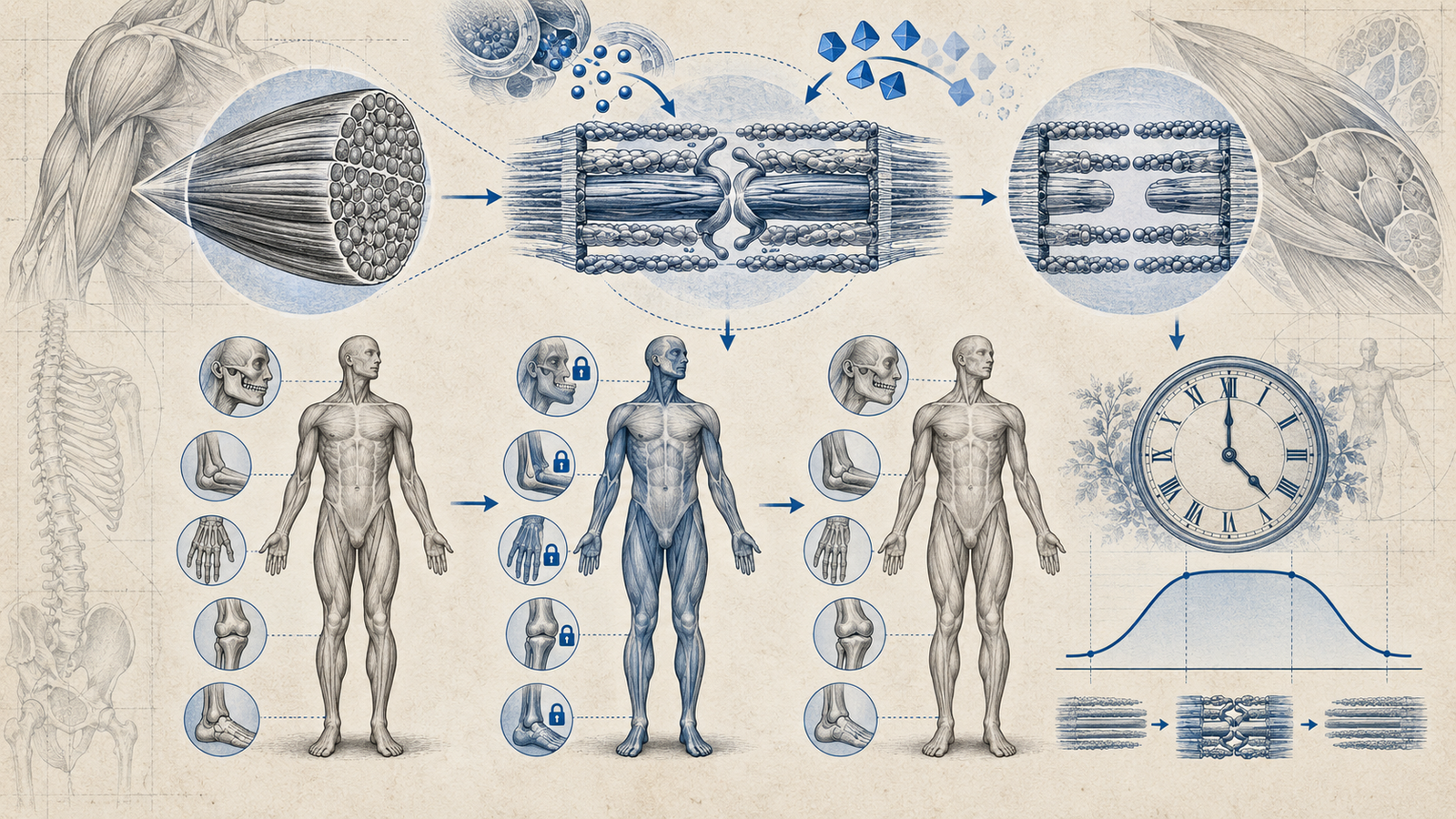
Muscle contraction and relaxation both depend on ATP. During life, ATP allows the myosin head to detach from actin after each contraction cycle, resetting the muscle for the next signal. After death, cellular metabolism stops and ATP production ceases entirely, while existing ATP stores are rapidly depleted. Without ATP, myosin heads remain locked onto actin filaments, unable to detach — this fixed actin-myosin cross-bridge is what physically produces the stiffness of rigor mortis, not a new contraction, but an inability to release an existing one.
The Classic Timeline
Rigor mortis follows a reasonably predictable timeline under average conditions, and these numbers are exactly what exam questions expect you to apply. Onset begins around 2 to 6 hours after death, becomes complete throughout the body by roughly 12 hours, persists in that fully rigid state for approximately 12 to 24 hours, and then begins to resolve, typically disappearing entirely by 36 to 48 hours as the muscle tissue itself begins to break down through autolysis and putrefaction.
Nysten's Law: The Order of Onset and Resolution
Rigor mortis doesn't affect all muscles simultaneously — it follows a predictable order described by Nysten's law: onset begins in smaller muscles first (the face and jaw), then progresses to larger muscle groups (neck, upper limbs, trunk, and finally lower limbs). Resolution follows the same order, smaller muscles first — meaning the face and jaw both stiffen first and soften first, while the legs are both the last to stiffen and the last to soften.
This order is often explained by the observation that smaller muscle masses, with less bulk and lower ATP reserves relative to their fibre density, deplete their ATP faster than larger muscle groups — though the precise mechanistic reason is debated, the order itself is consistently observed and consistently tested.
Factors That Speed Up or Slow Down the Timeline
Ambient temperature has the single largest effect: higher temperatures accelerate rigor mortis onset by speeding up the metabolic processes driving ATP depletion, while cold environments slow it considerably — a body in a hot climate may show full rigor within a few hours, while one in a cold environment can take much longer to reach the same point. Physical exertion immediately before death also accelerates onset, since vigorous muscle activity depletes ATP stores before death even occurs, giving the postmortem process a head start. Body build matters too: thin, muscular individuals tend to develop and resolve rigor faster than heavily built individuals, since their muscle mass has proportionally less ATP reserve to exhaust.
Rigor Mortis Alongside Other Postmortem Changes
Rigor mortis is one of three early postmortem changes typically assessed together to estimate time since death, and knowing how they relate to each other is as testable as any one change in isolation.
| Change | Onset | Complete / Fixed | Notes |
|---|---|---|---|
| Livor mortis | 30 min – 2 hrs | Fixed by 8–12 hrs | Purplish discoloration, gravity-dependent |
| Rigor mortis | 2–6 hrs | Complete by 12 hrs, resolves by 36–48 hrs | Follows Nysten's law, small muscles first |
| Algor mortis | Immediate, gradual | Approaches ambient over 12–24 hrs | Rate depends on environment, body size, clothing |
Livor mortis (postmortem lividity) is the purplish discoloration that develops as blood settles under gravity into the lowest-lying vessels after circulation stops, becoming visible within 30 minutes to 2 hours and fixing (no longer shifting if the body is moved) by around 8 to 12 hours. Algor mortis is the postmortem cooling of the body toward ambient temperature, following a roughly predictable rate that depends heavily on environmental conditions, body size, and clothing.
Cadaveric Spasm: The Finding Rigor Mortis Gets Confused With
Cadaveric spasm is worth distinguishing clearly from ordinary rigor mortis, since the two are frequently confused despite being genuinely different phenomena. Cadaveric spasm is an instantaneous stiffening occurring at the exact moment of death, typically affecting only the specific muscle group in active use at that instant — a weapon still gripped in the hand, or grass clutched during a struggle, are the classic forensic examples. Unlike ordinary rigor, which develops gradually over hours following the Nysten's law pattern, cadaveric spasm happens immediately and is often associated specifically with violent or emotionally charged deaths, making its presence itself forensically significant as evidence of the circumstances surrounding death, not just a timing marker.
Why Time-Since-Death Estimates From Rigor Alone Are Approximate
A genuinely important caveat worth holding onto: rigor mortis provides a useful estimated window for time since death, not a precise figure, and treating it as more exact than it is is a real forensic pitfall. Because temperature, exertion, body build, and even underlying illness at the time of death all shift the timeline meaningfully, examiners typically use rigor mortis alongside livor mortis, algor mortis, and other findings together, cross-checking one estimate against another rather than relying on any single postmortem change in isolation. A body found in a hot room with full rigor might genuinely be several hours younger than the same finding would suggest in a cold room, which is exactly the kind of environmental confound a vignette may build in deliberately.
Certain conditions can also produce an unusually rapid or unusually delayed rigor, worth knowing as exceptions to the standard timeline: death following extreme physical exertion or convulsive states (such as severe electrocution or certain poisonings) can produce faster-than-typical onset, sometimes overlapping in presentation with true cadaveric spasm, while conditions causing significant muscle wasting can produce a weaker, less complete rigor that resolves faster simply because there's less muscle bulk to stiffen and later break down.
Heat Stiffening and Cold Stiffening: Two Findings Worth Not Confusing With Rigor
Two additional postmortem findings are worth distinguishing from ordinary rigor mortis specifically because they can superficially resemble it. Heat stiffening occurs when a body is exposed to significant heat after death, such as in a fire, and results from direct protein coagulation in the muscle from heat itself, rather than from ATP depletion — this produces a pugilistic posture, with flexed limbs resembling a boxer's stance, caused by the stronger flexor muscle groups contracting more than the extensors under heat. This is a genuinely distinct mechanism from rigor mortis and can develop even in a body that has already passed through and resolved true rigor.
Cold stiffening, by contrast, results simply from the physical hardening of subcutaneous and deeper fat as body temperature drops well below normal, particularly in freezing conditions, and can mimic the rigidity of rigor mortis without involving the actin-myosin mechanism at all. Distinguishing these from true rigor mortis matters forensically because heat and cold stiffening don't follow Nysten's law and don't provide the same time-since-death information rigor normally would.
Reading a forensic medicine vignette involving postmortem changes efficiently means checking which specific change or combination of changes is described, matching the stated timing against the standard windows for each, and then explicitly considering whether any stated environmental or physiological detail in the stem should shift that estimate earlier or later than the textbook default — a hot room, a cold water recovery, or a described struggle before death are rarely incidental details in these questions.
It is worth noting that none of these postmortem changes exist to serve forensic convenience alone — they are direct, mechanistic consequences of what happens to a body once circulation and cellular metabolism stop, and understanding the underlying biochemistry of each is what actually allows a reasonable estimate to be constructed, rather than simply memorising a set of numbers to recite back on demand.
For the same mechanism-first approach applied to a different biochemical process, see our guide to glycolysis, and for how much of the paper Forensic Medicine carries overall, our subject-wise weightage breakdown.
Practise this on Reflex
Turn what you just read into recall with 14 years of tagged PYQs.
FAQ
Frequently asked questions
The questions aspirants ask most about this topic.
Depletion of ATP after death leaves myosin heads locked onto actin filaments, unable to detach. This fixed actin-myosin cross-bridge produces the muscle stiffness, rather than any new muscle contraction.
Onset around 2-6 hours after death, complete by roughly 12 hours, persisting for 12-24 hours, then resolving by 36-48 hours as autolysis and putrefaction begin.
The observation that rigor mortis develops in a predictable order, starting with smaller muscles (face and jaw) before progressing to larger muscle groups, and resolves in the same order.
Higher ambient temperature accelerates the onset of rigor mortis by speeding up metabolic ATP depletion, while colder temperatures slow it down.
Cadaveric spasm is an instantaneous stiffening at the moment of death, typically affecting only the muscle group in use at that moment, rather than the gradual, whole-body progression of ordinary rigor mortis.
The purplish discoloration from blood settling under gravity after circulation stops, becoming visible within 30 minutes to 2 hours and fixing, no longer shifting if the body is moved, by around 8 to 12 hours.
Temperature, physical exertion before death, body build, and underlying conditions all shift the timeline meaningfully, so forensic estimates typically combine rigor mortis with livor mortis, algor mortis, and other findings rather than relying on rigor alone.
About the author
Stay ahead in your preparation
Get expert tips, exam updates, and high-yield insights delivered straight to your inbox.
No spam. Unsubscribe anytime.
More in Subject Notes
View all → Forensic Medicine
Postmortem Lividity for NEET PG: Timeline, Color Clues, and Time of Death
Onset, fixation, the colour clues that flag poisoning, and how lividity helps estimate time since death.
 Surgery
Burns for NEET PG: The Rule of Nines, Burn Depth and the Parkland Formula Worked Step by Step
 Radiology
FAST Scan for NEET PG: The Four Windows, eFAST, and What a Positive Result Means
 Dermatology