NEET PG 2026 Subject Wise Weightage: Complete Data from 14 Years of PYQs
By Dr. Utsav Bhattacherjee, MBBS, MBA · 3 Aug 2026 · 14 min read
Last updated: 23 Sept 2026
On this page
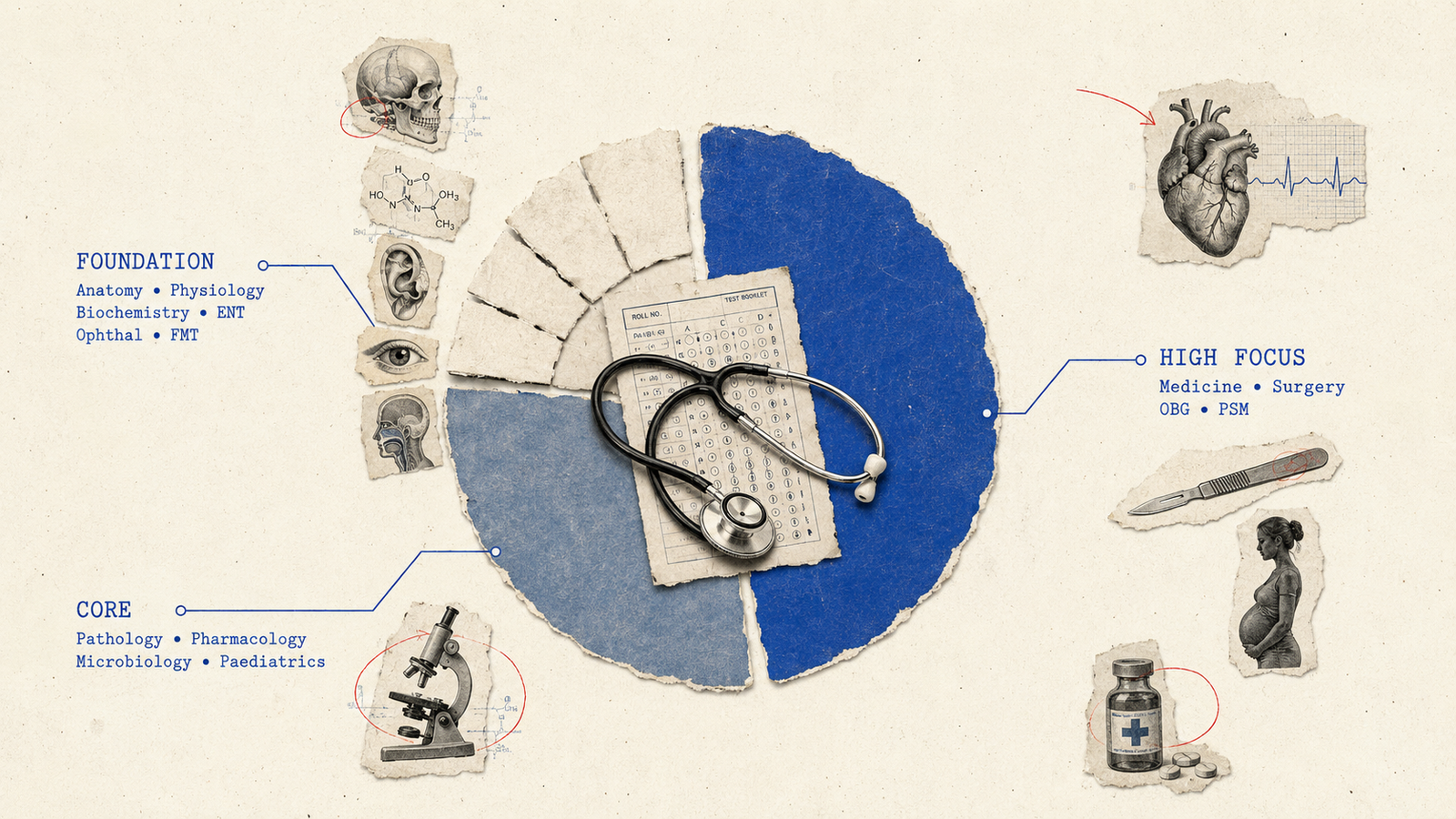
NBEMS does not publish an official subject-wise weightage for NEET PG. What exists instead is a pattern built from analysing actual question papers across 14 years of exams — and that pattern is reliable enough to build an entire preparation strategy around.
This post goes beyond the basic tables most guides offer. You will get the complete subject-wise breakdown calibrated to the new 2026 format (180 questions, 720 marks), trend data showing which subjects have grown and shrunk over time, high-yield topics within each subject, and a study time allocation model built directly from the weightage data. If you are still setting up your overall approach, start with our NEET PG 2026 preparation hub and come back to this for the subject maths.
One critical point before the numbers: the 2026 format change from 200 to 180 questions does not simply reduce every subject's count proportionally. Some subjects have historically been asked in fixed distributions tied to the exam structure. The recalibration to 180 questions shifts the absolute counts, not the relative importance.
What Changed in 2026 and Why It Changes the Weightage Math
Before 2026, NEET PG had 200 questions worth 800 marks across three broad sections (Pre-Clinical, Para-Clinical, Clinical). Starting with the August 30, 2026 exam, the format is 180 questions worth 720 marks across five locked sections — Groups A through E — of 36 questions each, with 42 minutes per section.
The key implication for subject-wise weightage: a subject that carried 25 questions out of 200 (12.5%) does not carry the same 12.5% of 180 — it may carry 22 questions (12.2%) or 20 questions (11.1%) depending on how NBEMS redistributes within the new section architecture. The relative importance of subjects is preserved. The absolute question count per subject shifts slightly.
Every table in this post reflects the 180-question format.
Complete NEET PG 2026 Subject Wise Weightage Table
Data derived from analysis of 14 years of NEET PG PYQs (2010–2024), scaled to the 180-question 2026 format.
| Subject | Approx. Questions (out of 180) | % Weightage | Marks Range |
|---|---|---|---|
| General Medicine | 24–28 | 13–16% | 96–112 |
| General Surgery | 18–22 | 10–12% | 72–88 |
| OBG | 14–18 | 8–10% | 56–72 |
| Pathology | 14–18 | 8–10% | 56–72 |
| Pharmacology | 12–16 | 7–9% | 48–64 |
| Microbiology | 12–14 | 7–8% | 48–56 |
| Paediatrics | 8–12 | 5–7% | 32–48 |
| SPM / Community Medicine | 8–12 | 5–7% | 32–48 |
| Anatomy | 8–10 | 4–6% | 32–40 |
| Physiology | 8–10 | 4–6% | 32–40 |
| Biochemistry | 6–9 | 3–5% | 24–36 |
| Dermatology | 5–8 | 3–5% | 20–32 |
| Psychiatry | 5–8 | 3–5% | 20–32 |
| Orthopaedics | 5–8 | 3–5% | 20–32 |
| ENT | 4–7 | 2–4% | 16–28 |
| Ophthalmology | 4–7 | 2–4% | 16–28 |
| Forensic Medicine | 4–6 | 2–4% | 16–24 |
| Anaesthesia | 3–6 | 2–3% | 12–24 |
| Radiology | 3–5 | 2–3% | 12–20 |
Important note: NBEMS does not publish official subject-wise counts. These ranges are based on PYQ pattern analysis and will vary slightly from paper to paper. Some subjects (Dermatology, Psychiatry) are often embedded within General Medicine questions in the paper — a question about a skin condition may be coded under Medicine rather than Dermatology in practice.
Subject Tier Classification
Tier 1 — Highest Weightage (Target 70%+ accuracy)
These five subjects together account for approximately 45–50% of the total paper. Getting these right moves your rank more than anything else.
General Medicine (13–16% of paper). The single most heavily weighted subject in NEET PG. Includes direct medicine questions plus clinical presentations across Cardiology, Nephrology, Endocrinology, Infectious Diseases, Haematology, and Neurology. In the 2024 paper, clinical medicine questions made up the largest single block of questions. Questions from Dermatology (skin conditions with clinical presentations) and Psychiatry (diagnosis, drug mechanisms) are often phrased as Medicine cases even when they test specialty knowledge.
General Surgery (10–12%). Second highest individual subject weightage. Questions cover surgical anatomy, operative steps, wound management, and post-operative complications. Clinical surgery questions — which present a patient scenario and ask for the next step in management — have increased as a proportion of this subject over recent cycles.
OBG (8–10%). One of the most consistent subjects across cycles. Antenatal management, obstetric emergencies, contraception methods, and gynaecological malignancy staging appear reliably every year. OBG has a high PYQ repetition rate — concepts that appeared in 2015 papers reappear in rephrased form in recent papers.
Pathology (8–10%). The highest-weighted laboratory subject. Tumour markers, cellular pathology, inflammation, and specific tumour classifications have dominated recent papers. Pathology also forms the basis for understanding Medicine and Surgery questions — good Pathology preparation has a compounding effect on clinical subject performance.
Pharmacology (7–9%). Drug mechanisms, adverse effects, and interactions are consistently tested. Drug adverse effects have been weighted more heavily than mechanisms in recent cycles, making pharmacovigilance-type questions important. The combination of good Pharmacology and Microbiology preparation accounts for roughly 14–17% of the paper combined.
Tier 2 — Moderate Weightage (Target 60%+ accuracy)
These subjects together account for approximately 25–30% of the paper. Strong performance here separates mid-range ranks from competitive ones.
Microbiology (7–8%). Laboratory diagnosis — which test identifies which organism — is the most frequently tested aspect. Specific organisms and their virulence factors, toxin mechanisms, and drug resistance patterns repeat reliably across years.
Paediatrics (5–7%). Growth and development milestones are the most-tested single topic area in Paediatrics. Neonatal conditions, immunisation schedules, and nutritional deficiency presentations follow. Paediatrics questions are often short clinical stems — they reward systematic preparation more than detailed knowledge.
SPM / Community Medicine (5–7%). Epidemiology, biostatistics, and disease control programs account for most marks. Questions on specific programs (National Health Mission, immunisation schedule updates) appear every year and are entirely predictable if you track official updates.
Anatomy (4–6%). Surgical anatomy (applied anatomy relevant to clinical procedures) has increasingly dominated over embryology and histology in recent papers. The shift toward clinical application in Anatomy means that knowing the anatomical basis of nerve injuries, surgical triangles, and compartment relationships is more valuable than memorising gross anatomy diagrams.
Physiology (4–6%). Cardiac physiology (Frank-Starling, pressure-volume loops), renal tubular physiology, and respiratory function testing appear reliably. Graph-based questions testing interpretation of physiological curves have increased in recent years.
Biochemistry (3–5%). Metabolic pathways (glycolysis, TCA cycle, fatty acid oxidation) and enzyme kinetics are the mainstay. Molecular biology topics — PCR, blotting techniques, restriction enzymes — have appeared increasingly in recent cycles.
Tier 3 — Lower Individual Weightage (Target 50%+ accuracy)
Each of these subjects contributes 2–5% of the paper individually. Combined, they account for roughly 20–25% of the total paper. Students who cover these even superficially consistently outperform those who skip them.
Dermatology (3–5%): Morphology-based questions, common skin conditions, and treatment protocols. Often overlaps with Medicine question stems.
Psychiatry (3–5%): Diagnostic criteria, drug mechanisms, ECT indications. High PYQ repetition rate.
Orthopaedics (3–5%): Fracture eponyms, nerve injuries from fractures, common paediatric orthopaedic conditions.
ENT (2–4%): Tuning fork tests (Weber, Rinne, ABC) are consistently high-yield. Surgical landmarks and audiological testing appear reliably.
Ophthalmology (2–4%): Glaucoma, retinal conditions, and ophthalmic drug side effects. Image-based questions have increased.
Forensic Medicine (2–4%): Medico-legal aspects and toxicology (organ-specific poisons and antidotes). High PYQ repetition — the same questions appear cycle after cycle with minimal variation.
Anaesthesia (2–3%): Stages of anaesthesia, local anaesthetic toxicity, and malignant hyperthermia management.
Radiology (2–3%): X-ray pattern recognition for high-yield conditions. Questions on CT findings for surgical emergencies have appeared in recent papers.
How Subject Weightage Has Shifted Over Time
NBEMS has progressively increased the clinical orientation of NEET PG over the past decade. Understanding this trend helps you allocate time accurately.
| Subject Group | Pre-2015 Approx. Share | 2020–2024 Approx. Share | 2026 Projected Share |
|---|---|---|---|
| Clinical (Medicine, Surgery, OBG, Paediatrics, Psychiatry, Dermatology) | 35–40% | 42–48% | 44–50% |
| Para-Clinical (Pathology, Pharmacology, Microbiology, Forensic, SPM) | 35–40% | 32–37% | 30–36% |
| Pre-Clinical (Anatomy, Physiology, Biochemistry) | 20–25% | 15–20% | 14–18% |
What this tells you: if you are allocating study time proportionally to an old weightage table, you are under-preparing for clinical subjects and over-preparing for pre-clinical ones. The trend has been consistent for a decade and is not reversing.
Subject-wise High-Yield Topics for 2026
These are the topics within each subject that have appeared most frequently across 14 years of PYQs. Covering these topics gets you to approximately 70–80% of each subject's marks with 40–50% of the study time.
| Subject | Top 3 High-Yield Topics |
|---|---|
| General Medicine | Cardiology (ECG, arrhythmias, heart failure); Nephrology (CKD, electrolytes, GN); Infectious diseases (TB, HIV, malaria) |
| General Surgery | Hernias (types, repair, complications); Thyroid surgery; GI cancers staging and management |
| OBG | Pre-eclampsia and eclampsia management; Contraception methods and failure rates; Gynaecological malignancy staging |
| Pathology | Tumour markers and their associated cancers; Inflammatory cell types and functions; Wound healing phases |
| Pharmacology | Autonomic drug mechanisms (adrenergic, cholinergic); Antibiotic spectra and resistance; Adverse effect profiles |
| Microbiology | Laboratory diagnosis tests (organism-specific); Clostridium species and toxins; STI causative organisms |
| Paediatrics | Growth and development milestones; Neonatal conditions (jaundice, RDS, NEC); Immunisation schedule |
| SPM | Epidemiological study design; National health programs; Biostatistics (sensitivity, specificity, NNT) |
| Anatomy | Surgical anatomy (triangles, spaces, fascial planes); Nerve injury at specific fracture sites; Embryological derivatives |
| Physiology | Cardiac physiology (Frank-Starling, pressure-volume loops); Renal tubular function; Respiratory function tests |
| Biochemistry | Glycolysis and TCA cycle (regulated steps); Enzyme kinetics (Km, Vmax); Molecular biology techniques |
| Dermatology | Bullous disorders (pemphigus vs pemphigoid); Leprosy classification and treatment; Psoriasis management |
| Psychiatry | ICD diagnostic criteria for major conditions; Drug mechanisms and side effects; ECT indications and contraindications |
| Orthopaedics | Fracture eponyms and nerve injuries; Compartment syndrome; Paediatric orthopaedic conditions |
| ENT | Tuning fork tests (Weber, Rinne, ABC interpretation); Vertigo causes and management; Common surgeries |
| Ophthalmology | Glaucoma (types, treatment mechanisms); Diabetic retinopathy staging; Ophthalmic drug adverse effects |
| Forensic Medicine | Medico-legal aspects of death; Toxicology (organ-specific poisons and antidotes); Sexual assault examination |
| Anaesthesia | Stages and signs of general anaesthesia; Local anaesthetic mechanism and toxicity; Malignant hyperthermia |
| Radiology | X-ray patterns for TB and pneumothorax; CT findings for extradural vs subdural haematoma; Fracture recognition |
Study Time Allocation Based on Weightage
This model allocates study time proportionally to subject weightage while adjusting for difficulty and PYQ availability. It is designed for a student with 3 to 6 months before the exam. For the week-by-week version, see our 3-month study plan; for the wider approach it sits inside, see the complete NEET PG preparation strategy.
| Subject | Weightage Share | Suggested Time Allocation | Priority |
|---|---|---|---|
| General Medicine | 13–16% | 15–18% of total study time | 1 |
| General Surgery | 10–12% | 11–13% | 2 |
| OBG | 8–10% | 9–11% | 3 |
| Pathology | 8–10% | 8–10% | 4 |
| Pharmacology | 7–9% | 7–9% | 5 |
| Microbiology | 7–8% | 6–8% | 6 |
| Paediatrics | 5–7% | 5–7% | 7 |
| SPM | 5–7% | 4–6% | 8 |
| Anatomy | 4–6% | 4–5% | 9 |
| Physiology | 4–6% | 4–5% | 10 |
| Biochemistry | 3–5% | 3–4% | 11 |
| Dermatology | 3–5% | 2–3% | 12 |
| Psychiatry | 3–5% | 2–3% | 13 |
| Orthopaedics | 3–5% | 3–4% | 14 |
| ENT | 2–4% | 2–3% | 15 |
| Ophthalmology | 2–4% | 2–3% | 16 |
| Forensic Medicine | 2–4% | 1–2% | 17 |
| Anaesthesia | 2–3% | 1–2% | 18 |
| Radiology | 2–3% | 1–2% | 19 |
Why Medicine gets slightly more than its weightage share: General Medicine questions require broader contextual knowledge than most other subjects. Questions on OBG, Paediatrics, Dermatology, and Psychiatry often appear in clinical Medicine presentation formats — preparation in Medicine therefore has a multiplier effect on other subjects.
Why Forensic Medicine, Anaesthesia, and Radiology get less than their weightage share: these subjects have very high PYQ repetition rates. Two focused weeks of PYQ drilling in each subject covers roughly 70% of their exam content reliably. Diminishing returns set in faster here than in clinical subjects where application questions vary more.
How to Use This Data With Your Score Calculator
Subject-wise weightage data is most useful when tracked against your actual practice performance.
After each mock test or full-length HAMMER weekly grand test, calculate your accuracy per subject against the weightage table. A subject where you are getting 40% accuracy but carries 12% of the paper is costing you significantly more marks than a subject where you are getting 40% accuracy but carries 3% of the paper.
Use the NEET PG 2026 score calculator to track your section-wise scores after every mock. When you see consistent weakness in one section, check which high-weightage subjects are driving that weakness — that tells you where to allocate additional study time.
A practical formula: multiply your accuracy percentage by the subject's weightage share. A 70% accuracy in General Medicine (weighted at 14%) contributes 9.8 effective percentage points toward your overall score. A 70% accuracy in Radiology (weighted at 2.5%) contributes 1.75 effective percentage points. The same accuracy improvement in Medicine is worth 5.6 times more to your overall score than the same improvement in Radiology.
Subject-Wise PYQ Coverage Target
| Subject | Recommended PYQ Depth | Years to Cover |
|---|---|---|
| General Medicine | Deep | 12–14 years |
| General Surgery | Deep | 12–14 years |
| OBG | Deep | 12–14 years |
| Pathology | Deep | 10–12 years |
| Pharmacology | Deep | 10–12 years |
| Microbiology | Moderate | 8–10 years |
| Paediatrics | Moderate | 8–10 years |
| SPM | Moderate | 8–10 years |
| Anatomy | Moderate | 8–10 years |
| Physiology | Moderate | 8–10 years |
| Biochemistry | Moderate | 6–8 years |
| Dermatology | Standard | 6–8 years |
| Psychiatry | Standard | 6–8 years |
| Orthopaedics | Standard | 6–8 years |
| ENT | Standard | 5–7 years |
| Ophthalmology | Standard | 5–7 years |
| Forensic Medicine | Standard | 5–7 years |
| Anaesthesia | Light | 4–6 years |
| Radiology | Light | 3–5 years |
Common Mistakes in Subject Prioritisation
Mistake 1 — Spending equal time on all 19 subjects. Students who study each subject for the same number of hours spend a disproportionate share of their study time on subjects that account for a small fraction of marks. Clinical subjects deserve proportionally more time.
Mistake 2 — Avoiding low-confidence subjects. If General Surgery is your weakest subject and it carries 10–12% of the paper, avoiding it to study Anatomy (4–6%) costs you twice as many marks. Prepare weak subjects in proportion to their weightage, not in proportion to your comfort level.
Mistake 3 — Using pre-2024 weightage tables. Several preparation guides still show weightage data calibrated to the old 200-question, 800-mark format. This overstates Pre-Clinical subject importance slightly and understates the shift toward clinical subjects that has occurred in recent cycles.
Mistake 4 — Ignoring within-subject distribution. General Medicine carries 13–16% of marks — but Cardiology alone accounts for roughly 4–5% of those marks. A student who has thoroughly prepared Cardiology within Medicine while broadly covering other Medicine topics will outperform a student who studied all of Medicine uniformly.
Practise this on Reflex
Turn what you just read into recall with 14 years of tagged PYQs.
FAQ
Frequently asked questions
The questions aspirants ask most about this topic.
General Medicine has the highest individual subject weightage — approximately 13–16% of the paper, or 24–28 questions out of 180. When you include Dermatology and Psychiatry, which are often asked in Medicine question formats, the effective Medicine cluster can account for close to 20% of the paper.
The relative importance of subjects has not changed significantly. What changed is the absolute question count per subject, because the paper moved from 200 to 180 questions — each subject carries roughly 10% fewer questions than before. The proportion of clinical subjects has continued its gradual increase over the past decade.
Forensic Medicine, Psychiatry, OBG and SPM have the highest PYQ repetition rates — the same concepts appear cycle after cycle with minimal variation. A focused 2–3 week PYQ-based preparation in each reliably converts into score improvement faster than equivalent time in more conceptually variable subjects like Medicine or Surgery.
Approximately 44–50% comes from direct clinical subjects — General Medicine, General Surgery, OBG, Paediatrics, plus Dermatology and Psychiatry. Including Pathology, Pharmacology and Microbiology, which carry significant clinical application, roughly 70–75% of the paper rewards clinical reasoning.
Yes, but not equally. No subject has zero questions, so all 19 need coverage — but time should be roughly proportional to weightage. Do not spend three weeks on Radiology at 2–3% when General Medicine at 13–16% needs that time. Cover the lower-weightage subjects with focused PYQ drilling and move on rather than attempting comprehensive coverage.
After every full-length mock, calculate your accuracy per subject and multiply it by that subject’s weightage share. That weighted accuracy is the metric that most directly predicts your rank. Focus improvement effort where low weighted accuracy is costing you the most.
About the author
Stay ahead in your preparation
Get expert tips, exam updates, and high-yield insights delivered straight to your inbox.
No spam. Unsubscribe anytime.
More in Exam Guide
View all → Exam Guide
UPSC CMS Exam: Eligibility, Pattern, Syllabus, and How Selection Works
UPSC CMS recruits medical officers for central and Delhi civic services. Here are the eligibility rules, age limit, exam pattern, syllabus, selection stages and how it compares with NEET PG.
 Exam Guide
DNB Full Form in Medical: Course, Admission, and How It Compares With MD/MS
DNB stands for Diplomate of National Board, a postgraduate qualification from NBEMS. Here is how admission, training and the exit exam work, and how DNB compares with MD/MS.
 Exam Guide
INI-CET November 2026: How to Use Your Last 30 Days, Week by Week
 Exam Guide