DNB Full Form in Medical: Course, Admission, and How It Compares With MD/MS
By Dr. Utsav Bhattacherjee, MBBS, MBA · 13 Oct 2026 · 15 min read
Last updated: 13 Oct 2026
On this page
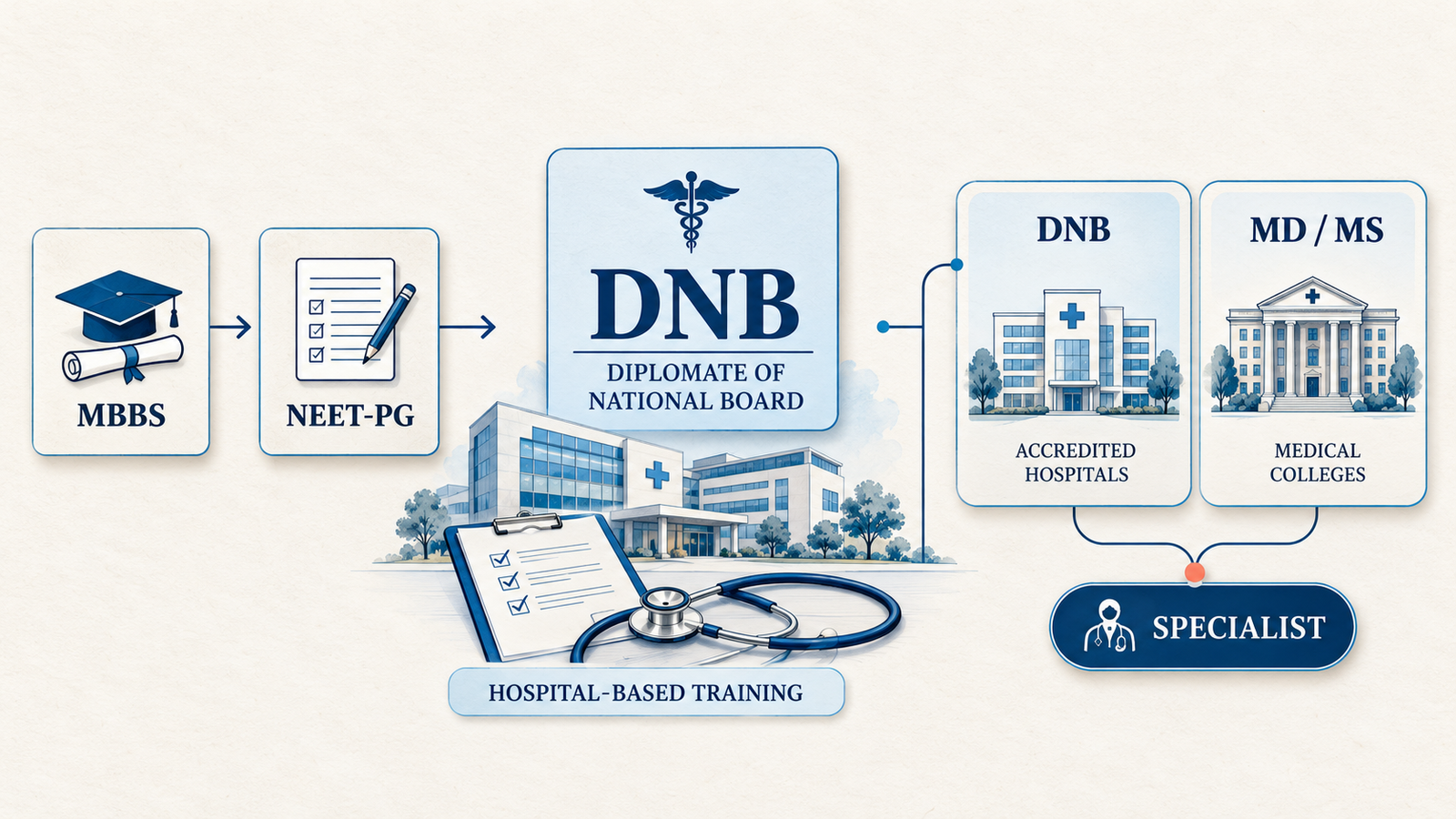
DNB stands for Diplomate of National Board. It is a postgraduate specialty qualification awarded by the National Board of Examinations in Medical Sciences (NBEMS), and it is not a short diploma course, despite the "Diploma of National Board" spelling that appears in many searches. For most purposes, including teaching posts, DNB is treated as equivalent to MD and MS, with one condition tied to the size of the training hospital. This guide explains what DNB means in medical, how admission and training work, how DNB compares with MD/MS, and how to choose between the two when both seats are on your list.
What DNB means in medical: full form and qualification
The full form of DNB is Diplomate of National Board. NBEMS awards the qualification after you complete specialty training and clear its exit examination. NBEMS works under the Ministry of Health and Family Welfare and also conducts NEET PG, the entrance exam used for DNB, MD and MS seats.
NBEMS runs DNB courses in about 30 broad-specialty disciplines, from General Medicine and General Surgery to Pediatrics, Anesthesiology and Radiodiagnosis. The full list follows the summary table below. Training takes place in hospitals accredited by NBEMS rather than in a university department. These can be government, charitable, private or corporate hospitals, and that is the main practical difference from MD/MS.
Two related names appear in the same searches. DrNB is the super-specialty level and FNB is a fellowship. Both are covered further down.
DNB at a glance
The table puts the broad-specialty course in one view. The sections after it explain each row.
| Point | DNB (broad specialty) |
|---|---|
| Full form | Diplomate of National Board |
| Awarded by | National Board of Examinations in Medical Sciences (NBEMS) |
| Entry after MBBS | NEET PG, then merit-based counselling by the Medical Counselling Committee (MCC) |
| Duration | 3 years after MBBS; 2 years for Post Diploma DNB in selected specialties |
| Training site | Hospitals accredited by NBEMS |
| Thesis | Required; assessed by NBEMS subject experts |
| Exit exam | DNB Final: theory first, then practical; usually held in June and December |
| Recognition | Recognized under the NMC Act, 2019; treated as equivalent to MD/MS |
DNB courses list: broad specialties
The NBEMS broad-specialty page lists 30 disciplines. The grouping below is ours, for readability, and not every discipline has seats in every session.
| Group | Disciplines |
|---|---|
| Pre-clinical and para-clinical | Anatomy; Biochemistry; Physiology; Pharmacology; Microbiology; Pathology; Forensic Medicine; Community Medicine |
| Medicine and allied | General Medicine; Dermatology, Venereology and Leprosy; Psychiatry; Respiratory Medicine; Geriatric Medicine; Palliative Medicine; Emergency Medicine; Family Medicine; Physical Medicine and Rehabilitation |
| Surgery and allied | General Surgery; Orthopedics; Otorhinolaryngology (ENT); Ophthalmology; Anesthesiology |
| Women and children | Obstetrics and Gynecology; Pediatrics; Maternal and Child Health |
| Imaging, oncology and others | Radiodiagnosis; Radiation Oncology; Nuclear Medicine; Immunohematology and Blood Transfusion; Hospital Administration |
DNB eligibility and admission
The three-year DNB after MBBS is filled through NEET PG. NBEMS conducts the exam, and the Medical Counselling Committee (MCC) under the Directorate General of Health Services runs merit-based counselling for these seats. DNB seats therefore sit in MCC counselling next to the all-India MD and MS seats, and your NEET PG rank decides which of them you can reach. Our NEET PG counselling guide explains the rounds, and NEET PG marks vs rank shows how a score becomes a rank.
Post Diploma DNB is a separate two-year route for doctors who have already completed a recognized two-year PG diploma. You take it in the same specialty as your diploma. Admission is through DNB-PDCET, an entrance test that NBEMS conducts, and NBEMS runs the counselling itself.
The Post Diploma route exists only in specialties that NBEMS has opened for it: Anesthesiology, Dermatology, Nuclear Medicine, Obstetrics and Gynecology, Ophthalmology, Orthopedics, ENT, Pediatrics, Pathology, Physical Medicine and Rehabilitation, Psychiatry, Radiation Oncology, Radiodiagnosis and Respiratory Medicine.
Eligibility conditions such as the internship cut-off date and registration rules are set in the NBEMS information bulletin for each session. They can change from year to year, so read the current bulletin before you apply instead of relying on an older article.
How the three-year DNB course works
A DNB trainee spends three years in an accredited hospital, with clinical work, teaching sessions and a thesis running side by side. Three things are decided by NBEMS rather than the hospital: thesis acceptance, the exit examination and the final award.
Thesis. Start the thesis early, because delays in acceptance can affect your eligibility for the final exam. The sequence is:
- You prepare a thesis synopsis (protocol) with your guide.
- The hospital's ethics and review committees approve it.
- NBEMS subject experts assess the thesis, and you may be asked to revise and resubmit.
- Once it is accepted, NBEMS issues a Thesis Acceptance Letter.
Exit examination. The DNB Final has two stages: theory first, then practical. NBEMS usually holds it twice a year, in June and December. You sit the practical only after clearing theory, and the qualification is awarded once you have passed both parts and your thesis has been accepted.
Stipend. DNB trainees receive a stipend from the training hospital. The amount differs between hospitals, so confirm it, along with duty hours and any bond or seat-leaving conditions, before you fill choices in counselling.
DNB vs MD/MS: what is the same and what differs
Both are three-year postgraduate specialty courses entered through NEET PG, and both end in a thesis or dissertation and a final examination. The differences lie in who awards the degree, where you train and who sets the exit exam.
| Factor | DNB | MD/MS |
|---|---|---|
| Awarded by | NBEMS | The university or institute that runs the course |
| Where you train | Hospitals accredited by NBEMS (government, charitable, private, corporate) | Medical colleges and institutes with the department |
| Entry | NEET PG; MCC counselling for the 3-year course | NEET PG, or INI-CET for the participating institutes; MCC or state counselling |
| Duration | 3 years | 3 years |
| Thesis | Yes, assessed by NBEMS | Yes, as a dissertation under the university's rules |
| Final exam | NBEMS DNB Final, usually June and December | University exam on the university's schedule |
| Faculty eligibility | Equivalent when the hospital condition is met (see below) | Direct |
| Next step for super-specialty | NEET-SS for DM, MCh and DrNB seats | NEET-SS for DM, MCh and DrNB seats |
The entrance exam is the same, so the choice is usually about a specific seat rather than the degree label.
Equivalence and the 500-bed condition
Equivalence is set by notification, not by opinion. NBEMS lists a Gazette notification dated 14 November 2022 on the recognition of DNB, DrNB and FNB qualifications under the NMC Act, 2019.
For faculty posts, NMC's Medical Institutions (Qualifications of Faculty) Regulations, 2025 treat a DNB in a broad or super specialty as equivalent to the corresponding MD/MS or DM/MCh qualification. The condition is that the training took place in a medical institution with an attached hospital, or in a hospital with 500 or more beds. The same regulations list DNB beside MD and MS as an eligible qualification for senior residency.
If a broad-specialty DNB was earned in a hospital with fewer than 500 beds, the regulations require one additional year of senior residency in the relevant specialty at a recognized institution. Take two DNB graduates in General Medicine, one trained in a hospital above the 500-bed mark and the other in a smaller hospital. They are not in the same position for a teaching post: the first meets the equivalence condition directly, while the second needs the extra year of senior residency first.
If you may want an academic career, ask the hospital for its bed strength and check the current regulation text before you rank the seat.
How to choose between a DNB seat and an MD/MS seat
Most real decisions are between two specific seats, not between two degree names. Consider a hypothetical candidate whose rank reaches both an MS General Surgery seat in a newer private medical college and a DNB General Surgery seat in a large accredited hospital. The comparison that matters is the training itself:
- Hands-on volume: how many procedures residents actually perform, not how many the hospital performs in total. Ask current residents.
- Teaching: who supervises you, and whether classes, journal clubs and case discussions run on a schedule.
- Thesis support: whether a guide and a working ethics committee are in place. NBEMS assesses the DNB thesis, so a weak setup costs time.
- Bed strength: if you may teach later, confirm that the DNB hospital has 500 or more beds. For an MD/MS seat, confirm the college's recognition status.
- Stipend and conditions: the monthly stipend, duty hours, and bond or seat-leaving rules.
- Exit results: whether recent trainees cleared the final exam on time.
- Next step: if you plan a super-specialty, ask where the department's recent graduates went.
If two seats score the same on these points, let location and your plans for the next five years decide. The degree label alone should not.
DNB seats and accredited hospitals: what to check each year
Seat numbers change with every session as hospitals gain or lose accreditation and seats are added or withdrawn. Do not rely on a seat count from an older article. Use the seat matrix published for the counselling round you are in, and confirm on the NBEMS website that the hospital is accredited for your specialty in the year you join.
These are the mistakes that most often cost candidates time or a better seat:
- Ranking by hospital brand alone. The training matters more than the name on the board, so check case exposure, supervision and teaching as described above.
- Ignoring bed strength. If you may teach later, a broad-specialty DNB from a hospital with fewer than 500 beds adds a year of senior residency.
- Treating the thesis as a formality. NBEMS assesses it, and delays in acceptance can affect your eligibility for the final exam.
- Skipping the conditions. Stipend, duty hours and bond or seat-leaving terms may make it costly to change your mind after allotment, so read them before you fill choices.
- Using last year's numbers. Seat counts and accreditation change every session, so work from the current round's seat matrix.
DrNB and FNB: what comes after DNB
DrNB (Doctorate of National Board) is the NBEMS super-specialty qualification, treated as equivalent to DM and MCh. It usually runs for three years after MD, MS or DNB. A small number of disciplines also have six-year programs that start directly after MBBS, so check the current NBEMS bulletin for the list. Seats for DM, MCh and DrNB are filled through NEET-SS.
FNB (Fellow of National Board) is a two-year fellowship in selected subspecialties, such as pain medicine, sports medicine and interventional cardiology, taken after a postgraduate qualification.
Jobs and recognition after DNB
- Teaching: see the equivalence section above. DNB counts toward faculty eligibility, subject to the hospital condition.
- Senior residency: the 2025 faculty regulations list DNB alongside MD and MS as an eligible qualification.
- Government and private jobs: many recruitment advertisements list DNB beside MD/MS, but each recruiter sets its own qualification clause, so read it for every post.
- Abroad: recognition is decided by each country's regulator, not by Indian equivalence. Check the specific country's rules before you plan around DNB.
Where to go next
If you are still preparing for the entrance exam, start with the NEET PG exam pattern and marking scheme. If you are weighing a government medical officer job against a postgraduate seat, read the UPSC CMS guide to see how that route works.
Practise this on Reflex
Turn what you just read into recall with 14 years of tagged PYQs.
FAQ
Frequently asked questions
The questions aspirants ask most about this topic.
DNB stands for Diplomate of National Board. It is a postgraduate specialty qualification awarded by the National Board of Examinations in Medical Sciences (NBEMS). The name is sometimes written as "Diploma of National Board," but it is not a short diploma course.
For the purposes the regulations cover, yes, with a condition. NMC's 2025 faculty regulations treat DNB as equivalent to the matching MD/MS or DM/MCh qualification when training was done in an institution with an attached hospital or in a hospital with 500 or more beds. A broad-specialty DNB from a smaller hospital needs one more year of senior residency for faculty eligibility.
The DNB after MBBS runs for three years. Doctors who have completed a recognized two-year PG diploma can take a two-year Post Diploma DNB in the same specialty, but only in specialties that NBEMS has opened for that route.
Take NEET PG, then take part in counselling run by the Medical Counselling Committee, where DNB seats are allotted by merit. Check the seat matrix for each round, and confirm the hospital's NBEMS accreditation for your specialty before you fill choices.
Yes. Under NMC's 2025 faculty regulations, DNB is listed alongside MD/MS in the qualification schedule and is treated as equivalent when the training hospital condition is met. If your broad-specialty DNB came from a hospital with fewer than 500 beds, an additional one-year senior residency in the specialty is required.
DNB is the broad-specialty qualification after MBBS. DrNB is the NBEMS super-specialty qualification, treated as equivalent to DM and MCh. FNB is a two-year fellowship in selected subspecialties, taken after a postgraduate qualification.
About the author
Stay ahead in your preparation
Get expert tips, exam updates, and high-yield insights delivered straight to your inbox.
No spam. Unsubscribe anytime.
More in Exam Guide
View all → Exam Guide
UPSC CMS Exam: Eligibility, Pattern, Syllabus, and How Selection Works
UPSC CMS recruits medical officers for central and Delhi civic services. Here are the eligibility rules, age limit, exam pattern, syllabus, selection stages and how it compares with NEET PG.
 Exam Guide
INI-CET November 2026: How to Use Your Last 30 Days, Week by Week
 Exam Guide
NEET PG 2026 Result Declared: Cutoff 262/720 & Scorecard
 Exam Guide