NEET PG 2026 Counselling Explained: AIQ, State Quota, MCC Rounds, Mop-Up & Stray Vacancy — Complete Process Guide
By Dr. Utsav Bhattacherjee, MBBS, MBA · 2 Jul 2026 · 13 min read
Last updated: 23 Sept 2026
On this page
Clearing NEET PG 2026 gets you a rank. It doesn't get you a seat.
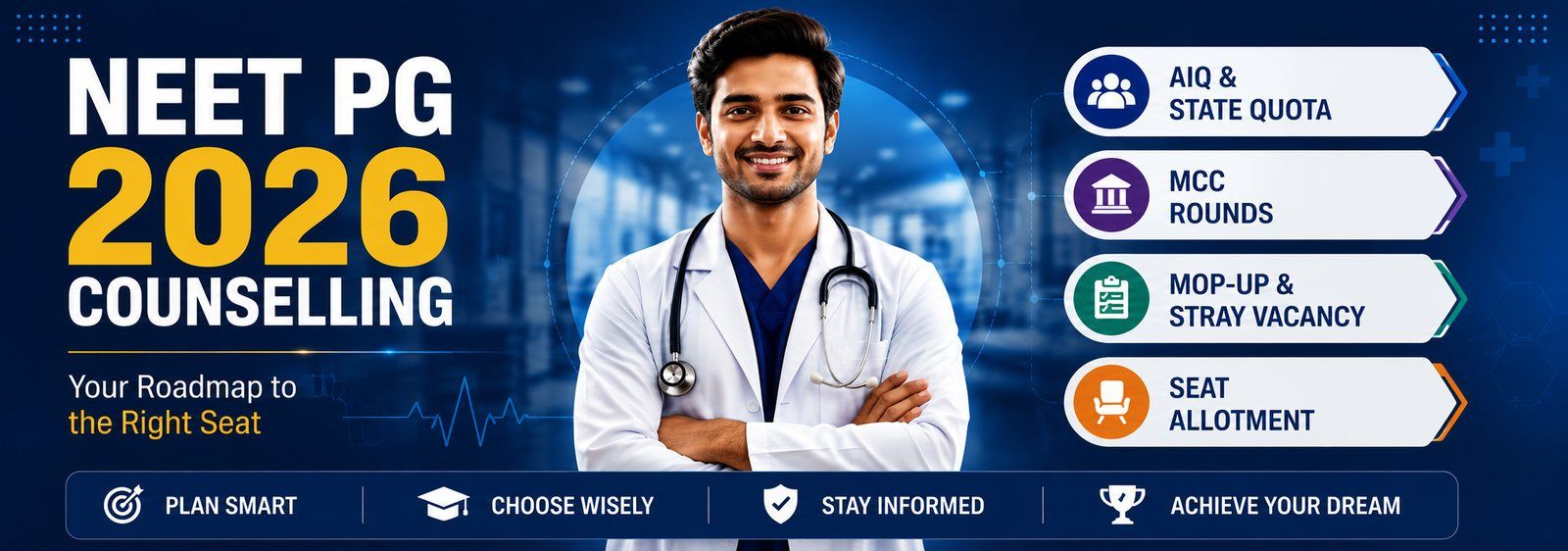
Between your rank and an MD/MS admission lies the counselling process — a multi-round, multi-authority system involving the Medical Counselling Committee (MCC) for All India Quota seats and separate state authorities for State Quota seats. Miss a registration deadline by an hour, fill your choices carelessly, or misunderstand how upgrades work between rounds, and you can lose an entire admission cycle. It helps to know roughly where you will land before any of that — calculate your NEET PG score on the 720-mark pattern and build your choice list around a realistic band.
This guide breaks down exactly how NEET PG 2026 counselling works — the quota system, the four rounds, the reporting rules, and the mistakes that cost candidates seats every single year. With the exam on 30th August 2026 and counselling expected to begin in the following weeks, this is the process to understand now, not after your result is out.
Key Takeaways
- NEET PG counselling runs on two parallel tracks — All India Quota (50% of government seats, run by MCC) and State Quota (the remaining 50% plus most private seats, run separately by each state).
- There are four rounds in total: Round 1, Round 2, Mop-Up, and Stray Vacancy — spanning roughly 4-6 months from result declaration to final reporting.
- Choice filling and locking is the single most consequential step — list every college/course you'd genuinely accept, in true order of preference, since the system allots strictly based on what you submit.
- Missing a reporting deadline forfeits your allotted seat automatically, with no extensions under any circumstances.
- Qualifying percentiles have historically been reduced sharply ahead of Round 3 (as in 2024 and 2025) to fill vacant seats — this expands eligibility only, and does not change anyone's rank.
The Two-Track Counselling System: AIQ and State Quota
NEET PG counselling in India runs on two parallel tracks, and understanding this split is the first thing every aspirant needs to get right.
All India Quota (AIQ) — 50% of Government Seats
The Medical Counselling Committee (MCC), under the Directorate General of Health Services, Ministry of Health & Family Welfare, conducts counselling for:
- 50% of seats in government medical colleges across India (open to candidates from any state, no domicile requirement)
- 100% of seats in central institutions — AIIMS (non-Delhi campuses covered by NEET PG for MD/MS, as applicable), certain central universities, and ESIC medical colleges
- Deemed university seats, which are 100% counselled through AIQ regardless of location
Registration for AIQ counselling happens online at mcc.nic.in, separate from your NEET PG application.
State Quota — 50% of Government Seats + Most Private Seats
The remaining 50% of government seats, along with the vast majority of private medical college seats, are counselled by individual state counselling authorities — a separate process for each state, with its own registration portal, timeline, and rules.
Most state quota counselling carries domicile requirements — you generally need to be a resident of that state (with specific proof requirements that vary by state) to participate. Some states allow limited "outside state" participation for private/management quota seats.
Key point: You can register for both AIQ and your home state's counselling simultaneously. Many candidates do this to maximise their chances. But if you're allotted a seat in both, you must choose one and formally surrender the other before the respective deadlines — holding two seats at once is not permitted.
The Four Rounds of NEET PG Counselling
Both AIQ and most state counselling systems follow a similar four-round structure, though exact state-level timelines vary.
Round 1: Primary Counselling
The first and largest round. All eligible candidates who meet the qualifying percentile can register, fill their college and course preferences in order, and receive an allotment based on rank, category, and preference order.
What happens in Round 1:
- Registration and fee payment
- Choice filling — ranking your preferred colleges and courses
- Choice locking — finalising your list before the deadline
- Seat allotment result published
- Reporting to the allotted college within the specified window, with document verification
If you're allotted a seat you're satisfied with, you report and your admission is confirmed. If you want a better seat, you can choose to "float" for Round 2 instead of reporting — but this carries risk (see the mistakes section below).
Round 2: Upgrade and Fresh Allotment
Round 2 serves two groups: candidates who didn't get a seat in Round 1, and candidates who got a seat but want to try for an upgrade.
Important: If you already hold a Round 1 seat and want to participate in Round 2, most systems require you to either float (risk losing your current seat if not upgraded, depending on the specific rules that year) or surrender it before Round 2 choice filling. Read the specific year's counselling rules carefully — this detail changes and has tightened in recent cycles.
Mop-Up Round
This round fills seats that remained vacant after Rounds 1 and 2 — either because no eligible candidate chose them, or because allotted candidates didn't report.
Key characteristics:
- Fresh registration is usually allowed for candidates who hadn't registered earlier, subject to eligibility
- The seat matrix is narrower — mostly less-preferred colleges, locations, or branches
- Competition is often lower per seat, but so is the seat quality on average
Stray Vacancy Round
The final round, typically held in October–November for a August-exam cycle. This round handles seats still vacant after the Mop-Up round — usually due to non-reporting or last-minute withdrawals.
What to expect:
- Very limited seats — often under 2% of the total
- Predominantly basic science subjects (Anatomy, Physiology, Biochemistry), Community Medicine, or less-preferred clinical branches
- Primarily reached by candidates with lower ranks, those who missed earlier rounds, or anyone seeking any PG medical seat over specific preferences
Across all four rounds, the entire counselling process for a given cycle typically spans 4–6 months from result declaration to final reporting.
Step-by-Step: How to Participate in NEET PG 2026 Counselling
1. Registration
Register separately on mcc.nic.in for AIQ, and on your state's specific counselling portal for state quota (search "[Your State] NEET PG counselling" for the official link — do not use unofficial aggregator sites for registration itself). Registration typically requires:
- NEET PG 2026 scorecard and rank letter
- MBBS degree certificate
- Internship completion certificate
- Medical registration certificate
- Category certificate, if applicable
- Registration fee (varies by quota and category; refundable in part in some systems, non-refundable in others — check the specific year's rules)
2. Choice Filling and Locking
This is the single most consequential step in the entire process, and the one candidates most often get wrong.
Principles for choice filling:
- List every college and course you'd genuinely accept, in true order of preference — not just your top 5. A longer, honestly-ordered list protects you from ending up with no seat at all.
- Order matters absolutely. MCC and state systems allot you the highest college/course on your list that your rank qualifies for at that round. If you rank a lower-preference option above a higher one by mistake, the system will allot based on what you submitted, not what you meant.
- Research before you fill, not during. Look at previous years' closing ranks for the colleges and branches you're considering — these give a realistic sense of where your rank is likely to land, though ranks shift year to year.
- Once locked, choices cannot be edited. Review multiple times before final submission.
3. Seat Allotment
Results are published on the counselling portal after choice locking closes. You'll see your allotted college and course, if any.
4. Reporting and Document Verification
If allotted, you must physically report to the allotted college within the specified window, carrying:
- NEET PG 2026 scorecard and admit card
- Rank letter / allotment letter
- Original MBBS degree and internship certificates
- Original medical registration certificate
- Category certificates, if applicable
- Passport-size photographs
- Any state-specific documents (domicile proof, etc.)
Missing the reporting deadline results in automatic forfeiture of the seat, with no extensions granted under any circumstances. This is the single highest-stakes deadline in the entire process — plan your travel and document readiness well in advance.
Common Counselling Mistakes That Cost Candidates Seats
Floating Without Understanding the Risk
Choosing to "float" for a better option in the next round, instead of reporting to a seat you already have, can backfire if the specific year's rules don't guarantee you retain your current seat as a fallback. Read the exact float/upgrade rules for that counselling cycle before deciding — don't assume last year's rules apply unchanged.
Filling Too Few Choices
Candidates sometimes list only 8–10 "dream" colleges, assuming they'll get one of them. If none come through and the list runs out, you may end up with no seat in that round at all, forced to wait for Mop-Up or Stray Vacancy with a much narrower set of options. A longer, honestly-ranked list is protective, not a compromise.
Missing Registration Deadlines by Hours
Each round has a hard registration and choice-locking deadline, typically enforced by server time with no leniency. Missing it by even a short window means missing the entire round — you cannot participate until the next one opens.
Holding Two Seats Simultaneously
If you're allotted seats in both AIQ and your state quota (or in two different state processes, where allowed), you must formally surrender one before the relevant deadline. Failing to do so can result in cancellation of both admissions in serious cases.
Not Reading State-Specific Rules Carefully
State counselling processes differ meaningfully from each other and from the AIQ process — different domicile requirements, different reservation structures, different float rules, different fee structures. Treat each state's counselling manual as its own document; don't assume AIQ rules apply.
Ignoring the Category Certificate Validity Window
Category certificates (OBC-NCL, EWS, PwBD) often have specific validity periods and must be in the correct central-government format for AIQ participation. An expired or wrongly-formatted certificate at the verification stage can mean losing a seat you were otherwise entitled to.
Understanding the Qualifying Percentile and Cutoff Reduction Pattern
To participate in counselling at all, you first need to clear the minimum qualifying percentile — separate from where you actually rank.
The standard qualifying percentiles have historically been:
- 50th percentile — UR / EWS
- 45th percentile — UR-PwBD
- 40th percentile — SC / ST / OBC (including PwBD)
An important pattern to be aware of: In recent cycles (2024 and again in 2025), the Ministry of Health & Family Welfare has approved a significant reduction of these qualifying percentiles ahead of Round 3, specifically to address a large number of vacant MD/MS seats after Rounds 1 and 2. In the 2025 cycle, this reduction went as far as the 7th percentile for General/EWS candidates and effectively 0th percentile for SC/ST/OBC candidates for Round 3 purposes — a decision that was legally challenged and upheld by multiple High Courts.
This percentile reduction, when it happens, does not change your rank or merit position — it only expands eligibility to participate in later rounds, allowing more candidates to compete for seats that would otherwise stay vacant. As of mid-2026, this "zero-percentile" pattern is reportedly under government review amid broader discussions about its impact on postgraduate medical education standards — worth monitoring if you're near the qualifying threshold, since the rules for the 2026 cycle may differ from 2025's.
We've covered qualifying percentiles and expected cut-off scores for NEET PG 2026 in more detail in a separate piece — see the related reading below.
Frequently Asked Questions
When does NEET PG 2026 counselling start?
Counselling typically begins 4–6 weeks after the result, which is expected by 30th September 2026 following the 30th August exam. Based on previous year patterns, MCC counselling registration for Round 1 is likely to open in October 2026, though NBEMS and MCC have not released official 2026 counselling dates as of this writing.
How many rounds are there in NEET PG counselling?
Four rounds: Round 1, Round 2, Mop-Up Round, and Stray Vacancy Round, conducted separately for AIQ (by MCC) and for each state's quota seats (by respective state authorities).
Can I participate in both AIQ and state quota counselling?
Yes, you can register and participate in both simultaneously. However, if you're allotted seats in both, you must choose one and surrender the other before the respective deadlines.
What happens if I miss the reporting deadline after seat allotment?
Your allotted seat is automatically forfeited and returned to the vacant seat pool for the next round. There are no extensions granted for reporting deadlines under any circumstances.
What is the difference between qualifying cutoff and admission cutoff?
The qualifying cutoff is the minimum percentile/score required to be eligible to participate in counselling at all. The admission cutoff is the actual rank or score at which a specific college and course closes in a given round — this varies significantly by institution, branch, and category, and is generally much higher than the bare qualifying cutoff.
Will the NEET PG 2026 qualifying percentile be reduced like in previous years?
Percentile reductions ahead of Round 3 have occurred in both 2024 and 2025 to address seat vacancies, and this is reportedly under government review for future cycles. Whether the same pattern applies to NEET PG 2026 has not been officially confirmed. Candidates should not assume a reduction will happen and should aim to clear the standard qualifying percentile on the first attempt.
Can I hold a state quota seat and later apply for AIQ upgrade?
Rules on this vary by state and by counselling cycle. Some systems allow floating between quotas with conditions; others require surrender before further participation. Always check the specific year's counselling manual rather than assuming continuity from previous cycles.
What documents do I need for NEET PG 2026 counselling registration?
NEET PG scorecard and rank letter, MBBS degree certificate, internship completion certificate, medical registration certificate, category certificate if applicable, and the registration fee for the relevant quota.
Is domicile required for state quota counselling?
In most states, yes — state quota seats typically require proof of domicile in that state, though the specific documentation and any exceptions (for management/NRI quota seats, for instance) vary by state. Check your specific state's counselling manual for exact requirements.
What to Do Between Now and Result Day
The exam is on 30th August. Results are expected by 30th September. That gives you roughly 12 weeks before counselling realistically begins.
Use this time to:
- Research previous years' closing ranks for colleges and branches you're interested in, so your choice-filling isn't done from a standing start under time pressure.
- Get your document file in order now — MBBS certificate, internship certificate, registration certificate, category certificate — the same documents needed for your NEET PG application will largely serve counselling too, but verify validity windows again closer to the counselling dates.
- Decide your quota strategy — will you participate in AIQ only, your home state only, or both? This shapes how you'll approach choice filling later.
- Keep preparing until exam day. None of the counselling planning above should distract from the fact that your rank — determined entirely by your performance on 30th August — is what all of this counselling strategy depends on.
Related reading on Reflex:
- NEET PG 2026 Registration Is Open: Complete Application Guide, Deadline & Fee
- NEET PG 2026 Expected Cut-off & Qualifying Percentile by Category
- NEET PG 2026 Single-Shift Exam: The End of Normalisation & What Changes for Your Rank
- NEET PG 2026: The 90-Day Strategy for Final-Year MBBS Students & Interns
Practise this on Reflex
Turn what you just read into recall with 14 years of tagged PYQs.
About the author
Stay ahead in your preparation
Get expert tips, exam updates, and high-yield insights delivered straight to your inbox.
No spam. Unsubscribe anytime.
More in Exam Guide
View all → Exam Guide
UPSC CMS Exam: Eligibility, Pattern, Syllabus, and How Selection Works
UPSC CMS recruits medical officers for central and Delhi civic services. Here are the eligibility rules, age limit, exam pattern, syllabus, selection stages and how it compares with NEET PG.
 Exam Guide
DNB Full Form in Medical: Course, Admission, and How It Compares With MD/MS
DNB stands for Diplomate of National Board, a postgraduate qualification from NBEMS. Here is how admission, training and the exit exam work, and how DNB compares with MD/MS.
 Exam Guide
INI-CET November 2026: How to Use Your Last 30 Days, Week by Week
 Exam Guide