NEET PG Marks vs Rank: How Cutoffs Really Work in 2026
By Dr. Utsav Bhattacherjee, MBBS, MBA · 5 Jun 2026 · 5 min read
Last updated: 23 Sept 2026
On this page
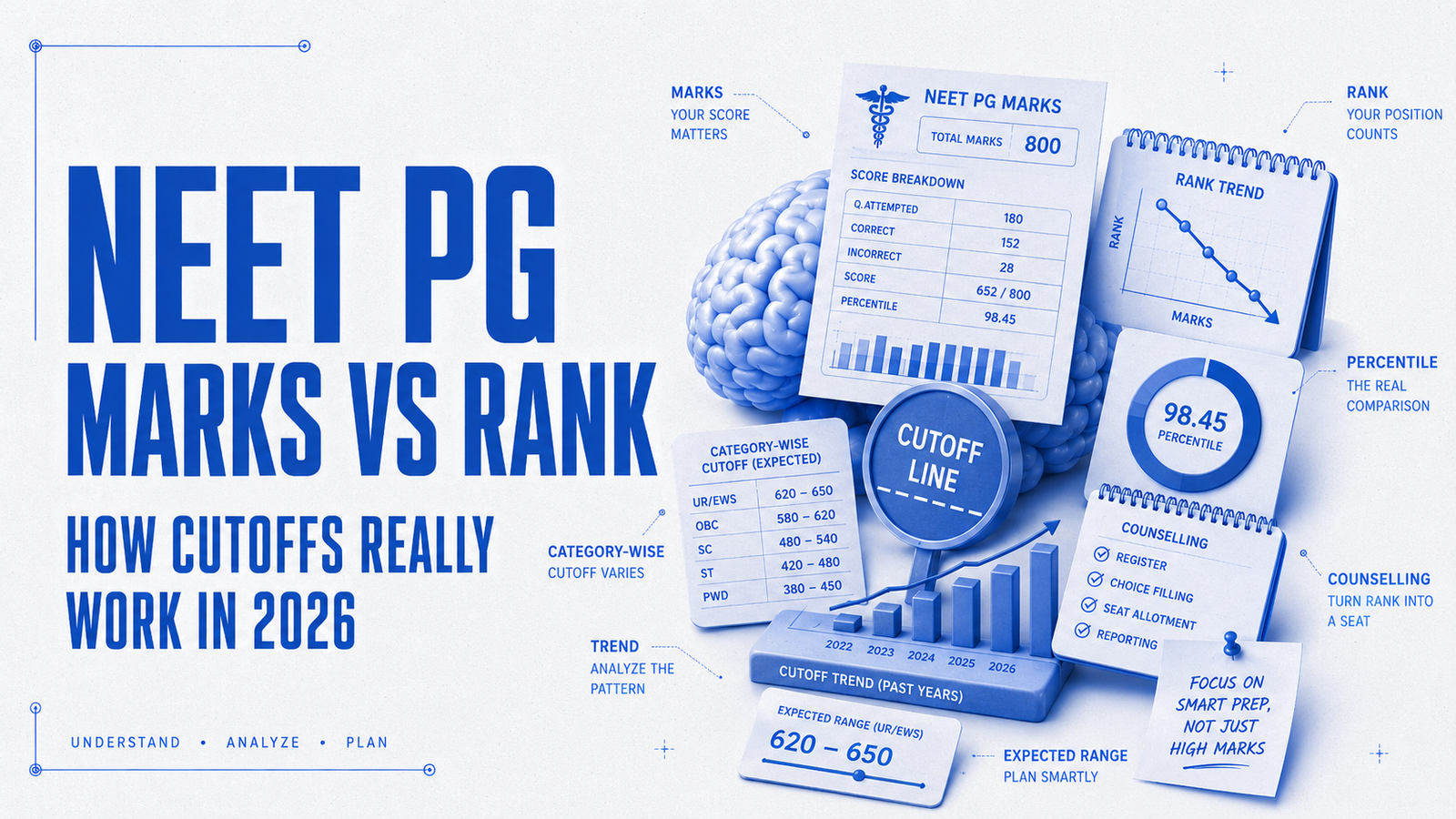
Most students treat their NEET PG score as the whole story. It isn’t. Your rank — the number that actually determines counselling — comes from how your marks compare to everyone else’s, and the qualifying cutoff published on result day is often not the cutoff that ends up mattering by the final counselling round. Start with the raw figure itself — our free NEET PG score calculator applies the +4/−1 scheme across all 180 questions.
Marks, Percentile, and Rank Are Three Different Things
- Marks: your raw score out of 720 (as of the 2026 pattern).
- Percentile: the percentage of candidates who scored at or below you. Formula: (Total Candidates − Your Rank) ÷ Total Candidates × 100.
- Rank: your absolute position among everyone who appeared — this is what counselling actually runs on.
Here’s a worked example. If roughly 2,10,000 candidates appear and your All India Rank is 15,000, your percentile is:
(2,10,000 − 15,000) ÷ 2,10,000 × 100 ≈ 92.9 percentile
That means you outperformed about 93% of everyone who sat the exam — even though your raw marks alone tell you nothing about that without knowing the full distribution. Two candidates with identical marks in different years can end up with very different percentiles, because percentile depends on the whole candidate pool’s performance that year, not just your own score.
The Category-Wise Qualifying Percentile
To even be eligible for counselling, you need to clear a minimum percentile for your category. Historically, NBEMS has set these at:
| Category | Qualifying percentile |
|---|---|
| General / EWS | 50th percentile |
| SC / ST / OBC (including PwBD) | 40th percentile |
| General – PwBD | 45th percentile |
As of this writing, NBEMS has not separately notified a different qualifying percentile for 2026 — the default expectation is that these historical thresholds carry forward unless the Ministry of Health & Family Welfare revises them. Always confirm the officially declared figure with your result, since this has changed substantially in recent cycles (see below).
Qualifying Cutoff Is Not Admission Cutoff
This is the distinction that trips up the most students, and it’s worth spelling out as two separate thresholds:
- Qualifying cutoff — the minimum percentile/marks to be eligible to participate in counselling at all. Clearing this gets you nothing on its own.
- Admission (closing) cutoff — the marks/rank at which a specific course, in a specific college, in a specific round, actually stopped admitting candidates. This is what determines whether you get a particular seat, and it’s usually far higher than the qualifying cutoff, especially for competitive branches and colleges.
Historically, qualifying cutoffs have sat in the 250–300 mark range (on the old 800-point scale) for the General category, while admission cutoffs for a sought-after speciality at a top government college can run 700+ marks. Qualifying is the floor for entering the room; it says nothing about which door you can walk through once you’re in it.
The Part Nobody Tells You: Cutoffs Get Revised Mid-Counselling
Here’s what "how cutoffs really work" actually means in practice. In the 2025 cycle, the initial qualifying percentile was set at the standard 50th percentile for General/EWS. Partway through counselling, with roughly 18,000 seats sitting vacant, the Ministry of Health & Family Welfare revised the General category cutoff downward — all the way to the 7th percentile in later rounds. SC/ST/OBC candidates were, at one point, made eligible for counselling even at a 0 percentile — including candidates with negative raw scores, a direct consequence of the −1 negative marking.
The takeaway: the cutoff published on result day is a starting point, not a guarantee of where things end. If you’re near the qualifying line after results, don’t assume you’re out — later rounds have historically pulled the threshold down substantially to fill vacant seats, particularly in less sought-after specialities and colleges.
Why 2026 Numbers Aren’t Directly Comparable to Past Years
NEET PG 2026 is scored out of 720 (180 questions), down from 800 (200 questions) in earlier cycles. That means a 2025 cutoff of, say, 276 marks and a 2026 cutoff can’t be compared as raw numbers — the scales are different. Based on current-cycle trend estimates, candidates are expected to need roughly 590+ marks for a rank under 3,000, and 675+ for a top-20 All India Rank — but these are trend-based projections, not official figures, and will move depending on this year’s paper difficulty and candidate pool. Compare percentiles across years, not raw marks.
How to Check Your Official Cutoff
Once results are declared, category-wise qualifying percentiles and cutoff marks are published directly on natboard.edu.in alongside your scorecard. Cross-check your category’s specific figure there rather than relying on any blog’s projected estimate, including this one — projections are directional, official results are the only number that counts for counselling eligibility.
What This Means for Your Strategy
Don’t anchor your entire outlook to the qualifying cutoff announced on result day — it’s the floor, not the finish line, and it’s historically moved during counselling. Track official NBEMS and MCC announcements through every round rather than a single published number. And separate two goals clearly in your own head: qualifying to sit for counselling, and scoring competitively enough for the branch and college you actually want. They are not the same target, and conflating them is where a lot of unnecessary panic after results comes from.
Understanding this dynamic is one part of the picture — the other is understanding why the goalposts keep moving year over year in the first place. We cover that in our piece on NEET PG rank inflation.
Practise this on Reflex
Turn what you just read into recall with 14 years of tagged PYQs.
FAQ
Frequently asked questions
The questions aspirants ask most about this topic.
"Good" depends entirely on your target — qualifying, a government seat generally, or a specific competitive speciality. Based on current trend estimates on the new 720-mark scale, roughly 590+ marks tracks toward a rank under 3,000, while top specialities at elite colleges typically need scores well above that.
No. Percentage is your raw score as a fraction of total marks. Percentile is your relative standing compared to every other candidate — a 90th percentile doesn’t mean you scored 90% of the marks, it means you outperformed 90% of everyone who appeared.
It can. As shown in the 2025 cycle, qualifying percentiles have been revised downward mid-counselling when a large number of seats remained vacant, so the effective cutoff by the final round can be very different from what was published on result day.
On natboard.edu.in, published alongside the result declaration, broken down by category.
About the author
Stay ahead in your preparation
Get expert tips, exam updates, and high-yield insights delivered straight to your inbox.
No spam. Unsubscribe anytime.
More in Exam Guide
View all → Exam Guide
UPSC CMS Exam: Eligibility, Pattern, Syllabus, and How Selection Works
UPSC CMS recruits medical officers for central and Delhi civic services. Here are the eligibility rules, age limit, exam pattern, syllabus, selection stages and how it compares with NEET PG.
 Exam Guide
DNB Full Form in Medical: Course, Admission, and How It Compares With MD/MS
DNB stands for Diplomate of National Board, a postgraduate qualification from NBEMS. Here is how admission, training and the exit exam work, and how DNB compares with MD/MS.
 Exam Guide
INI-CET November 2026: How to Use Your Last 30 Days, Week by Week
 Exam Guide