Postmortem Lividity for NEET PG: Timeline, Color Clues, and Time of Death
By Dr. Utsav Bhattacherjee, MBBS, MBA · 31 May 2026 · 2 min read
Last updated: 23 Sept 2026
On this page
Postmortem lividity (livor mortis) is one of the most reliably tested Forensic Medicine topics precisely because it does two jobs at once: it helps estimate time since death, and its color and pattern can flag poisoning or that a body was moved after death.
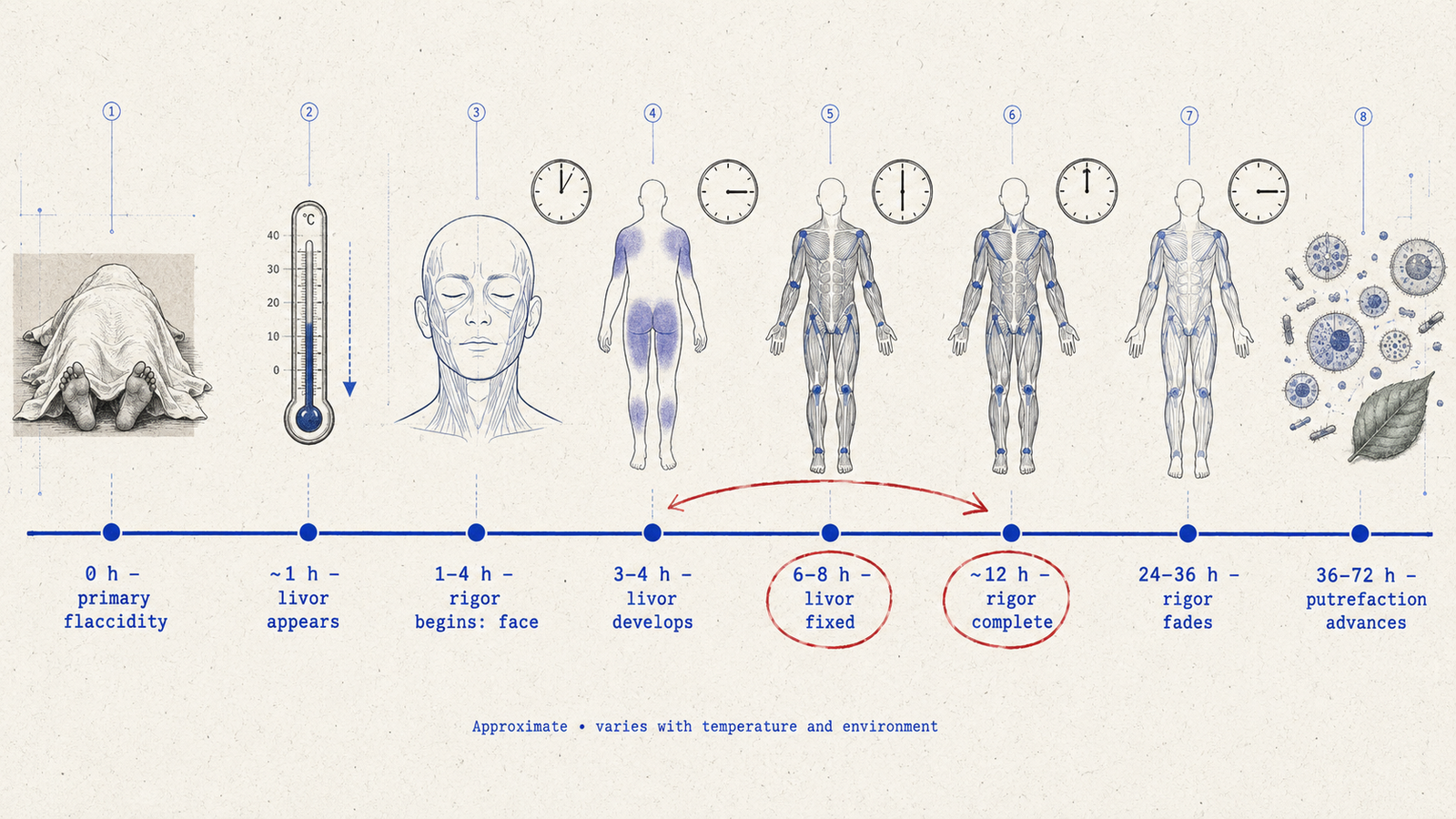
The Postmortem Changes Timeline
| Change | Onset | Key detail |
|---|---|---|
| Livor mortis (lividity) | 20 minutes–3 hours | Fixes (stops shifting) by 6–12 hours |
| Rigor mortis | 1–2 hours | Follows a rough "rule of twelve": onset in ~12 hrs, persists ~12 hrs, resolves in ~12 hrs |
| Algor mortis (cooling) | Immediate, gradual | Body cools roughly 0.5–1°C per hour, depending on ambient conditions |
| Putrefaction | 24–48 hours | Greenish discoloration typically starts in the right iliac fossa first |
Rigor mortis appears and disappears in the same order it develops (small muscles of the face and jaw first), while lividity behaves differently — it can still be pressed away and shifted with a change in body position before it fixes.
Why Lividity Fixation Matters
Before fixation, lividity blanches under pressure and shifts if the body’s position changes — blood is still pooling under gravity in the dependent parts of the body. Once fixed, it no longer blanches or shifts even if the body is repositioned. This distinction is what makes lividity useful for detecting whether a body was moved after death: a fixed lividity pattern inconsistent with the position the body was found in is a strong indicator that it was moved sometime after death occurred.
Color Clues Worth Knowing
- Cherry-red lividity: classically associated with carbon monoxide poisoning or cyanide poisoning.
- Brownish lividity: suggests methemoglobinemia, as seen in nitrite or nitrate poisoning.
- Normal lividity: a purplish-blue color, from deoxygenated blood pooling in dependent areas.
Why Right Iliac Fossa First for Putrefaction
The right iliac fossa is closest to the cecum, which harbors a high bacterial load — this proximity is why greenish discoloration from putrefaction classically appears there before anywhere else on the body.
Time-since-death estimation is a classic scenario-based Forensic Medicine question — the kind Reflex’s daily TROCAR quiz uses to build pattern recognition, not just fact recall.
Practise this on Reflex
Turn what you just read into recall with 14 years of tagged PYQs.
FAQ
Frequently asked questions
The questions aspirants ask most about this topic.
The purplish-blue discoloration that appears on the dependent parts of a body after death, caused by blood settling under gravity once circulation stops.
Yes — its onset (20 minutes to 3 hours) and fixation (6–12 hours) provide a rough window, though it’s used alongside rigor mortis and body temperature for a fuller estimate.
Carbon monoxide or cyanide poisoning.
Yes — it follows the same sequence in reverse, starting with the small muscles of the face and jaw.
About the author
Stay ahead in your preparation
Get expert tips, exam updates, and high-yield insights delivered straight to your inbox.
No spam. Unsubscribe anytime.
More in Subject Notes
View all → Forensic Medicine
Rigor Mortis for NEET PG: The Timeline Every Time-of-Death Question Is Really Testing
 Microbiology
Malaria Life Cycle for NEET PG: Species, Smear Morphology, Complications and Treatment
How the malaria parasite moves between mosquito and human, what separates the species on a smear, and how diagnosis, complications and treatment follow from the life cycle.
 Physiology
Oxygen-Hemoglobin Dissociation Curve for NEET PG: Every Shift Explained
Why the oxygen-hemoglobin dissociation curve is sigmoid, what moves it right or left, and how to apply each shift to fetal hemoglobin, stored blood, altitude and carbon monoxide poisoning.
 Pharmacology
Cholinergic Drugs for NEET PG: Classification, Receptors and Organophosphate Poisoning
A working classification of cholinergic drugs, the receptors behind each effect, which drug fits which clinical scenario, and how to answer organophosphate poisoning questions.