FMGE June 2026 Result: The Night 32,793 Foreign Medical Graduates Opened One PDF and Found Out Who They'd Become
Reflex · 8 Jul 2026 · 12 min read
On this page
On the evening of 7th July 2026, somewhere close to 37,448 people did the exact same thing at almost the exact same time.
They opened a PDF on natboard.edu.in. They pressed Ctrl+F. They typed in a roll number they'd memorised months ago, back when it was just a string of digits on an admit card. And then they waited the half-second it takes a browser to search a document — the longest half-second in most of their lives that week.
For 5,086 of them, the number appeared, highlighted, right there on the screen. Somewhere, in a hostel room, at a kitchen table in Manila or Tbilisi or Dhaka, on a phone screen at 2am because the time zones never quite line up — there was a breath let out. Maybe a call home. Maybe tears that had nothing to do with sadness.
For 31,645 others, the search came back empty. No highlight. No number. Just a document that didn't have you in it, and a silence that's much louder than any exam hall ever was.
This is the story of that PDF — what it actually said, why so few names were in it this time, and what the other 31,645 people need to hear right now, because it is not what most of them are telling themselves tonight.
The Number Everyone's Talking About: 13.6%
Here's the plain arithmetic behind that PDF.
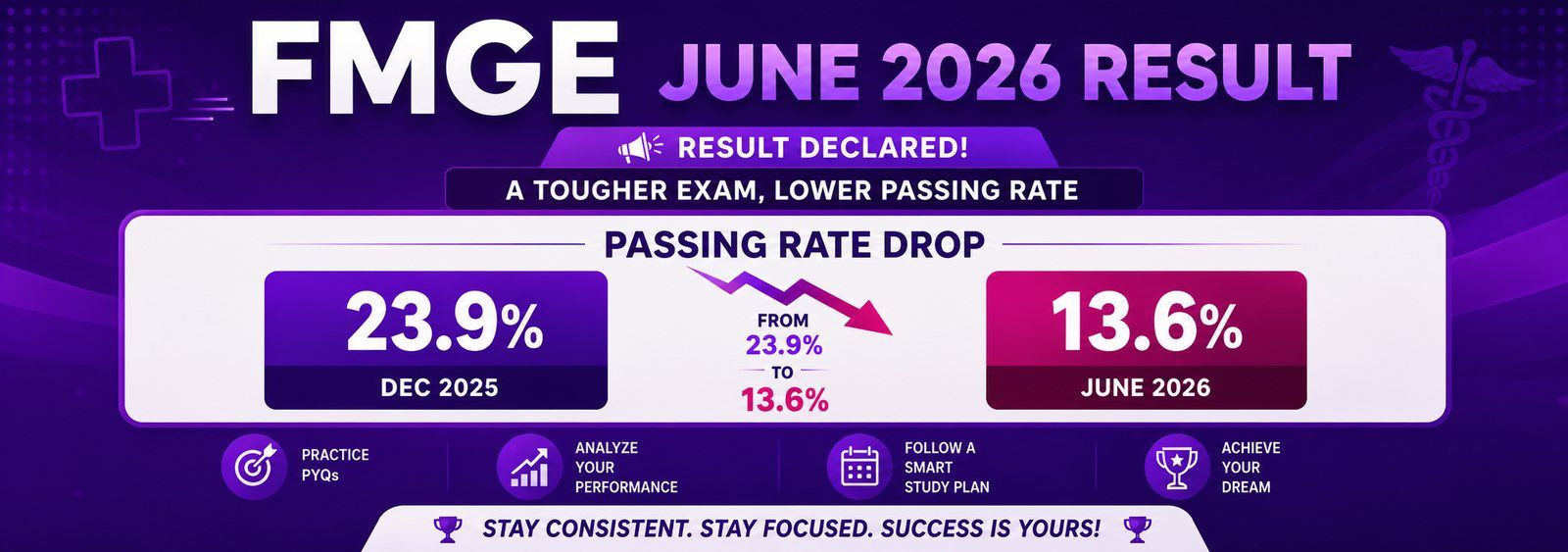
37,448 candidates sat for FMGE on 28th June 2026. 5,086 of them qualified. That works out to a pass percentage of roughly 13.6% — meaning that for every 100 people who walked into an exam hall that day, only about 14 walked out having crossed the line.
To understand how brutal that number actually is, you have to put it next to the session before it. In December 2025, 42,872 candidates appeared, and 10,262 passed — a pass rate of 23.9%. Nearly one in four people passed that session. This time, it was closer to one in seven.
That's not a small dip. That's the exam getting meaningfully, measurably harder — or the candidates who sat this time facing a paper built differently. Either way, if you were one of the 31,645, the story you should be telling yourself is not "I wasn't good enough." It's "I sat one of the tougher papers FMGE has thrown in recent memory, and I still have every reason to come back."
Here's the full picture, laid out plainly:
| Metric | June 2026 | December 2025 |
|---|---|---|
| Appeared | 37,448 | 42,872 |
| Qualified | 5,086 | 10,262 |
| Failed | 31,645 | — |
| Absent | 1,148 | — |
| Results withheld | 20 | — |
| Pass percentage | ~13.6% | 23.9% |
| Qualifying marks | 150/300 | 150/300 |
The exam was conducted on 28th June 2026. The result went live on 7th July 2026. Individual scorecards — the ones that actually show you your marks, not just your pass/fail status — become downloadable from 16th July 2026, through your candidate login on natboard.edu.in.
What the PDF Doesn't Tell You
Here's something worth sitting with, because it changes the entire emotional weight of that Ctrl+F moment.
FMGE isn't a race. It never was.
There is no merit list. No one is "ahead" of you. The person who scored 280 and the person who scored 152 are, as far as NBEMS and the NMC are concerned, exactly the same kind of qualified. Nobody asks a doctor what their FMGE score was. They ask if they passed.
This matters enormously for how you should feel tonight if your name wasn't in that document. You weren't beaten by 31,644 other people. You were measured against a single, fixed number — 150 out of 300 — on a paper that, this session, a much smaller share of people managed to clear. The bar didn't move for you specifically. It just turned out to be a harder bar for everyone this time.
If you've spent the last day telling yourself some version of "everyone else gets it and I don't," the numbers say otherwise. Six out of every seven people in that exam hall are having the exact same conversation with themselves right now that you are.
For the 5,086: What Comes Next
If your roll number lit up on that PDF, here's the practical road ahead of you — because passing FMGE is the start of a process, not the end of one.
Watch for the Pass Certificate notification. NBEMS distributes this only in person, after verifying your identity and original documents. There's no downloadable version that substitutes for it — your online scorecard, once it's live on 16th July, is for your own records, not for registration.
Get your paperwork in order now, before the verification schedule is announced: your original FMGE admit card, your foreign medical degree and mark sheets, your eligibility certificate, your passport, and a valid Indian photo ID.
Then comes registration — provisional or permanent, with the NMC or your State Medical Council — and, if it's still pending, your internship. From there, the door opens either to clinical practice or to further postgraduate study through NEET PG, for which you're now eligible.
You did the hard part. The rest is paperwork and patience.
For the 31,645: This Is the Part That Actually Matters
If you're reading this because your name wasn't there, I want to say something plainly, before anything else: the story you tell yourself about tonight will shape what you do for the next five and a half months, until December.
There are two stories available to you.
Story one: "I studied for months. I watched every lecture. I still failed. Maybe I'm just not built for this."
Story two: "I studied broadly, the way almost every FMGE aspirant is taught to study — across all 19 subjects, comprehensively, the way you'd prepare for a competitive ranking exam. But FMGE isn't a ranking exam. It's a threshold. And nobody sat me down and asked whether my hours were going toward the 50% of content that actually decides pass or fail."
The second story is the true one for most of the 31,645. And it's the only one of the two that gives you something to actually do differently.
Why "Studying Harder" Isn't the Right Lesson From This Result
Almost every FMGE preparation platform on the market was originally built for NEET PG — a competitive exam where every additional mark of knowledge can move your rank up, where comprehensive depth genuinely pays off, because someone else's extra 10 marks is directly your loss of rank.
FMGE doesn't work that way. You don't need to know more than the person sitting three seats away from you. You need to reliably cross 150 out of 300, on a paper that is well known, across sessions, for repeating the same clinical patterns, the same high-yield concepts, the same style of question, year after year.
When your preparation looks like a NEET PG candidate's — broad video lectures, exhaustive notes, an attempt to "cover everything" — you end up spending real hours, real money, and real emotional energy on content that was never going to be the difference between 148 and 152. That's not a discipline problem. That's a targeting problem.
What a Different December Looks Like
This is exactly the gap Reflex FMGE (www.reflexfmge.com) was built to close.
Not another comprehensive video library that asks for a year you don't have. A preparation platform built around what FMGE has actually asked, session after session — because when the exam itself repeats its patterns this consistently, your preparation should be built around those patterns, not around a syllabus designed for a different exam entirely.
Picture what your next five and a half months could look like if every hour you spent studying was an hour spent on a question type, a clinical scenario, a high-yield topic that has genuinely shown up before — instead of an hour spent hoping that broad coverage would somehow translate into the specific 150 marks you need.
That's not studying harder. It's studying toward the actual finish line, instead of toward an imagined, much longer one.
What Might Have Actually Happened This Session
While NBEMS hasn't issued a public explanation for the sharp drop from 23.9% to 13.6%, a fall of this size is far more consistent with a genuinely tougher, more clinically demanding paper than with a sudden, nationwide dip in how well 37,448 people happened to prepare. NBEMS itself noted that every question in the June 2026 paper was reviewed post-exam for technical correctness, with marks awarded to all candidates wherever a question was found flawed or had two correct answers — a sign that the paper was scrutinised carefully, not an easy one.
If you were close to 150 — 130s, 140s — this context matters. You are not far from the person who passed. You may simply need four or five more high-yield concepts locked in, not a complete overhaul of how you study.
How to Check Your Result and Scorecard
- Go to natboard.edu.in
- Find the FMGE June 2026 Result notification
- Download the digitally signed PDF
- Ctrl+F your roll number
- From 16th July 2026, log in to download your individual scorecard — save it immediately, since it's only available for 6 months and NBEMS will not entertain requests after that window closes
- Remember: this scorecard is for your reference only. The Pass Certificate, distributed in person after verification, is what you'll actually need for registration.
Frequently Asked Questions
What is the FMGE June 2026 pass percentage?
Approximately 13.6% — 5,086 candidates qualified out of 37,448 who appeared, a sharp fall from December 2025's 23.9% pass rate.
How many candidates passed FMGE June 2026?
5,086 candidates, out of 37,448 who sat for the exam on 28th June 2026.
What is the qualifying mark for FMGE?
150 out of 300 (50%), with no relaxation for any category of candidate.
When are FMGE June 2026 scorecards available?
From 16th July 2026, via the candidate login on natboard.edu.in. Scorecards remain downloadable for 6 months only.
Can the online scorecard be used for NMC or State Medical Council registration?
No. Only the Pass Certificate, issued after in-person verification, is valid for registration purposes.
Is FMGE a ranked exam?
No. FMGE is purely pass/fail. There is no merit list — everyone who crosses 150/300 passes, regardless of how anyone else performs.
Why was this session's pass rate so much lower than December 2025?
There's no official NBEMS explanation, but a drop of this scale is far more consistent with a tougher, more demanding question paper than a sudden nationwide decline in preparation quality.
Is there a limit to how many times I can attempt FMGE?
No. You can reappear as many times as needed, provided you meet eligibility criteria and reapply for each session.
What should I focus on differently for December 2026 if I didn't pass this time?
Prioritise the question patterns and high-yield concepts that have genuinely repeated across past FMGE sessions, rather than trying to comprehensively re-cover all 19 subjects again. FMGE rewards reliability at a fixed threshold, not exhaustive knowledge.
One Last Thing, Before You Close This Tab
If your roll number was in that PDF — congratulations. Genuinely. Go get your paperwork ready.
If it wasn't, here's what I'd ask you to do tonight, instead of replaying the Ctrl+F moment one more time: close the tab, and decide — just decide — that December is going to look different. Not busier. Different.
Five and a half months is enough time to turn 140-something into 150-plus, if those months are spent on the right 50%, not just more of everything. That's the whole idea behind Reflex FMGE — previous-year-question-first preparation, built around the patterns this exam actually repeats, so the next time you open a PDF and search for your roll number, you already know it's going to be there.
Explore it at **www.reflexfmge.com**.
You didn't lose this round to 31,644 other people. You lost it to a harder paper and, maybe, hours spent on the wrong 50%. Both of those are fixable between now and December.
Related reading on Reflex:
- FMGE December 2026: Building a Preparation Plan That Targets What Actually Repeats
- FMGE vs NEET PG: What Qualified Graduates Should Know About Further PG Options
- FMGE High-Yield Topics: What Actually Shows Up Across Sessions
- NEET PG 2026 Registration Open: New Exam Pattern & Everything You Need to Know
Practise this on Reflex
Turn what you just read into recall with 14 years of tagged PYQs.
Stay ahead in your preparation
Get expert tips, exam updates, and high-yield insights delivered straight to your inbox.
No spam. Unsubscribe anytime.
More in Exam Guide
View all → Exam Guide
NEET PG 2026 Study Plan: 3 Months, Subject by Subject
Three months before NEET PG 2026 is not a lot of time. It is enough time, if you use it correctly. This is a week-by-week plan built around the August 30 exam date, subject weightage, and the five-section locked format.
 Exam Guide
How to Prepare for NEET PG 2026: A Complete Strategy Guide
NEET PG preparation comes down to three things: which subjects to prioritise, how to structure daily practice, and how to simulate the actual exam before you sit it. Here is a strategy built on what actually moves ranks.
 Exam Guide
Best App for NEET PG Preparation in 2026: Video Lectures vs PYQ-First Apps
Choosing the best app for NEET PG preparation comes down to one question: do you need more content, or more practice? The answer changes which app you should be using — and when.
 Exam Guide
How to Start NEET PG Prep: A Study Plan Built on Actual Weightage
A study plan built around real subject weightage: what to study first, how to split your hours, and how to build a revision cycle that holds.