Immunization Schedule for NEET PG: The Complete Age-Wise Breakdown
By Dr. Utsav Bhattacherjee, MBBS, MBA · 21 Jul 2026 · 2 min read
Last updated: 23 Sept 2026
On this page
Immunization schedule questions test the sequence and timing more than the vaccines themselves — which dose comes at which age, and which vaccine is the odd one out in a described schedule. Organizing the schedule by age window, rather than trying to memorize a flat list, is what makes this stick.
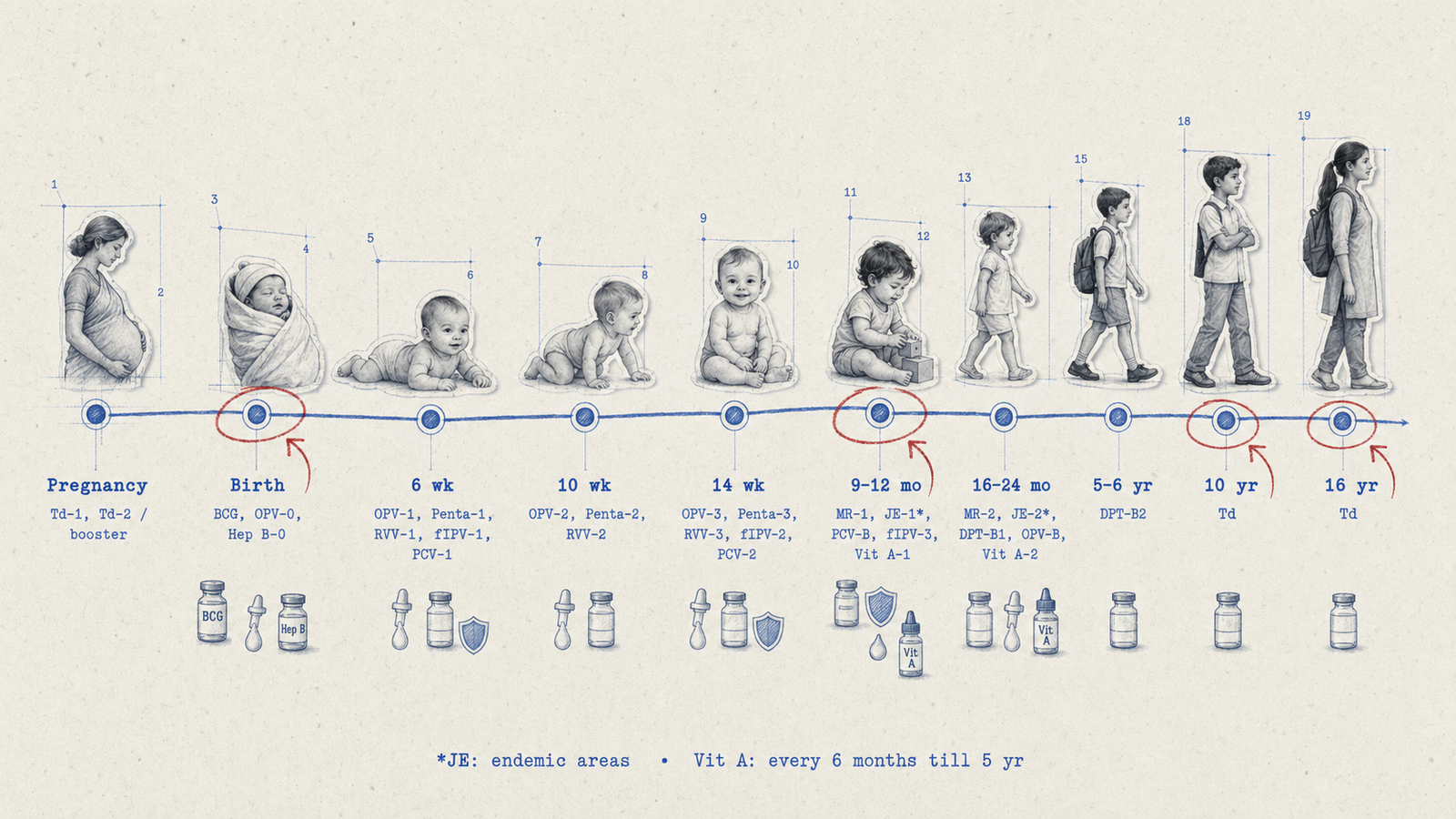
The Standard Schedule, by Age
| Age | Vaccines (as per India’s Universal Immunization Programme) |
|---|---|
| At birth | BCG, OPV-0, Hepatitis B birth dose |
| 6, 10, 14 weeks | DPT, OPV, Hepatitis B, Hib (often as a combination/pentavalent vaccine), IPV |
| 9 months | Measles-Rubella (MR) first dose |
| 16–24 months | DPT booster, OPV booster, MR second dose |
| 5–6 years | DPT second booster |
| 10 and 16 years | Tetanus toxoid (TT) |
Note: national immunization schedules are periodically revised — vaccines like Rotavirus and Pneumococcal Conjugate Vaccine (PCV) have been added to the UIP in recent years in a phased, state-wise manner. Always cross-check the current schedule against the latest official Ministry of Health & Family Welfare notification rather than relying solely on any single source, including this one.
Why BCG Is Given at Birth
BCG protects primarily against severe, disseminated forms of childhood tuberculosis (miliary TB, TB meningitis) rather than reliably preventing pulmonary TB in adulthood — which is exactly why it’s given as early as possible, at birth, rather than later in childhood.
The OPV vs IPV Distinction
Oral Polio Vaccine (OPV) is a live attenuated vaccine given orally, used heavily in India’s Pulse Polio campaigns for its ease of administration and ability to induce intestinal immunity. Inactivated Polio Vaccine (IPV) is given by injection and carries no risk of vaccine-derived poliovirus, which is why global polio eradication strategy has shifted toward incorporating IPV alongside OPV.
Age-sequencing questions like this are exactly what Reflex’s daily TROCAR Pediatrics rounds are built to drill.
Practise this on Reflex
Turn what you just read into recall with 14 years of tagged PYQs.
FAQ
Frequently asked questions
The questions aspirants ask most about this topic.
BCG, the zero dose of Oral Polio Vaccine (OPV-0), and the Hepatitis B birth dose.
The first Measles-Rubella (MR) dose is given at 9 months, with a second dose at 16–24 months.
Because its main protective benefit is against severe, disseminated childhood TB (like TB meningitis and miliary TB), which can occur very early in life if the vaccine isn’t given promptly.
OPV is a live, oral vaccine that induces intestinal immunity; IPV is an injectable, inactivated vaccine with no risk of vaccine-derived poliovirus.
About the author
Stay ahead in your preparation
Get expert tips, exam updates, and high-yield insights delivered straight to your inbox.
No spam. Unsubscribe anytime.
More in Pediatrics
View all → Pediatrics
Intussusception for NEET PG: The Classic Triad, Target Sign and Reduction Methods
A revision guide to intussusception in children: who gets it, why the classic triad is often incomplete, how ultrasound confirms it, and when to reduce with an enema or operate.
 Pediatrics
Neonatal Jaundice for NEET PG: Physiological vs Pathological Criteria and the Phototherapy Logic
A revision guide to neonatal jaundice: how to separate physiological from pathological jaundice, how phototherapy and exchange decisions are structured, and what kernicterus and cholestasis look like.
 Pediatrics
Kawasaki Disease for NEET PG: The Five Criteria, the 10-Day IVIG Window and the Coronary Risk
What counts as Kawasaki disease, why the 10-day IVIG window matters, how aspirin is used, and how coronary artery involvement is graded and followed.
 Pediatrics
Tetralogy of Fallot for NEET PG: One Septal Shift, Four Defects, and the Tet Spell
One shifted septum explains the four defects of Tetralogy of Fallot, the boot-shaped heart, the fading murmur and the stepwise management of a tet spell.