Krebs Cycle Mnemonic for NEET PG: Steps, Enzymes, and Clinical Correlations
By Dr. Utsav Bhattacherjee, MBBS, MBA · 22 Jul 2026 · 2 min read
Last updated: 23 Sept 2026
On this page
The Krebs cycle (citric acid cycle / TCA cycle) shows up in Biochemistry questions less as "name the intermediates" and more as "which enzyme is inhibited here, and what’s the clinical consequence." Knowing the sequence is step one; knowing where the classic poisons and deficiencies act is what actually answers the exam question.
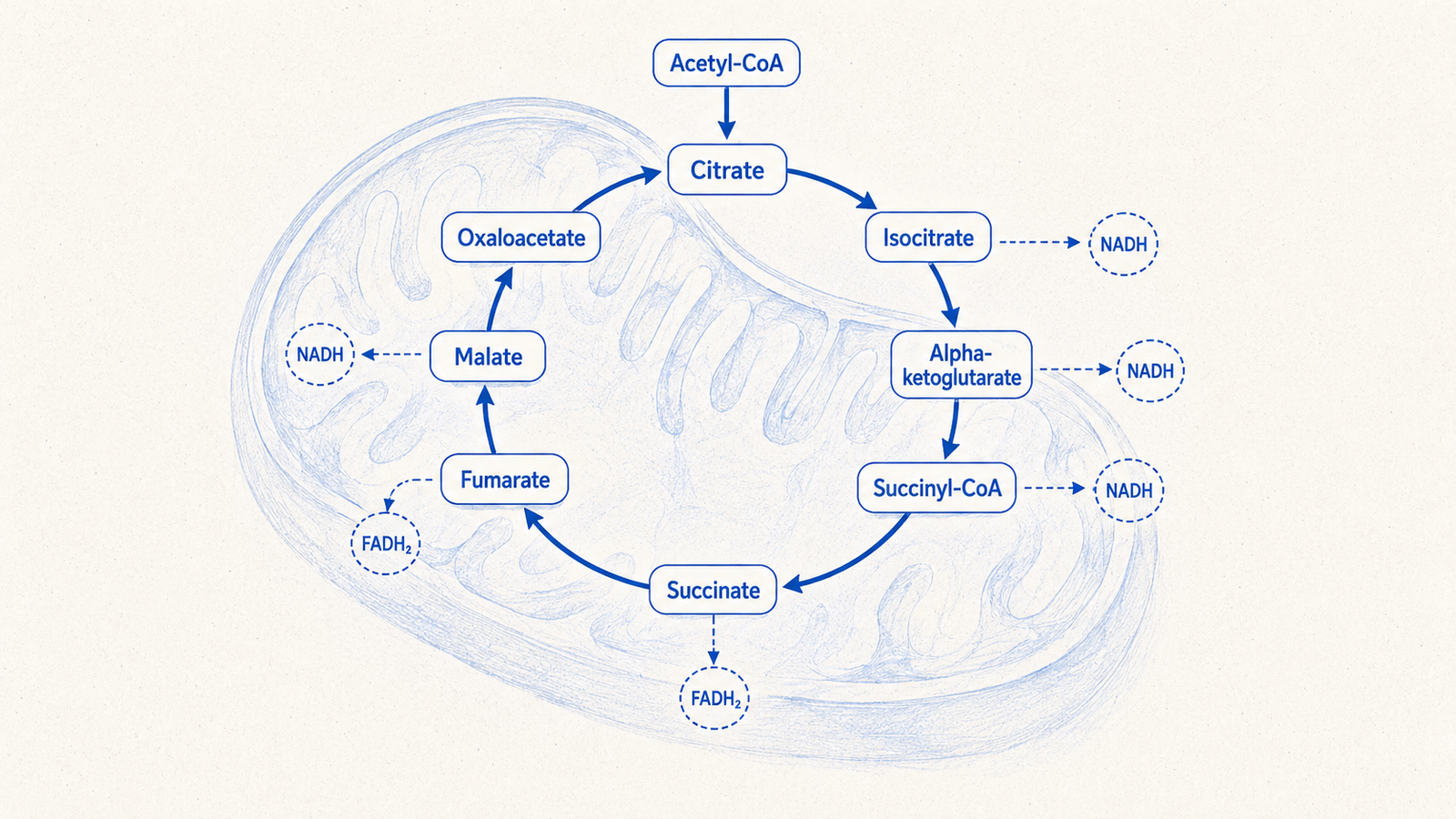
The 8 Steps, in Order
| Step | Intermediate | Enzyme |
|---|---|---|
| 1 | Citrate | Citrate synthase |
| 2 | Isocitrate | Aconitase |
| 3 | α-Ketoglutarate | Isocitrate dehydrogenase |
| 4 | Succinyl-CoA | α-Ketoglutarate dehydrogenase |
| 5 | Succinate | Succinyl-CoA synthetase |
| 6 | Fumarate | Succinate dehydrogenase |
| 7 | Malate | Fumarase |
| 8 | Oxaloacetate | Malate dehydrogenase |
A simple way to hold the order: Citrate, Is, Krebs’, Special, Sauce, For, Making, Oxaloacetate — the first letters (C-I-K-S-S-F-M-O) retrace the same eight intermediates in sequence.
Where It Happens and What It Yields
The cycle runs in the mitochondrial matrix. One turn of the cycle, starting from one acetyl-CoA, produces 3 NADH, 1 FADH2, and 1 GTP (or ATP), along with 2 CO2. Through the electron transport chain, each NADH yields roughly 2.5 ATP and each FADH2 roughly 1.5 ATP — putting the total energy yield per acetyl-CoA at around 10 ATP.
The Rate-Limiting Steps
Three enzymes are considered the key regulatory points: citrate synthase, isocitrate dehydrogenase, and α-ketoglutarate dehydrogenase. These are the steps most sensitive to feedback inhibition by ATP and NADH — and, not coincidentally, the steps most frequently featured in clinical-correlation questions.
Clinical Correlations Worth Knowing
- Arsenic poisoning inhibits α-ketoglutarate dehydrogenase — a thiamine-dependent enzyme, mechanistically similar to how arsenic affects pyruvate dehydrogenase.
- Fluoroacetate/fluorocitrate poisoning inhibits aconitase, a phenomenon classically called "lethal synthesis" because fluoroacetate itself is harmless until it’s converted into fluorocitrate inside the cycle.
- Thiamine (B1) deficiency impairs both pyruvate dehydrogenase and α-ketoglutarate dehydrogenase, since both are thiamine pyrophosphate–dependent — this is part of why thiamine deficiency (as in Wernicke’s encephalopathy) has such wide-reaching metabolic effects.
Metabolic pathway questions like this reward pattern recall over rote memorization — exactly what Reflex’s daily TROCAR Biochemistry rounds are built to drill.
Practise this on Reflex
Turn what you just read into recall with 14 years of tagged PYQs.
FAQ
Frequently asked questions
The questions aspirants ask most about this topic.
In the mitochondrial matrix.
Roughly 10 ATP per acetyl-CoA, once the NADH and FADH2 generated are processed through the electron transport chain.
Arsenic inhibits α-ketoglutarate dehydrogenase; fluoroacetate (converted to fluorocitrate) inhibits aconitase; thiamine deficiency impairs α-ketoglutarate dehydrogenase.
Citrate synthase, isocitrate dehydrogenase, and α-ketoglutarate dehydrogenase.
About the author
Stay ahead in your preparation
Get expert tips, exam updates, and high-yield insights delivered straight to your inbox.
No spam. Unsubscribe anytime.
More in Subject Notes
View all → Biochemistry
Glycolysis for NEET PG: The Three Enzymes That Actually Decide the Answer
 Microbiology
Malaria Life Cycle for NEET PG: Species, Smear Morphology, Complications and Treatment
How the malaria parasite moves between mosquito and human, what separates the species on a smear, and how diagnosis, complications and treatment follow from the life cycle.
 Physiology
Oxygen-Hemoglobin Dissociation Curve for NEET PG: Every Shift Explained
Why the oxygen-hemoglobin dissociation curve is sigmoid, what moves it right or left, and how to apply each shift to fetal hemoglobin, stored blood, altitude and carbon monoxide poisoning.
 Pharmacology
Cholinergic Drugs for NEET PG: Classification, Receptors and Organophosphate Poisoning
A working classification of cholinergic drugs, the receptors behind each effect, which drug fits which clinical scenario, and how to answer organophosphate poisoning questions.