NEET PG Study Plan 2026: Your Month-by-Month Schedule
By Dr. Utsav Bhattacherjee, MBBS, MBA · 10 Aug 2026 · 9 min read
Last updated: 23 Sept 2026
On this page
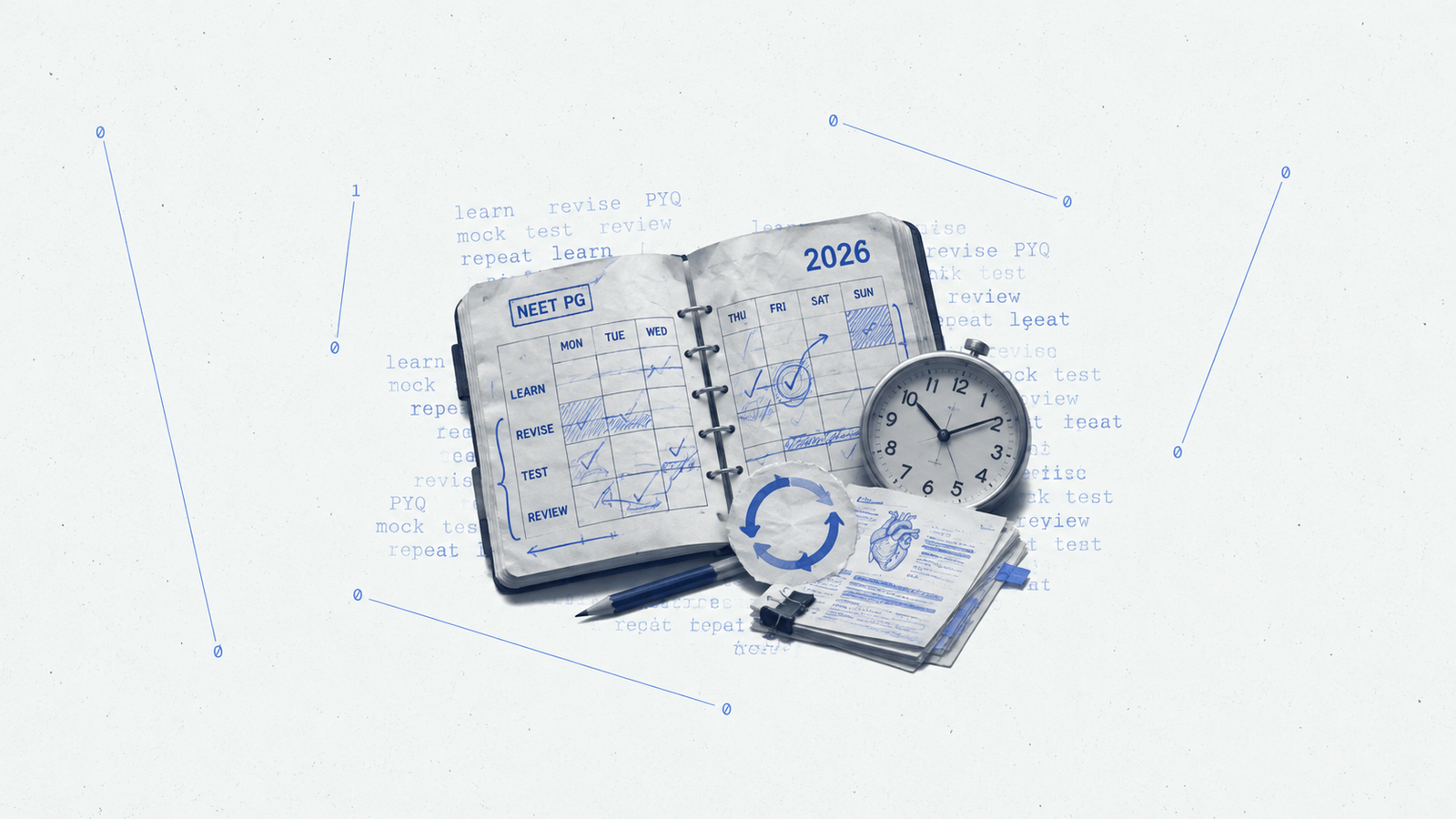
A clear NEET PG study plan is the difference between preparation that compounds and preparation that drifts. The syllabus spans nineteen subjects, the exam rewards application over recall, and the aspirants who succeed are rarely the ones who studied the most hours — they are the ones who studied to a plan. This guide lays out a complete NEET PG preparation strategy for 2026: how to start, how to structure your months, how to revise, and how to handle the final stretch, whether you are beginning from scratch or returning for another attempt.
You do not need a complicated system. You need a simple one you can actually follow, day after day, until the exam. That is what this study plan is built to give you.
How to start your NEET PG preparation
The hardest part of any NEET PG preparation strategy is the beginning, because the syllabus feels vast and it is unclear where to place the first hour. Start here.
Understand the exam before you study for it. Before opening a single book, know the NEET PG exam pattern — the number of questions, the marking scheme, and how marks translate to rank. You cannot build a study plan for a target you have not defined. Knowing the pattern tells you where the marks are and how to weight your time.
Fix your resources and stop hunting. Choose one review book per subject and one question bank, and commit to them. The single most common mistake beginners make is collecting materials instead of using them. Once your book list is set, the hunting stops and the studying starts.
Start with a high-yield foundational subject. Do not begin with a scattered clinical subject. Begin with Pathology or Pharmacology — they carry heavy exam weight and make every clinical subject easier later. Starting with a subject you can master builds momentum; starting with a hard one stalls it.
Study, then test — from day one. This is the habit that separates a good study plan from a mediocre one. After you read a topic, immediately practise questions on it. Reading builds recognition; solving builds recall. Do not save questions for the end of your preparation — that is the most expensive mistake in NEET PG prep.
The core of a NEET PG study plan: read, note, practise, revise
Every effective NEET PG preparation strategy, no matter whose it is, reduces to the same four-step loop applied to every subject:
- Read one subject from a single review book, for concepts rather than memorisation.
- Note each topic down to a few revisable lines as you go.
- Practise MCQs on that topic immediately, while it is fresh.
- Revise the subject three to four times before the exam, from your notes.
That is the entire method. Everything below is just how to schedule it across the months you have.
A subject-wise preparation strategy
Not every subject deserves equal time. A smart NEET PG study plan weights your hours by how many marks a subject returns.
High-yield, read deeply: Pathology and Pharmacology are the backbone of NEET PG. Pathology links to almost every clinical subject; Pharmacology is highly repetitive across years, so questions reward practice enormously. Give these your best hours and your earliest slots.
Scoring, efficient returns: Microbiology, Biochemistry, and Physiology are scoring subjects where a good review book plus consistent MCQ practice gives strong marks for relatively little time. Do not over-read here — invest in questions.
Large clinical subjects: Medicine and Surgery are big and high-yield. Use one comprehensive review book each and lean heavily on previous-year questions to learn how the exam frames clinical scenarios.
The short subjects: Ophthalmology, ENT, Dermatology, Psychiatry, Radiology, Anaesthesia, Orthopedics, and Forensic Medicine individually carry fewer marks but together add up to a significant share. Handle them efficiently with concise books and targeted practice — never skip them, but never over-invest.
A month-by-month NEET PG study schedule
Adapt this to the months you have before your attempt. The structure matters more than the exact dates.
The foundation phase (first block). Cover the high-yield and pre-clinical subjects first — Pathology, Pharmacology, Physiology, Biochemistry, Microbiology, Anatomy. Read, note, and practise each as you go. This phase builds the base everything else rests on.
The clinical phase (middle block). Move into Medicine, Surgery, Obstetrics and Gynaecology, and Pediatrics, then the short subjects. Keep practising questions on the earlier subjects so they do not fade — spaced practice is what makes them stick.
The revision phase (final block). Stop new reading and shift almost entirely to revision and questions. Revise each subject from your notes, take full-length mock tests under timed conditions, and analyse every mock to find your weak areas. This is where marks are won.
Two principles hold across all three phases: revise as you go (do not leave all revision to the end), and never stop practising questions (they are the bridge between knowing and scoring).
How to use mock tests in your study plan
Mock tests are not a final-week formality — they are a core part of a NEET PG preparation strategy. Once you are a few subjects in, begin taking full-length timed mocks regularly. Each mock does three things: it builds exam stamina, it trains your time management across a long paper, and it reveals exactly which topics you are weak in. The score matters less than the analysis. After every mock, review each wrong answer, identify the concept behind it, and go back to that topic. A mock you do not analyse is a mock half-wasted.
The final stretch: rapid revision and last-minute preparation
In the last few weeks, your NEET PG study plan changes shape. This is the rapid-revision phase, and the rules are different from the months before. Our guide to using the last stretch well goes deeper, but the essentials are these.
- No new topics. Late in preparation, starting something new costs confidence more than it adds marks. Consolidate what you know.
- Revise from your notes, not full books. This is why you built short notes all along — so the final revision is fast.
- Practise, practise, practise. Shift almost entirely to questions and full-length mocks. Your job now is to convert knowledge into exam-ready recall.
- Do a focused last-minute revision of high-yield points — the tables, values, and one-liners that recur across years.
- Protect your sleep and your calm in the final week. A rested mind recalls better than an exhausted one that crammed one more chapter.
A good rapid-revision plan is not frantic — it is the calm, confident consolidation of work you have already done. If you followed the loop all along, the last stretch is revision, not rescue.
A NEET PG study plan for repeaters
If this is not your first attempt, your study plan should look different. Do not simply re-read everything from the start. Instead, use your previous mock and exam performance to identify your weakest subjects and topics, and weight your time toward them. Repeaters usually do not need more reading — they need sharper, more honest practice and targeted revision of the areas that cost them marks last time. Analyse where you lost marks, and build your plan around fixing exactly that.
Final word
A NEET PG study plan does not need to be elaborate — it needs to be followed. Understand the pattern, fix your resources, start with high-yield subjects, and run the read-note-practise-revise loop through every subject. Take mocks, analyse them honestly, and let the final weeks be calm consolidation rather than frantic cramming. Preparation that follows a simple plan consistently will always beat scattered effort, however intense.
The fastest way to turn your study plan into marks is to test yourself as you go. Practise free NEET PG questions with explanations, organised by subject and difficulty, on our practice question bank — read a subject, then prove you know it.
Practise this on Reflex
Turn what you just read into recall with 14 years of tagged PYQs.
FAQ
Frequently asked questions
The questions aspirants ask most about this topic.
Start by understanding the exam pattern, fixing one review book per subject, and beginning with a high-yield foundational subject like Pathology or Pharmacology. Then follow a simple loop: read a topic, note it down, and practise questions on it immediately.
The best NEET PG study plan is a simple, repeatable one: cover high-yield and pre-clinical subjects first, then clinical subjects, then a final revision phase of notes and mock tests. Revise each subject three to four times and practise questions throughout rather than only at the end.
Consistency matters more than raw hours. A steady, focused daily routine you can sustain for months beats occasional long days followed by burnout. Quality of focus and regular question practice matter more than the hour count.
Begin with a high-yield foundational subject — Pathology or Pharmacology. They carry heavy exam weight and make the clinical subjects easier to understand later.
Begin full-length timed mocks once you are a few subjects in, and take them regularly through the rest of your preparation. Analysing each mock to find weak topics is more valuable than the score itself.
In the final weeks, stop new topics, revise from your notes rather than full books, do focused rapid revision of high-yield points, and shift almost entirely to questions and mock tests. Protect your sleep in the final week.
A disciplined self-study plan with a good book per subject and consistent question practice can be enough. What matters is following a structured plan and testing yourself regularly, whichever route you choose.
About the author
Stay ahead in your preparation
Get expert tips, exam updates, and high-yield insights delivered straight to your inbox.
No spam. Unsubscribe anytime.
More in Exam Guide
View all → Exam Guide
INI-CET November 2026: How to Use Your Last 30 Days, Week by Week
 Exam Guide
NEET PG 2026 Result Declared: Cutoff 262/720 & Scorecard
 Exam Guide
INI-CET Registration for January 2027: The Two-Stage Process, Documents, and Mistakes to Avoid
 Exam Guide