Spore-Forming Bacteria for NEET PG: Bacillus, Clostridium, and Sterilization
By Dr. Utsav Bhattacherjee, MBBS, MBA · 23 Jul 2026 · 2 min read
Last updated: 23 Sept 2026
On this page
Spore-forming bacteria matter in NEET PG for two reasons at once — the organisms themselves are classic exam material, and the fact that they form spores at all is the reason certain sterilization protocols exist in the first place.
The Two Genera That Matter
All medically important spore-forming bacteria are gram-positive rods, split by their oxygen requirement:
| Genus | Oxygen requirement | Key species |
|---|---|---|
| Bacillus | Aerobic | B. anthracis, B. cereus |
| Clostridium | Anaerobic | C. tetani, C. botulinum, C. perfringens, C. difficile |
Spore Position Is a Real Identification Clue
Spore position within the bacterial cell is a genuine microscopy clue, not just trivia:
- C. tetani: terminal spore, giving the classic "drumstick" appearance.
- C. botulinum: subterminal spore, giving a "tennis racquet" appearance.
- B. anthracis: central spore, without bulging the cell — a useful contrast to the other two.
Why This Matters for Sterilization
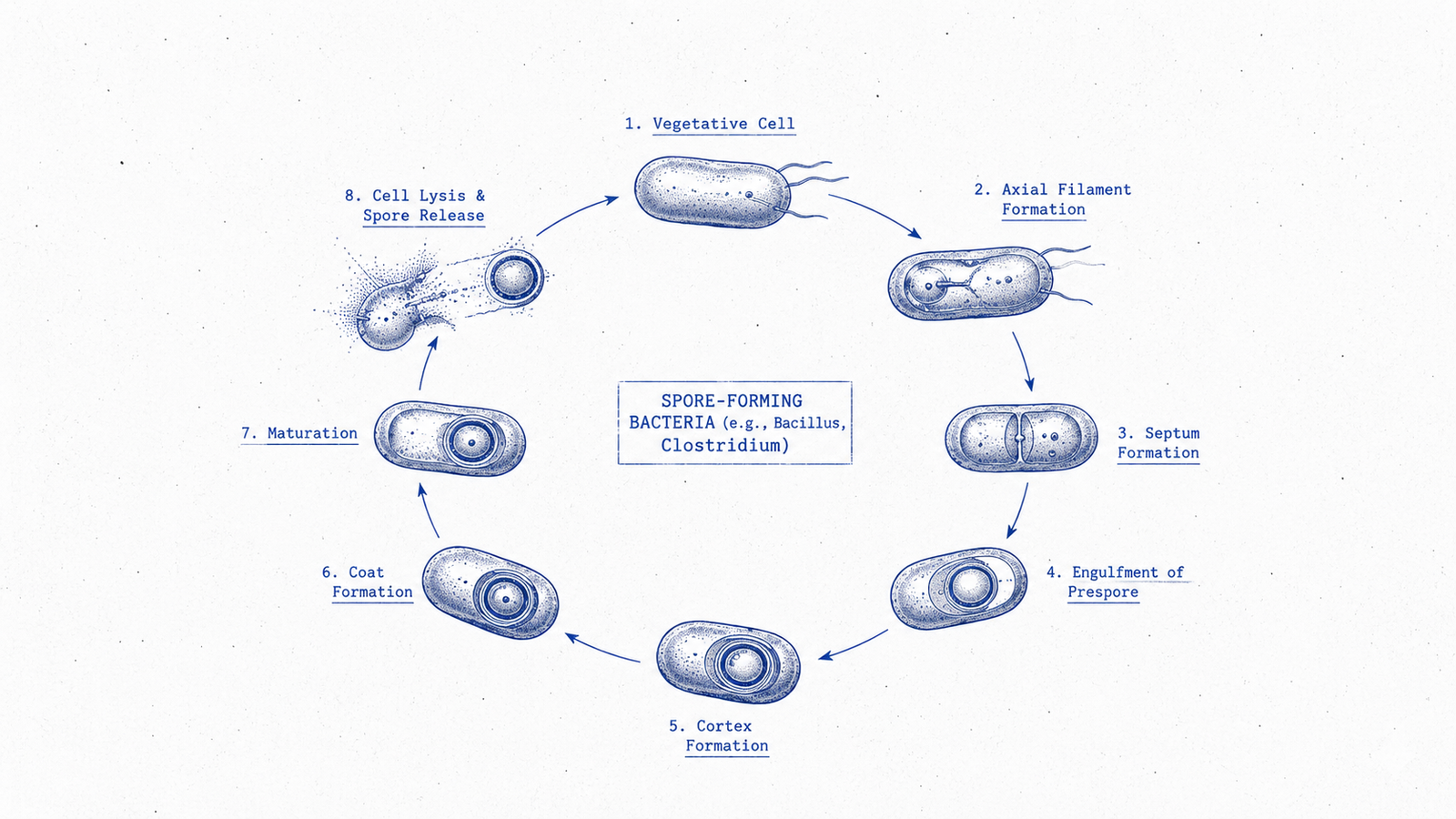
Bacterial spores are dramatically more resistant to heat, drying, and disinfectants than the vegetative (active) form of the bacteria. This single fact is why boiling alone doesn’t guarantee sterility — it kills vegetative organisms but not necessarily spores — and why autoclaving (steam under pressure, typically 121°C) is the standard for true sterilization in clinical and lab settings.
Clinical Correlations Per Organism
- C. tetani: spores commonly found in soil, and classically introduced through deep puncture wounds (rusty nails are the textbook example, though it’s the soil contamination that matters, not the rust itself) — the organism produces tetanospasmin, a neurotoxin causing muscle rigidity and spasm.
- C. botulinum: associated with improperly canned or preserved food; produces botulinum toxin, which causes flaccid paralysis by blocking acetylcholine release at the neuromuscular junction.
- C. perfringens: classically associated with gas gangrene (clostridial myonecrosis) and food poisoning.
- C. difficile: associated with antibiotic use, particularly clindamycin and fluoroquinolones, causing pseudomembranous colitis.
- B. anthracis: causes anthrax, with cutaneous, inhalational, and gastrointestinal forms — inhalational anthrax carries the highest mortality.
Organism-to-disease matching like this is exactly the kind of high-speed recall Reflex’s daily TROCAR Microbiology rounds are built to sharpen.
Practise this on Reflex
Turn what you just read into recall with 14 years of tagged PYQs.
FAQ
Frequently asked questions
The questions aspirants ask most about this topic.
The two medically important genera are Bacillus (aerobic — B. anthracis, B. cereus) and Clostridium (anaerobic — C. tetani, C. botulinum, C. perfringens, C. difficile).
Spores are far more resistant to heat and disinfectants than active bacteria, which is why autoclaving (not just boiling) is required for true sterilization.
A terminal spore, as seen in C. tetani, gives the bacterium a "drumstick" appearance under the microscope.
Botulinum toxin, which blocks acetylcholine release at the neuromuscular junction, causing flaccid paralysis.
About the author
Stay ahead in your preparation
Get expert tips, exam updates, and high-yield insights delivered straight to your inbox.
No spam. Unsubscribe anytime.
More in Subject Notes
View all → Microbiology
Malaria Life Cycle for NEET PG: Species, Smear Morphology, Complications and Treatment
How the malaria parasite moves between mosquito and human, what separates the species on a smear, and how diagnosis, complications and treatment follow from the life cycle.
 Microbiology
Gram Staining for NEET PG: What the Color Actually Tells You About the Cell Wall
 Physiology
Oxygen-Hemoglobin Dissociation Curve for NEET PG: Every Shift Explained
Why the oxygen-hemoglobin dissociation curve is sigmoid, what moves it right or left, and how to apply each shift to fetal hemoglobin, stored blood, altitude and carbon monoxide poisoning.
 Pharmacology
Cholinergic Drugs for NEET PG: Classification, Receptors and Organophosphate Poisoning
A working classification of cholinergic drugs, the receptors behind each effect, which drug fits which clinical scenario, and how to answer organophosphate poisoning questions.