Antihypertensive Drugs for NEET PG: Classification and Drug-of-Choice Questions
By Dr. Utsav Bhattacherjee, MBBS, MBA · 17 Jun 2026 · 2 min read
Last updated: 23 Sept 2026
On this page
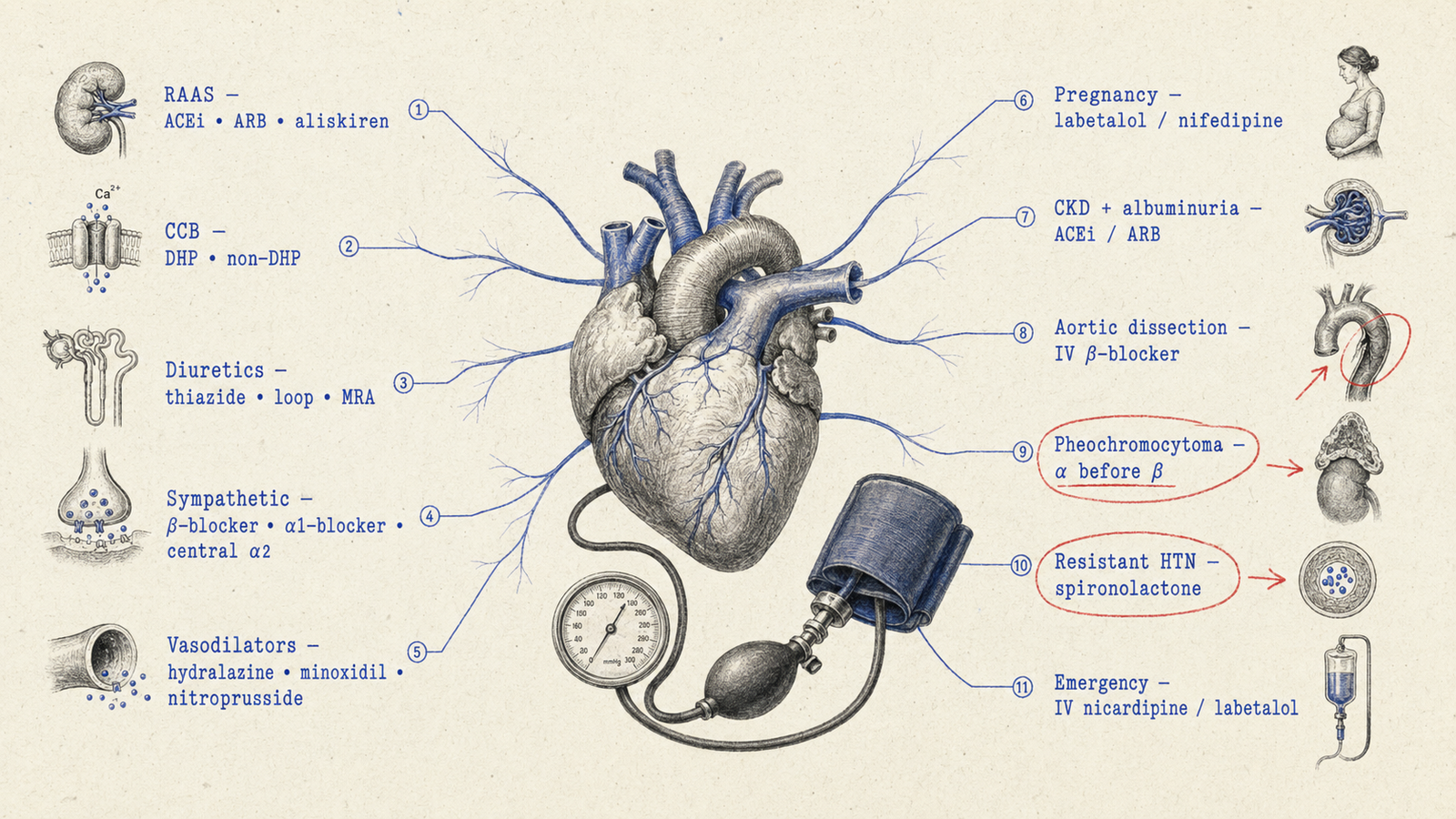
Antihypertensive questions in NEET PG rarely ask you to just list a drug class — they hand you a clinical scenario (pregnancy, post-MI, a diabetic with proteinuria) and ask which class is the right call. The classification is the easy part; matching class to scenario is where marks are actually won or lost.
Classification at a Glance
| Class | Examples |
|---|---|
| Thiazide diuretics | Hydrochlorothiazide |
| Loop diuretics | Furosemide |
| Potassium-sparing diuretics | Spironolactone |
| ACE inhibitors | Enalapril, Ramipril, Captopril |
| ARBs | Losartan, Telmisartan |
| Calcium channel blockers (dihydropyridine) | Amlodipine, Nifedipine |
| Calcium channel blockers (non-dihydropyridine) | Verapamil, Diltiazem |
| Beta blockers (cardioselective) | Atenolol, Metoprolol |
| Beta blockers (non-selective) | Propranolol |
| Combined alpha/beta blockers | Carvedilol, Labetalol |
| Centrally acting agents | Clonidine, Methyldopa |
| Direct vasodilators | Hydralazine, Minoxidil |
| Alpha blockers | Prazosin, Doxazosin |
Drug-of-Choice Scenarios Examiners Actually Ask
- Hypertension in pregnancy: Methyldopa is the classic drug of choice, alongside Labetalol and Nifedipine in many protocols. ACE inhibitors and ARBs are contraindicated in pregnancy due to fetotoxic effects, particularly in the second and third trimesters.
- Post-myocardial infarction: Beta blockers are first-line, both for their anti-ischemic effect and their mortality benefit.
- Diabetic with proteinuria: ACE inhibitors or ARBs are preferred for their renoprotective effect, independent of their blood-pressure-lowering action.
- Hypertensive emergency: Fast-acting IV agents (such as sodium nitroprusside or labetalol) are used, distinct from the oral agents used for chronic management.
Side Effects Worth Knowing Cold
- ACE inhibitors: dry cough (from bradykinin accumulation), hyperkalemia, angioedema.
- ARBs: similar to ACE inhibitors but without the cough, since they don’t affect bradykinin metabolism the same way.
- Non-dihydropyridine CCBs (Verapamil, Diltiazem): avoid combining with beta blockers — the combination risks severe bradycardia and heart block, since both depress AV conduction.
- Thiazides: hypokalemia, hyperglycemia, hyperuricemia (can precipitate gout).
Drug-of-choice questions are exactly the kind of applied pharmacology Reflex’s daily TROCAR quiz drills, subject by subject.
Practise this on Reflex
Turn what you just read into recall with 14 years of tagged PYQs.
FAQ
Frequently asked questions
The questions aspirants ask most about this topic.
Methyldopa is the classic first choice, with Labetalol and Nifedipine also commonly used. ACE inhibitors and ARBs are contraindicated.
Because they inhibit the breakdown of bradykinin, which accumulates and triggers cough — a mechanism ARBs don’t share.
Beta blockers, for both symptom control and mortality benefit.
It’s generally avoided — both slow AV conduction, and the combination risks significant bradycardia or heart block.
About the author
Stay ahead in your preparation
Get expert tips, exam updates, and high-yield insights delivered straight to your inbox.
No spam. Unsubscribe anytime.
More in Subject Notes
View all → Pharmacology
Cholinergic Drugs for NEET PG: Classification, Receptors and Organophosphate Poisoning
A working classification of cholinergic drugs, the receptors behind each effect, which drug fits which clinical scenario, and how to answer organophosphate poisoning questions.
 Pharmacology
NEET PG/INICET Preparation Tips to Score High in Pharmacology
Pharmacology is vast, and not every topic carries equal weightage. Knowing what to prioritize is the first step.
 Microbiology
Malaria Life Cycle for NEET PG: Species, Smear Morphology, Complications and Treatment
How the malaria parasite moves between mosquito and human, what separates the species on a smear, and how diagnosis, complications and treatment follow from the life cycle.
 Physiology
Oxygen-Hemoglobin Dissociation Curve for NEET PG: Every Shift Explained
Why the oxygen-hemoglobin dissociation curve is sigmoid, what moves it right or left, and how to apply each shift to fetal hemoglobin, stored blood, altitude and carbon monoxide poisoning.