Antitubercular Drugs for NEET PG: Mechanisms, Side Effects and a Memory Aid
Reflex · 29 Oct 2026 · 11 min read
Last updated: 29 Oct 2026
On this page
Antitubercular drugs look like a simple list of four names, but each one has its own mechanism, signature toxicity and interactions. The way to hold it together is to learn each drug on three axes, which are what it blocks, what it harms and what you check before and during treatment.
This guide covers the first line antitubercular drugs (isoniazid, rifampicin, pyrazinamide and ethambutol), with streptomycin as a short add-on. It gives a drug-by-drug adverse effect table, a mechanism mnemonic, a monitoring table and the Indian programme regimen with its doses and weight bands.
Key Takeaways
First line ATT means isoniazid (H), rifampicin (R), pyrazinamide (Z) and ethambutol (E), often remembered as RIPE or HRZE.
Isoniazid is a prodrug activated by mycobacterial KatG. Its headline toxicities are hepatitis and peripheral neuropathy from pyridoxine (B6) depletion.
Rifampicin inhibits bacterial DNA-dependent RNA polymerase. It turns body fluids red-orange and is the strongest CYP-450 inducer among the group.
Pyrazinamide causes hepatotoxicity and hyperuricaemia. Ethambutol's key toxicity is optic neuropathy, so baseline vision testing matters.
India's National TB Elimination Programme issues its own treatment guideline. The ICMR Standard Treatment Workflow for the NTEP (March 2022) gives 2HRZE/4HRE as a daily fixed-dose combination by weight band, not the WHO regimens.
For another pharmacology topic to revise, see the notes on antihypertensive drugs.
First Line Antitubercular Drugs at a Glance
The four first line antitubercular drugs are isoniazid, rifampicin, pyrazinamide and ethambutol. In the Cureus narrative review on treatment and toxicity considerations in tuberculosis, these four form the core of drug-susceptible TB treatment. Streptomycin, an aminoglycoside, is the injectable you will see alongside them in the MSD Manual's tuberculosis chapter.
The table below is the core of this post. Read across a row to get the mechanism, the headline adverse effects and one pearl to attach to the drug.
| Drug | Mechanism | Headline adverse effects | One-line pearl |
|---|---|---|---|
| Isoniazid (H) | Prodrug activated by mycobacterial KatG; active form inhibits mycolic acid synthesis | Hepatitis, peripheral neuropathy, rash, fever; CNS toxicity mostly in children | Neuropathy comes from pyridoxine (B6) depletion |
| Rifampicin (R) | Reversibly inhibits bacterial DNA-dependent RNA polymerase, blocking transcription | Red-orange body fluids, hepatotoxicity (less common than with isoniazid), rare cholestatic jaundice, fever, thrombocytopenia | Strongest CYP-450 inducer, so many drug interactions |
| Pyrazinamide (Z) | Converted to pyrazinoic acid inside the bacterium; thought to acidify the cell, exact mechanism poorly understood | Hepatotoxicity (dose-dependent), hyperuricaemia, arthralgia, photosensitivity, rash, GI upset | Active against non-replicating bacilli |
| Ethambutol (E) | Bacteriostatic; inhibits arabinogalactan synthesis in the cell wall | Optic neuropathy or neuritis, impaired colour discrimination | Can be irreversible, so test vision before starting |
| Streptomycin (S) | Aminoglycoside | Ototoxicity, renal tubular damage, rash, fever, agranulocytosis, serum sickness | Contraindicated in pregnancy |
Isoniazid: Mechanism and Side Effects
Isoniazid is a prodrug. The mycobacterial enzyme KatG activates it, and the active form inhibits mycolic acid synthesis, which stops the bacterium building its cell wall, as described in the Cureus review.
The two toxicities to know well are hepatitis and peripheral neuropathy.
Isoniazid hepatotoxicity
Hepatotoxicity is more likely in slow NAT2 acetylators, according to the same review. The MSD Manual adds the clinical risk groups: patients over 35, those with alcohol use disorder or chronic liver disease, and postpartum patients.
The MSD Manual also gives a sense of scale. An asymptomatic rise in aminotransferases occurs in up to 20% of patients on isoniazid, while clinical hepatitis occurs in about 1 in 1000. So a mild enzyme rise is common, and true hepatitis is not.
Isoniazid neuropathy and pyridoxine
Isoniazid causes peripheral neuropathy by depleting pyridoxine (vitamin B6). The Cureus review, the Infection and Drug Resistance review on common adverse reactions of first-line anti-tuberculosis drugs and the MSD Manual all agree on this mechanism.
Pyridoxine is therefore the supplement paired with isoniazid. The MSD Manual says higher-risk groups include pregnant or breastfeeding patients and people with undernutrition, diabetes, HIV, alcohol use disorder, cancer, uraemia or advanced age. It is usually not needed in children and healthy young adults.
Other isoniazid effects worth a line
Isoniazid can also cause rash and fever. Psychosis or other CNS toxicity is reported mostly in children, and seizures can occur at high doses. The Cureus review notes that isoniazid has MAO-inhibiting activity, and the MSD Manual lists interactions with phenytoin and disulfiram.
Rifampicin: Mechanism, Orange Fluids and Enzyme Induction
Rifampicin reversibly inhibits bacterial DNA-dependent RNA polymerase, which blocks transcription.
Its most recognisable adverse effect is the red-orange colour of body fluids.
Rifampicin as a CYP-450 inducer
Rifampicin is the strongest CYP-450 inducer among the first line drugs. The Cureus review lists interactions with HIV protease inhibitors, azole antifungals, tacrolimus and cyclosporine, and notes reduced reliability of hormonal contraceptives. The MSD Manual names CYP3A4 induction and points to anticoagulants, oral contraceptives and methadone.
The practical rule is simple. If a patient on rifampicin takes another drug, ask whether induction will lower that drug's level.
Try it on one example. A patient on rifampicin also takes an oral contraceptive: what should you ask? Ask whether rifampicin's enzyme induction will lower the contraceptive's effect. Both the Cureus review and the MSD Manual flag this pairing, and the Cureus review notes reduced reliability of hormonal contraceptives.
Rifampicin toxicity
Hepatotoxicity occurs with rifampicin but is less common than with isoniazid, per the MSD Manual. Rarer effects include cholestatic jaundice, fever, thrombocytopenia and renal failure. The Infection and Drug Resistance review also reports neutropenia.
Pyrazinamide and Ethambutol: Toxicities to Separate
Pyrazinamide and ethambutol each have a distinct signature. Pyrazinamide is the metabolic and hepatic drug, while ethambutol is the eye drug.
Pyrazinamide: hyperuricaemia and hepatitis
Pyrazinamide is converted to pyrazinoic acid inside the bacterium, and it is thought to acidify the cell, though its exact mechanism is poorly understood. It is active against non-replicating bacilli.
Its toxicities are dose-dependent hepatotoxicity and hyperuricaemia. The Cureus review says hyperuricaemia can precipitate gout, while the MSD Manual describes it as common, usually mild and rarely causing gout. Both are worth remembering because they differ in emphasis. Arthralgia, photosensitivity, rash and GI upset also occur, and the Cureus review states that pyrazinamide is contraindicated in pre-existing liver or kidney injury.
The MSD Manual explains why the drug is kept in the regimen: including pyrazinamide in the first 2 months allows a 6-month total course and helps prevent rifampicin resistance.
Ethambutol: optic neuropathy
Ethambutol is bacteriostatic and inhibits arabinogalactan synthesis in the cell wall. The Cureus review notes that only the D isomer is used.
Its key toxicity is optic neuropathy or neuritis. The risk depends on dose and duration, and the damage can be irreversible. Risk is higher with reduced renal function. Pyrazinamide is also contraindicated in pre-existing kidney injury, which makes renal status relevant to two of the four first line drugs. Colour discrimination becomes impaired, and the sources disagree on which colour pair is affected, so learn it as impaired colour discrimination and test it at baseline.
Streptomycin: The Add-On Injectable
Streptomycin is an aminoglycoside, and the MSD Manual describes it alongside the four first line drugs. Its toxicities follow the aminoglycoside pattern: ototoxicity and renal tubular damage.
Other reported effects are rash, fever, agranulocytosis and serum sickness. The MSD Manual lists pregnancy as a contraindication. Monitoring follows the toxicity, with hearing, balance and creatinine checked during use.
Antitubercular Drugs Mnemonic: A Memory Aid
The mnemonic below compresses mechanism and toxicity into short phrases you can recall under time pressure. Check each phrase against the tables in this post.
For the drug names, use RIPE (rifampicin, isoniazid, pyrazinamide, ethambutol) or HRZE, the order used in regimen labels.
| Drug | Mechanism phrase | Toxicity phrase |
|---|---|---|
| Isoniazid | "I stop the wall" (mycolic acid) | Neuropathy and hepatitis |
| Rifampicin | "R stops the RNA" | Orange fluids and enzyme induction |
| Pyrazinamide | "Z acidifies" | Hyperuricaemia and hepatitis |
| Ethambutol | "E blocks arabinogalactan" | Optic neuritis |
| Streptomycin | Aminoglycoside | "S: ear and kidney" (ototoxicity and nephrotoxicity) |
Two overlaps need care. Isoniazid, rifampicin and pyrazinamide can all injure the liver, so hepatitis alone does not identify the drug. Use the second feature: neuropathy points to isoniazid, orange fluids to rifampicin, hyperuricaemia to pyrazinamide and the eye to ethambutol.
For another drug group revised the same way, see the notes on cholinergic drugs.
Monitoring Antitubercular Drugs
Monitoring follows the toxicity profile. The MSD Manual recommends baseline visual acuity and colour vision testing for ethambutol, which the Cureus review also advises. For streptomycin, it advises watching hearing and balance and checking creatinine.
For the liver, the MSD Manual does not recommend routine serial liver tests unless risk factors are present. Testing is symptom-led for most patients. The table below collects the points.
| Drug | What to monitor | Why |
|---|---|---|
| Ethambutol | Baseline visual acuity and colour vision | Optic neuropathy can be irreversible |
| Streptomycin | Hearing, balance and creatinine | Ototoxicity and renal tubular damage |
| Isoniazid, rifampicin, pyrazinamide | Symptoms, with liver tests when indicated | Hepatotoxicity; routine serial tests not advised without risk factors |
Managing drug-induced hepatotoxicity
The MSD Manual gives general guidance, not national programme rules. Stop isoniazid for symptoms with any significant rise in liver tests, or for an asymptomatic rise above 5 times normal.
If hepatotoxicity develops while the patient is on a combination, stop all the drugs and then rechallenge each separately. This lets you identify which drug is responsible.
Antitubercular Drugs Regimen in India
Under India's National TB Elimination Programme (NTEP), treatment of TB (except confirmed drug-resistant TB) is a daily fixed-dose combination (FDC) of first line drugs in weight bands, given under direct observation. The regimen is 2HRZE/4HRE, meant for isoniazid- and rifampicin-sensitive cases and for cases where the sensitivity pattern cannot be established. The details below come from the ICMR/DHR Standard Treatment Workflow for the NTEP, which is dated March 2022 and covers adults with drug-sensitive TB.
| Phase | Drugs | Duration |
|---|---|---|
| Intensive phase | H, R, Z, E | 8 weeks (56 doses) |
| Continuation phase | H, R, E | 16 weeks (112 doses) |
Only pyrazinamide stops in the continuation phase. The workflow extends the continuation phase up to 24 weeks in some forms, such as CNS and skeletal TB.
| Drug | Adult daily dose (range) |
|---|---|
| Isoniazid (H) | 5 mg/kg (4 to 6) |
| Rifampicin (R) | 10 mg/kg (8 to 12) |
| Pyrazinamide (Z) | 25 mg/kg (20 to 30) |
| Ethambutol (E) | 15 mg/kg (12 to 18) |
The 4-FDC tablet used in the intensive phase contains H 75 mg, R 150 mg, Z 400 mg and E 275 mg. The 3-FDC tablet used in the continuation phase contains H 75 mg, R 150 mg and E 275 mg.
| Weight band | Tablets per day (intensive and continuation phase) |
|---|---|
| 25 to 34 kg | 2 |
| 35 to 49 kg | 3 |
| 50 to 64 kg | 4 |
| 65 to 75 kg | 5 |
| Over 75 kg | 6 |
If the patient's weight rises by more than 5 kg and crosses into the next band during treatment, the next higher weight-band FDC is given. The workflow lists pyridoxine at 10 mg per day. For comparison, the WHO recommendation for the 6-month drug-susceptible regimen is rifampicin-containing, with a 2-month intensive phase and a 4-month continuation phase. WHO Module 4 (2025) also covers 4-month regimens. These are WHO recommendations and should not be read as the Indian programme's policy.
Common Mix-Ups in Antitubercular Drugs
Three confusions come up repeatedly when revising this topic.
- Mechanism versus toxicity. Rifampicin inhibits RNA polymerase, but its enzyme induction is a separate property. Keep "what it blocks in the bacterium" apart from "what it does to the patient's liver enzymes".
- Neuropathy versus neuritis. Isoniazid causes peripheral neuropathy through pyridoxine depletion. Ethambutol causes optic neuropathy or neuritis. Similar words, different drugs.
- Hyperuricaemia versus gout. Pyrazinamide commonly raises uric acid, but the MSD Manual notes that this is usually mild and rarely causes gout.
Test yourself on these with antimicrobials practice questions for pharmacology, and revise each drug against the tables above.
Conclusion
Antitubercular drugs reward a structured approach. For each of isoniazid, rifampicin, pyrazinamide and ethambutol, pin down the bacterial target, the signature toxicity and the monitoring step, then use the mnemonic only as a prompt to recall them. Keep the sources apart as well: the Indian programme's regimen (2HRZE/4HRE, daily FDC by weight band) comes from the NTEP workflow, while WHO regimens are a separate set of recommendations.
The next step is to attempt questions on the topic and check each wrong answer against the drug-by-drug table. Active recall shows exactly which rows of the table need another pass.
Practise this on Reflex
Turn what you just read into recall with 14 years of tagged PYQs.
FAQ
Frequently asked questions
The questions aspirants ask most about this topic.
The first line antitubercular drugs are isoniazid, rifampicin, pyrazinamide and ethambutol, often remembered as RIPE or HRZE. Streptomycin, an aminoglycoside, is described alongside them in the MSD Manual.
Isoniazid can cause hepatitis and peripheral neuropathy. The neuropathy results from pyridoxine (vitamin B6) depletion. Rash, fever and CNS toxicity (mostly in children) can also occur, and hepatotoxicity is more likely in slow NAT2 acetylators.
Rifampicin colours body fluids red-orange. Urine is one of the body fluids affected.
Ethambutol. Its key toxicity is optic neuropathy or neuritis, which depends on dose and duration and can be irreversible. Baseline visual acuity and colour vision testing is advised.
According to the MSD Manual, including pyrazinamide in the first 2 months allows a 6-month total course and helps prevent rifampicin resistance.
Stay ahead in your preparation
Get expert tips, exam updates, and high-yield insights delivered straight to your inbox.
No spam. Unsubscribe anytime.
More in Subject Notes
View all → Pharmacology
Cholinergic Drugs for NEET PG: Classification, Receptors and Organophosphate Poisoning
A working classification of cholinergic drugs, the receptors behind each effect, which drug fits which clinical scenario, and how to answer organophosphate poisoning questions.
 Pharmacology
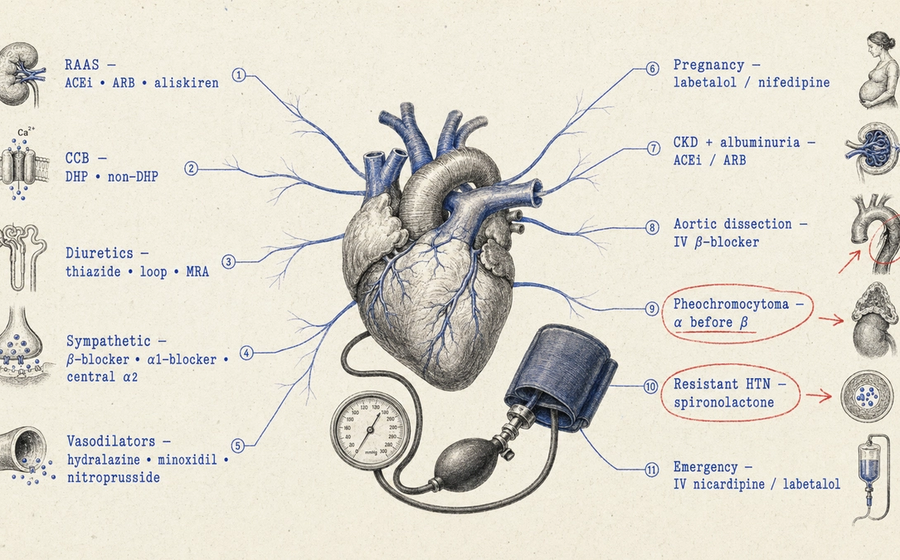
Antihypertensive Drugs for NEET PG: Classification and Drug-of-Choice Questions
Every drug class, plus the drug-of-choice scenarios examiners ask: pregnancy, post-MI, hypertensive emergency.
 Pharmacology
NEET PG/INICET Preparation Tips to Score High in Pharmacology
Pharmacology is vast, and not every topic carries equal weightage. Knowing what to prioritize is the first step.
 Pathology
Virchow's Triad for NEET PG: Three Components, Each With Clinical Examples
Virchow's triad lists the three factors that promote thrombosis: endothelial injury, abnormal blood flow and hypercoagulability. Learn each component with clinical examples and a worked renal cell carcinoma case.