APGAR Score for NEET PG: Components, Scoring, and What It Predicts
By Dr. Utsav Bhattacherjee, MBBS, MBA · 25 Jul 2026 · 2 min read
Last updated: 23 Sept 2026
On this page
APGAR score questions are usually straightforward on the surface — score a described newborn — but the real test is knowing which time point (1 minute or 5 minutes) actually matters for a given clinical claim.
What APGAR Stands For
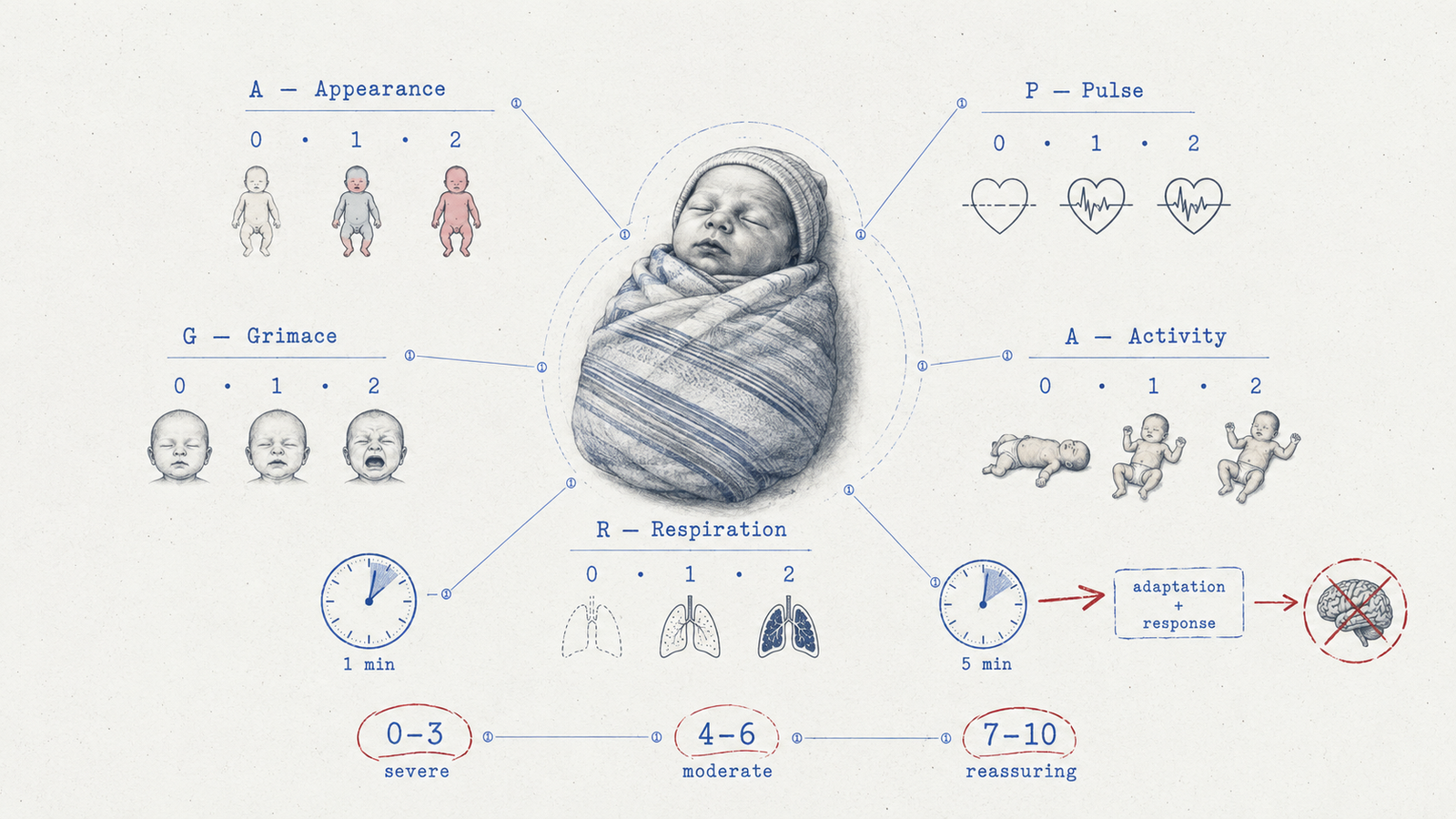
| Letter | Component | 0 points | 1 point | 2 points |
|---|---|---|---|---|
| A | Appearance (color) | Blue/pale all over | Body pink, extremities blue | Completely pink |
| P | Pulse (heart rate) | Absent | Below 100 bpm | Above 100 bpm |
| G | Grimace (reflex irritability) | No response | Grimace | Cry, cough, or sneeze |
| A | Activity (muscle tone) | Limp | Some flexion | Active motion |
| R | Respiration | Absent | Slow, irregular | Good, crying |
Each component scores 0, 1, or 2, for a maximum total of 10.
Scoring and Interpretation
| Total score | Interpretation |
|---|---|
| 7–10 | Normal |
| 4–6 | Moderately depressed — some resuscitative measures typically needed |
| 0–3 | Severely depressed — immediate resuscitation required |
Why Two Time Points, and Why They Mean Different Things
The score is taken at 1 minute and again at 5 minutes after birth, and the two serve different purposes:
- The 1-minute score reflects how well the baby tolerated labor and delivery, and flags the immediate need for resuscitation.
- The 5-minute score is the more meaningful predictor of neurological outcome, since it reflects how the baby has responded to any resuscitative efforts already given.
A low 1-minute score followed by a normal 5-minute score generally indicates the resuscitation worked and the outlook is good — this distinction is exactly what a well-built exam question will test.
A Common Misconception Worth Correcting
A low APGAR score does not, by itself, diagnose birth asphyxia or predict long-term neurological damage — it’s a snapshot of immediate transitional status, not a definitive prognostic tool on its own. Persistently low scores at 10, 15, or 20 minutes carry more prognostic weight than an isolated low 1-minute score.
Scoring-and-interpreting questions like this are a staple of Reflex’s daily TROCAR Obstetrics & Gynaecology rounds.
Practise this on Reflex
Turn what you just read into recall with 14 years of tagged PYQs.
FAQ
Frequently asked questions
The questions aspirants ask most about this topic.
Appearance, Pulse, Grimace, Activity, and Respiration.
A total score of 7 to 10 at either time point is considered normal.
Not by itself — a single low score, especially at 1 minute, reflects immediate transitional status rather than a definitive long-term outcome. Persistently low scores over a longer period carry more prognostic significance.
The 5-minute score is considered the better predictor, since it reflects the baby’s response after any immediate resuscitation.
About the author
Stay ahead in your preparation
Get expert tips, exam updates, and high-yield insights delivered straight to your inbox.
No spam. Unsubscribe anytime.
More in Obstetrics & Gynaecology
View all → Obstetrics & Gynaecology
Bishop Score for NEET PG: The Five Components, the Favourable Cervix and What the Score Decides
The Bishop score rates the cervix on five features to predict whether induction of labour will work. Learn the point table, the simplified version, the cut-offs and how the score steers cervical ripening.
 Obstetrics & Gynaecology
Placenta Previa vs Abruptio Placentae for NEET PG: The Painless vs Painful Bleeding Table
Placenta previa causes painless bleeding with a soft uterus. Abruptio placentae causes painful bleeding with a tender, hypertonic uterus. Here is the full NEET PG comparison.
 Obstetrics & Gynaecology
Partograph for NEET PG: What the Alert Line and Action Line Actually Mean
 Obstetrics & Gynaecology