Cold Chain for NEET PG: Levels, ILR and Deep Freezer, VVM and the Shake Test
Reflex · 17 Nov 2026 · 11 min read
Last updated: 17 Nov 2026
On this page
A vaccine that was stored badly can look normal in the vial and still fail to protect. The cold chain prevents this: it is a continuous, monitored, temperature-controlled path from vaccine manufacture to the moment of administration, with a target of +2 °C to +8 °C for most vaccines in the WHO Expanded Programme on Immunization (BMJ Medicine, 2026).
In India, the Universal Immunization Programme, one of the national health programmes, relies on more than 27,000 cold chain points, meaning facilities that hold cold chain equipment (Indian Journal of Community Medicine, 2026). This post covers the levels, the equipment (ILR and deep freezer), heat- and freeze-sensitive vaccines, the vaccine vial monitor (VVM), the shake test and the open vial policy.
The immunization schedule post covers which vaccine is given when. This one covers how the vials stay usable until they reach the child.
Key Takeaways
Most vaccines are held at +2 °C to +8 °C, and cumulative heat above +8 °C damages them.
Indian vaccine stores run from GMSDs through state, divisional and district stores to CHCs and PHCs, then outreach sessions. ILRs hold +2 °C to +8 °C, while deep freezers hold -15 °C to -25 °C.
Aluminium-adjuvanted vaccines (DTP, TT, DT, Td, hepatitis B, Hib) are freeze-sensitive. Live vaccines (OPV, measles, BCG, yellow fever) lose potency quickly with heat.
The VVM records cumulative heat only. Discard the vial once the inner square matches or is darker than the outer circle.
The shake test detects freeze damage by comparing a suspect vial with a frozen control after a 10-second shake.
Opened vials of listed liquid vaccines can be reused for up to 28 days if the conditions are met. Reconstituted BCG and measles are discarded after 4 hours.
Why the Cold Chain Has an Upper and a Lower Limit
Vaccines can be damaged at both ends of the range. Cumulative exposure above +8 °C damages them, and freeze-sensitive vaccines are damaged below 0 °C as well (Indian three-state study, 2020). A frozen vaccine can lose potency and may cause more local reactions, including sterile abscess (study of aluminium-adsorbed vaccines).
The lower levels are where the limits slip furthest. In the same three-state study, data loggers in 213 devices across Bihar, Gujarat and Kerala (2014-15) recorded +2 °C to +8 °C for 75.4% of the observation period at state and divisional stores and 56.7% at sub-district stores. Sub-zero exposure was 17.7% at sub-district stores against 8.5% at state and divisional stores, and routine manual temperature checks did not capture it.
Levels of the Cold Chain in India
Vaccines move down a series of stores, from the government medical supply depots (GMSDs) to outreach session sites. The three-state study cited above describes the equipment at each level.
| Level | Where vaccines are held |
|---|---|
| GMSD | Cold rooms, walk-in coolers (WICs) and walk-in freezers (WIFs) |
| State and divisional vaccine stores | Usually WICs, ILRs and WIFs |
| District vaccine store | ILRs |
| Sub-district store (CHC and PHC) | ILRs |
| Outreach session site | Vaccine carriers with ice packs |
Sources count the tiers differently: this study calls the structure a five-tier storage system, while a national review of effective vaccine management describes a four-tier supply system. Learn the sequence and the equipment at each step rather than a tier number.
Cold Chain Equipment: ILR, Deep Freezer, Cold Box and Vaccine Carrier
ILR stands for ice-lined refrigerator. The temperature ranges below come from the three-state study.
| Equipment | Temperature | Use |
|---|---|---|
| Cold room, WIC | +2 °C to +8 °C | Bulk vaccine storage at the upper levels |
| ILR | +2 °C to +8 °C | Vaccines at state, divisional, district and sub-district stores |
| WIF, deep freezer (DF) | -15 °C to -25 °C | Long-term freezer storage; ice packs are frozen in the DF |
| Cold box (various sizes) | Ice packs hold +2 °C to +8 °C | Transport between stores |
| Vaccine carrier | Ice packs hold +2 °C to +8 °C | Transport to outreach sessions |
OPV and rotavirus vaccine may be held at -20 °C at bulk stores, so freezers at the upper levels can hold vaccines. At urban health centres, the Surat audit criteria below keep the deep freezer for ice packs.
ILR and Deep Freezer Working Rules
An audit of 20 urban health centres in Surat (International Journal of Preventive Medicine, 2013) scored practice against Government of India handbook criteria. Those criteria give these working rules:
- The ILR holds only vaccines and diluents. The DF holds only ice packs, not vaccines or water bottles.
- Heat-sensitive OPV and measles go at the bottom of the ILR basket. BCG, DPT, DT and TT go in the upper part.
- Ice packs stand on edge in the DF in a criss-cross pattern with 1-2 mm gaps. They are conditioned in a dedicated space before use (Indore study, 2026).
- Defrost when the ice layer exceeds 5 mm, and record it.
- A DF temperature above -15 °C counts as a break in the cold chain.
- Each ILR and DF has its own voltage stabiliser, stays out of direct sunlight, and has its own thermometer and record book. Temperature is checked twice daily.
Memory cue: ILR = vaccines and diluents only; DF = ice packs only.
Thermometers, Loggers and eVIN
A thermometer gives only a snapshot and misses most violations between checks. WHO-recommended tools include electronic 30-day refrigerator loggers at the primary store, intermediate store and service level, plus an irreversible freeze indicator at all six points of the chain. In a cited study, loggers caught all violations while thermometers missed almost all (Expert Review of Vaccines, 2014).
The Electronic Vaccine Intelligence Network (eVIN) was developed in India with the UNDP. It combines a smartphone stock-tracking app with temperature loggers and cloud dashboards, and it was rolled out in phases. By 2021 all districts digitised stock and storage temperature, with more than 50,000 loggers installed (EVM comparison).
Heat-Sensitive and Freeze-Sensitive Vaccines in the Cold Chain
A review of quality tools along the cold chain sorts vaccines by their main weakness.
| Group | Main hazard | Examples |
|---|---|---|
| Aluminium-adjuvanted vaccines | Freezing, because aluminium salts may collapse | DTP, tetanus toxoid, DT, Td, hepatitis B, Hib |
| Live vaccines | Heat, because potency falls quickly at higher temperatures | OPV, measles, BCG, yellow fever |
Every vaccine is damaged by cumulative exposure above +8 °C, so the table shows the extra hazard to watch for, not the only one. The three-state study lists a wider set of freeze-sensitive vaccines: DPT, liquid pentavalent, TT, hepatitis A and B, HPV, meningitis C, PCV, cholera, influenza, Hib and IPV.
An original memory aid: alum means avoid ice; live means limit heat. It simplifies, but it sorts the examples in the table.
Vaccine Vial Monitor: The Heat Gauge of the Cold Chain
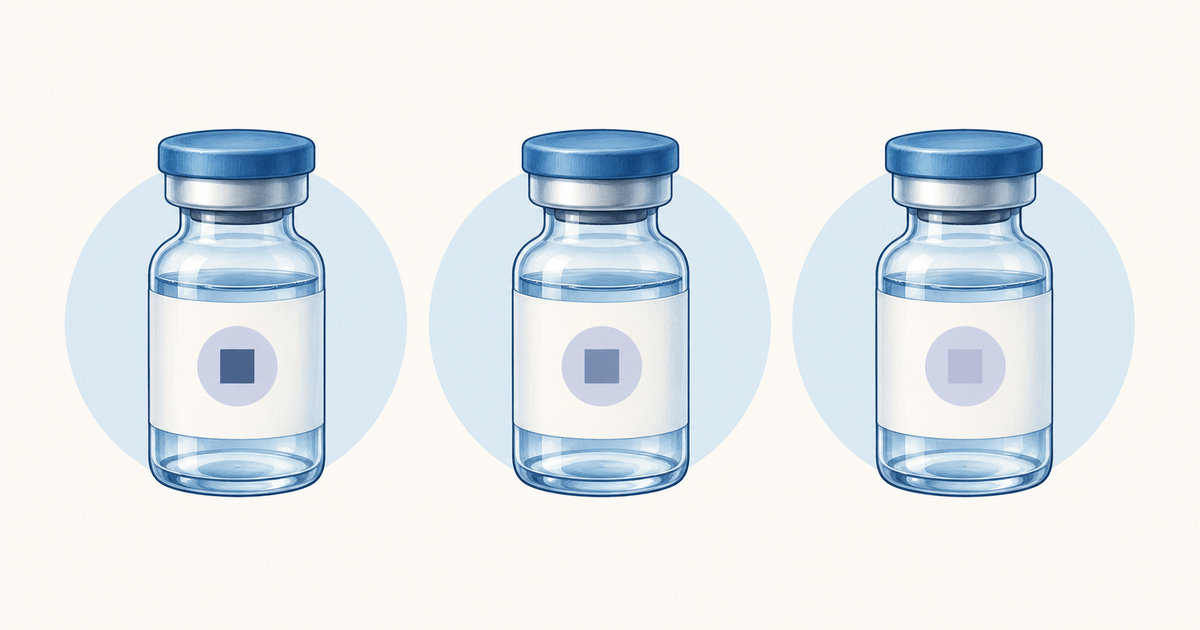
The VVM is a small heat-sensitive label on the vial cap, introduced in 1996. A light-coloured square sits inside a larger dark circle. With excess heat the square irreversibly darkens until it matches the circle to the naked eye, so staff can spot and discard heat-compromised vials (BMJ Medicine review).
The square-and-circle comparison is the discard rule, and readings are described in four stages. At stages 1 and 2 the square is still lighter than the circle and the vial can be used. At stage 3 the square matches the circle, which is the discard point, and at stage 4 it is darker than the circle. Discard the vial at either stage. A scoping review of vaccines used outside the cold chain refers to "VVM Stages 3 or 4 (discard point)".
The VVM measures cumulative heat exposure, which is duration multiplied by degree of heat. It cannot signal freezing, and its response to heat is delayed, so a recent brief heat episode can go undetected.
VVMs are calibrated for different heat sensitivities. At 37 °C the colour end point arrives as follows.
| VVM type | Time to colour end point at 37 °C |
|---|---|
| VVM 2 (most sensitive; used for products such as live OPV) | 48 hours |
| VVM 7 | 7 days |
| VVM 14 | 14 days |
| VVM 30 | 30 days |
Shake Test: Detecting Freeze Damage in the Cold Chain
The shake test checks whether an aluminium-adsorbed, freeze-sensitive vaccine (DTP, TT, DT, Td, hepatitis B or Hib) has been frozen. It does not prevent freezing. It reduces wastage by showing which suspect vials were actually affected (Expert Review of Vaccines, 2014).
Freezing breaks the lattice between the adjuvant and the antigen, and the separated adsorbent forms larger, heavier granules that settle faster (Polish precipitation study). The WHO side-by-side method uses that difference.
- Select two identical vials (same batch, same manufacturer) of the vaccine suspected of freezing exposure.
- Freeze one vial deliberately, then thaw it. This is the frozen control. The other vial is the test vial.
- Hold both vials together in one hand and shake them vigorously for 10 seconds.
- Place them side by side on a flat surface and watch how fast each one settles.
- Read the result. If the test vial settles more slowly than the frozen control, it has not been frozen. If both settle at a similar rate, the test vial has been frozen and should not be used.
A 2010 study of 475 vials of 8 types of freeze-sensitive vaccines found 100% sensitivity, specificity and positive predictive value for aluminium-based freeze-sensitive vaccines. The test takes about 10 minutes once a frozen standard is ready, and it is not appropriate for acellular vaccines (freeze-indicator study).
The shake test is not commonly practised by cold chain handlers and vaccinators, yet frozen vials do turn up: the three-state logger study found them at PHCs and CHCs in Bihar, Gujarat and Kerala (three-state study). In the Surat audit, 12 of 20 vaccinators (60%) knew the test.
Open Vial Policy and Reconstituted Vaccines in the Cold Chain
India adopted the open vial policy for liquid vaccines in 2011. The listed vaccines are OPV, IPV, DPT, hepatitis B, liquid pentavalent, TT and PCV (vaccine wastage study, 2020). An opened vial can be used at more than one session within 28 days if it is stored appropriately, handled aseptically, and has a valid expiry date and VVM. Partly used vials return to the store after a session and are reissued.
The WHO multi-dose vial policy states the same idea in four points. The vaccine must be prequalified by WHO at the time of use, approved for use up to 28 days after opening, unexpired, and kept at the manufacturer-recommended temperature with the VVM not past the discard point (formulation review). Expiry and VVM are separate checks, and a vial has to pass both.
| Situation | Rule |
|---|---|
| Opened vial of a listed liquid vaccine | Reuse across sessions for up to 28 days if stored correctly, handled aseptically, unexpired and VVM not at the discard point |
| Reconstituted BCG or measles vaccine | Discard after 4 hours |
The 4-hour rule comes from the Government of India handbook criteria applied in the Surat audit. There, 19 of 20 centres (95%) discarded reconstituted vaccine on time, and 75% noted the reconstitution time on the vial.
Running a Cold Chain Point: Records, Failures and EVM
The Surat criteria also cover failure preparedness: an emergency contact posted near the unit, back-up power (inverter or generator), alternative storage identified in advance, and local-language posters. The table shows how often the 20 urban health centres met some of these and other criteria.
| Practice | Share of centres |
|---|---|
| Temperature recorded twice daily | 100% (20 of 20) |
| VVM read at the vaccination session | 65% |
| Ice packs criss-crossed with 1-2 mm gaps in the DF | 35% (7 of 20) |
| Emergency contact posted near the unit | 15% |
In Indore, functional power back-up rose from 22.2% to 72.5% after eVIN. That single-district study had no control group, so the change cannot be credited to eVIN alone (Indore study).
WHO-UNICEF Effective Vaccine Management (EVM) assessment scores nine criteria: vaccine arrival; temperature during storage and transport; storage capacity; buildings, equipment and vehicles; maintenance and repair; stock management; distribution; vaccine management; and information systems and supportive functions. The minimum target is 80% for each criterion. India has completed 29 EVM assessments, including national ones in 2013 and 2018 (EVM comparison).
Cold Chain Practice Scenarios
Use these as reasoning drills. Each answer follows from the rules above.
- The VVM square matches the circle. This is the discard point, so the vial is discarded.
- A DPT vial may have frozen, and the VVM looks fine. The VVM cannot detect freezing, so use the shake test against a frozen control from the same batch.
- A reconstituted measles vial is still in use 5 hours after reconstitution. It is past the 4-hour limit, so it is discarded.
- The DF reads above -15 °C. Treat it as a break in the cold chain.
Cold Chain Revision in One Paragraph
The cold chain keeps vaccines between +2 °C and +8 °C from the depot to the session site, using ILRs, deep freezers, cold boxes and vaccine carriers, and it is watched with thermometers, loggers, VVMs and freeze checks. Heat damages every vaccine, freezing damages the aluminium-adjuvanted ones, and the VVM and the shake test each cover one of those two failures. To practise applying these rules, work through the community medicine immunization practice questions.
Practise this on Reflex
Turn what you just read into recall with 14 years of tagged PYQs.
FAQ
Frequently asked questions
The questions aspirants ask most about this topic.
An ILR (ice-lined refrigerator) maintains +2 °C to +8 °C, the same range as cold rooms and walk-in coolers. Walk-in freezers and deep freezers maintain -15 °C to -25 °C, and a deep freezer rising above -15 °C is treated as a break in the cold chain.
Discard the vial when the inner square of the VVM matches the outer circle (the discard point) or is darker than the circle. The VVM records cumulative heat exposure only, so it cannot show that a vaccine has been frozen. Expiry is a separate check, so the vial must also be within its expiry date.
Take two identical vials from the same batch and manufacturer, one of them the suspect vial. Freeze the other vial and thaw it to make a frozen control. Shake both together in one hand for 10 seconds, then stand them side by side on a flat surface. If the suspect vial settles more slowly than the frozen control, it has not been frozen. If both settle at a similar rate, it has been frozen. The test applies to aluminium-adsorbed vaccines and is not appropriate for acellular vaccines.
An opened vial of a listed liquid vaccine (OPV, IPV, DPT, hepatitis B, liquid pentavalent, TT or PCV) can be used at more than one session within 28 days if it is stored appropriately, handled aseptically, and its expiry date and VVM are valid. Reconstituted BCG and measles vaccines are discarded after 4 hours.
DTP, tetanus toxoid, DT, Td, hepatitis B and Hib vaccines are aluminium-adjuvanted and freeze-sensitive. Live vaccines such as OPV, measles, BCG and yellow fever lose potency quickly at higher temperatures. Every vaccine is damaged by cumulative exposure above +8 °C.
Stay ahead in your preparation
Get expert tips, exam updates, and high-yield insights delivered straight to your inbox.
No spam. Unsubscribe anytime.
More in Community Medicine (PSM)
View all → Community Medicine (PSM)
Incubation Period of Diseases for NEET PG: A Route-Wise Table from Hours to Years
A revision guide to the incubation period: the definition, how it differs from latent period and serial interval, and WHO and CDC values for common diseases grouped by route of spread.
 Community Medicine (PSM)
Sensitivity and Specificity for NEET PG: A Worked 2x2 Table, PPV, NPV and the Prevalence Effect
Learn sensitivity and specificity through one worked 2x2 table, see why PPV and NPV move with prevalence, and sort out series versus parallel testing.
 Community Medicine (PSM)
Levels of Prevention for NEET PG: The Timing Question That Resolves Every Exam Trap
 Community Medicine (PSM)
National Health Programmes List for NEET PG: The Complete Guide
Every major National Health Programme, organised by category — communicable, non-communicable, and maternal-child.