Levels of Prevention for NEET PG: The Timing Question That Resolves Every Exam Trap
By Dr. Utsav Bhattacherjee, MBBS, MBA · 9 Sept 2026 · 12 min read
Last updated: 23 Sept 2026
On this page
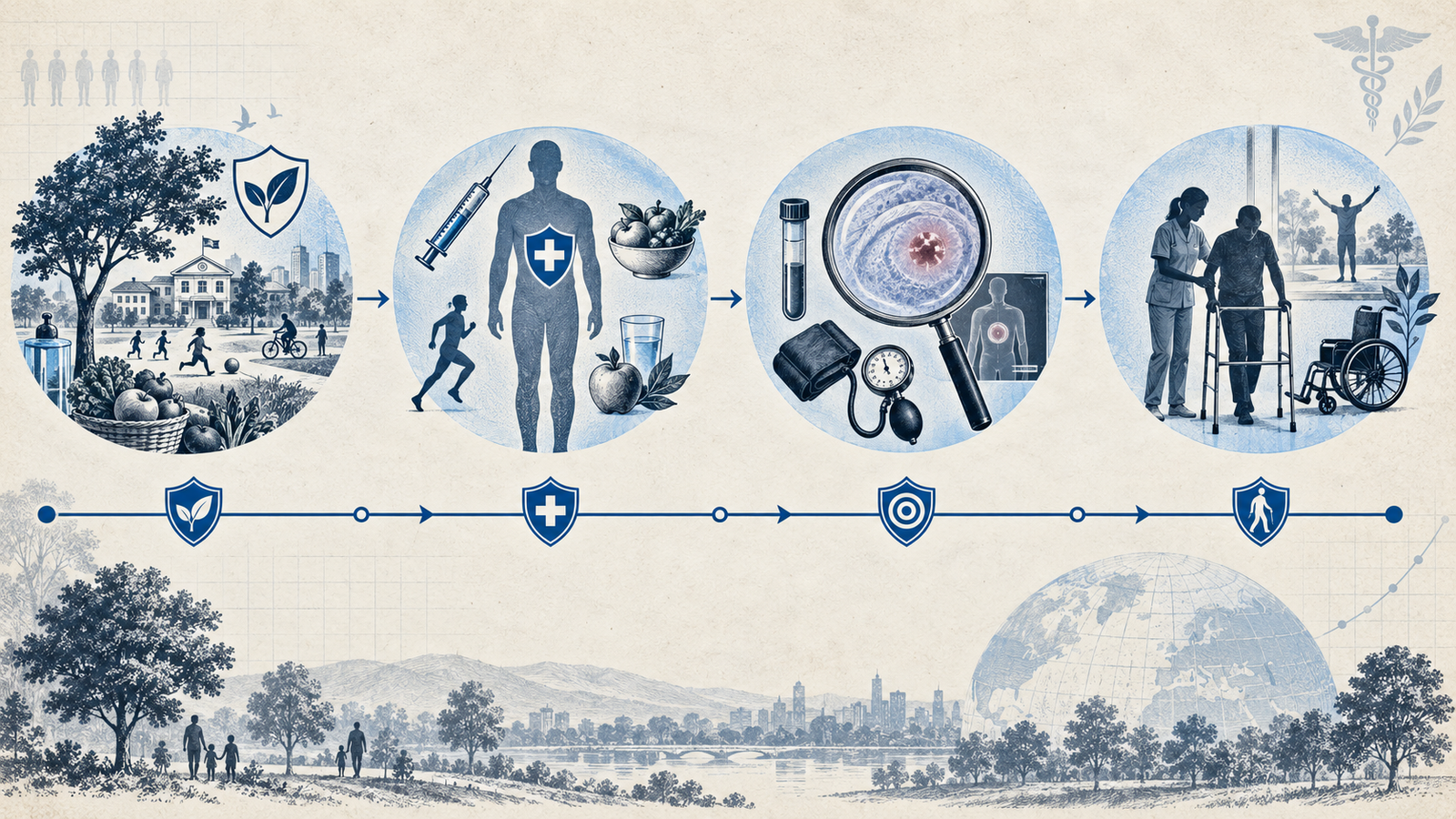
Levels of prevention questions almost always come down to one judgment call: has the disease process already started in this specific patient or population, or not? Get that timing right, and sorting an intervention into primordial, primary, secondary, or tertiary becomes far more reliable than trying to memorize examples in isolation.
Primordial Prevention: Stopping Risk Factors Before They Exist
Primordial prevention operates at the earliest possible point — before a risk factor even establishes itself in a population, rather than before disease develops in an already-exposed individual. This is the level most often confused with primary prevention, and the distinction is worth holding onto precisely: primary prevention reduces disease risk in people who already carry a risk factor, while primordial prevention prevents the risk factor from becoming widespread in the population in the first place.
Classic examples: anti-tobacco legislation aimed at preventing smoking initiation in a population that hasn't started smoking yet, urban planning that builds physical activity into daily life before sedentary habits take hold, and public health policies discouraging trans-fat use in food manufacturing before widespread dietary exposure occurs. Each of these acts on the population's exposure to a risk factor itself, not on individuals who already have that risk factor.
Primary Prevention: Stopping Disease Before It Starts
Primary prevention targets healthy or at-risk individuals before disease onset, aiming to reduce the incidence of new cases. Unlike primordial prevention, the risk factor may already be present or the population already exposed — the intervention targets the individual's susceptibility or exposure directly, rather than the population-wide existence of the risk factor.
Classic examples: immunization (preventing a specific infectious disease in a susceptible individual), health education about diet and exercise, chemoprophylaxis (such as antimalarial prophylaxis before travel to an endemic area), and genetic counseling before conception in at-risk couples. Immunization specifically is the example most often used to anchor this level, since it so clearly acts before any disease process has begun in that specific person.
Secondary Prevention: Catching Disease Early
Secondary prevention operates after disease has already begun, but before it becomes clinically apparent or symptomatic — the goal is early detection and prompt treatment, catching disease in a preclinical or early clinical stage when intervention is more effective and outcomes are better than waiting for symptoms to appear.
Classic examples: Pap smear screening for cervical cancer, mammography for breast cancer, screening for hypertension or diabetes in asymptomatic adults, and newborn screening programs for metabolic disorders. Every screening test used in an otherwise healthy, asymptomatic population is a secondary prevention activity by definition — the disease process is presumed to already exist in some proportion of those screened, even though no one has symptoms yet.
Tertiary Prevention: Reducing the Impact of Established Disease
Tertiary prevention operates once disease is clinically established, aiming to reduce complications, disability, and the impact of the disease on quality of life, rather than to prevent the disease itself or catch it earlier. This is the level focused on managing what has already happened, not on preventing what hasn't.
Classic examples: cardiac rehabilitation after a myocardial infarction, diabetic foot care aimed at preventing amputation in a patient who already has diabetes, physiotherapy after a stroke to minimize long-term disability, and structured disease management programs for chronic conditions like COPD aimed at reducing exacerbations and hospitalizations.
One Disease, All Four Levels: Diabetes as a Through-Line
Applying all four levels to a single condition makes the distinctions concrete rather than abstract. Take type 2 diabetes as the example running through each level.
Primordial: urban planning and food policy that reduce population-wide obesity and sedentary lifestyle trends before individuals develop insulin resistance at all — the target is the risk factor's prevalence in society, not any specific at-risk person.
Primary: counseling a specific overweight patient with a family history of diabetes on diet and exercise, aiming to prevent that individual from ever developing the disease — the risk factor already exists in this person, but diabetes itself hasn't.
Secondary: screening asymptomatic adults with fasting blood glucose or HbA1c to catch diabetes before symptoms like polyuria or polydipsia appear — the disease process is presumed already underway.
Tertiary: diabetic foot care and retinopathy screening in a patient already diagnosed with diabetes, aimed at preventing amputation and blindness — the disease is established, and the goal has shifted entirely to limiting its downstream damage.
The Four Levels, Side by Side
| Level | Disease Status | Goal | Diabetes Example |
|---|---|---|---|
| Primordial | Risk factor not yet established in population | Prevent risk factor from arising | Food policy reducing population obesity trends |
| Primary | Risk factor present, disease absent | Prevent disease onset | Diet/exercise counseling for an at-risk individual |
| Secondary | Disease present, subclinical | Early detection, prompt treatment | Fasting glucose screening in asymptomatic adults |
| Tertiary | Disease clinically established | Reduce complications | Diabetic foot and retinopathy care |
The Exam Trap Worth Naming Directly: Primordial vs Primary
Both primordial and primary prevention act before an individual develops disease, which is exactly why questions distinguishing them are genuinely tricky rather than a simple recall exercise. The reliable test: ask whether the intervention targets the existence of the risk factor itself in the population (primordial — e.g., policy preventing smoking from ever starting widely) or an individual's exposure or susceptibility to a risk factor that may already exist (primary — e.g., vaccinating a specific person against a disease that's already circulating). Population-level policy aimed at a risk factor's existence points toward primordial; individual-level intervention against an already-present risk factor or pathogen points toward primary.
A Second-Order Distinction: Screening vs Diagnosis
Secondary prevention specifically hinges on the concept of screening asymptomatic populations, which is a genuinely different activity from diagnosing a symptomatic patient who has actively sought care. A mammogram performed because a woman felt a lump is diagnostic workup, driven by a symptom — it isn't secondary prevention in the population-health sense, even though it uses the identical test. A mammogram performed as part of a routine, age-based screening program on a woman with no symptoms is the secondary-prevention activity, since the entire premise is catching disease before it announces itself.
Where the Model Originated
The primary/secondary/tertiary framework traces to Leavell and Clark's classic model of disease prevention, originally structured around the natural history of disease — the idea that any disease progresses through a predictable sequence from susceptibility, through subclinical disease, to clinical disease, and finally to recovery, disability, or death, with a distinct intervention appropriate to each stage. Primordial prevention was added later as public health thinking extended further upstream, recognizing that population-level risk factor prevalence itself was a meaningful, separate point of intervention rather than something to address only once individuals were already at risk.
Where Herd Immunity Fits
Herd immunity is worth placing carefully within this framework, since it sits at an interesting boundary. Vaccinating an individual is straightforwardly primary prevention for that person. But once vaccination coverage in a population reaches the threshold needed to interrupt transmission, the resulting protection extended to unvaccinated individuals — those too young, immunocompromised, or otherwise unable to be vaccinated themselves — starts to resemble a population-level effect closer in spirit to primordial prevention, even though it's built entirely from a primary intervention applied at scale. This is less a fifth category than a reminder that the levels describe a logical framework, and real public health programs can straddle more than one level in their effects even when the initial action is cleanly one thing.
Why This Distinction Matters Beyond the Exam
Health systems allocate resources differently across these levels, and getting the level right shapes what counts as success. A primordial program is judged by population risk-factor prevalence over years or decades. A primary program is judged by incidence of new cases. A secondary program is judged by the stage at which disease is caught and whether earlier detection actually changed outcomes. A tertiary program is judged by complication rates and quality of life in people who already have the disease. Conflating these levels when designing or evaluating a health program is a real, practical version of the same category error the exam question is testing.
Where a specific vignette places an intervention along this scale often depends on one detail alone: whether the sentence describing the patient population uses the word symptomatic, asymptomatic, or at-risk — that single word is usually enough to settle secondary versus primary versus primordial.
FAQs
What is the difference between primordial and primary prevention?
Primordial prevention stops a risk factor from becoming established in a population, typically through policy. Primary prevention targets individuals who may already have a risk factor, aiming to prevent disease onset in them specifically.
Is a Pap smear primary or secondary prevention?
Secondary prevention. It screens asymptomatic women to detect changes before symptoms develop, which is the defining feature of secondary prevention.
What level of prevention is cardiac rehabilitation?
Tertiary prevention. It occurs after a cardiac event has already happened, aiming to reduce further complications rather than prevent the disease itself.
Which model did the primary/secondary/tertiary framework originate from?
Leavell and Clark's model of disease prevention, structured around the natural history of disease. Primordial prevention was added later as a distinct, further-upstream category.
Is herd immunity primary or primordial prevention?
Vaccinating an individual is primary prevention. But population-level herd immunity, protecting unvaccinated individuals once coverage crosses a threshold, behaves more like a primordial effect even though it's built from primary interventions at scale.
What distinguishes screening from diagnostic testing in this framework?
Screening is performed on asymptomatic individuals as part of secondary prevention. Diagnostic testing is performed on symptomatic patients, and isn't classified as prevention even when it uses the identical test.
For the same mechanism-first classification approach applied to a different topic, see our guide to types of hypersensitivity reactions, and for how much of the paper Community Medicine carries overall, our subject-wise weightage breakdown.
Practise this on Reflex
Turn what you just read into recall with 14 years of tagged PYQs.
FAQ
Frequently asked questions
The questions aspirants ask most about this topic.
Primordial prevention stops a risk factor from becoming established in a population, typically through policy. Primary prevention targets individuals who may already have a risk factor, aiming to prevent disease onset in them specifically.
Secondary prevention. It screens asymptomatic women to detect changes before symptoms develop, which is the defining feature of secondary prevention.
Tertiary prevention. It occurs after a cardiac event has already happened, aiming to reduce further complications rather than prevent the disease itself.
Leavell and Clark's model of disease prevention, structured around the natural history of disease. Primordial prevention was added later as a distinct, further-upstream category.
Vaccinating an individual is primary prevention. But population-level herd immunity behaves more like a primordial effect even though it's built from primary interventions at scale.
Screening is performed on asymptomatic individuals as part of secondary prevention. Diagnostic testing is performed on symptomatic patients, and isn't classified as prevention even when it uses the identical test.
About the author
Stay ahead in your preparation
Get expert tips, exam updates, and high-yield insights delivered straight to your inbox.
No spam. Unsubscribe anytime.
More in Subject Notes
View all → Community Medicine (PSM)
National Health Programmes List for NEET PG: The Complete Guide
Every major National Health Programme, organised by category — communicable, non-communicable, and maternal-child.
 Pediatrics
Kawasaki Disease for NEET PG: The Five Criteria, the 10-Day IVIG Window and the Coronary Risk
What counts as Kawasaki disease, why the 10-day IVIG window matters, how aspirin is used, and how coronary artery involvement is graded and followed.
 Pediatrics
Tetralogy of Fallot for NEET PG: One Septal Shift, Four Defects, and the Tet Spell
One shifted septum explains the four defects of Tetralogy of Fallot, the boot-shaped heart, the fading murmur and the stepwise management of a tet spell.
 Microbiology
Malaria Life Cycle for NEET PG: Species, Smear Morphology, Complications and Treatment
How the malaria parasite moves between mosquito and human, what separates the species on a smear, and how diagnosis, complications and treatment follow from the life cycle.