Cranial Nerves Mnemonics for NEET PG: Names, Foramina & Clinical Correlations
By Dr. Utsav Bhattacherjee, MBBS, MBA · 24 Jul 2026 · 4 min read
Last updated: 23 Sept 2026
On this page
Cranial nerves are one of the few anatomy topics that don't stay in anatomy. The same 12 nerves resurface in Medicine (stroke localization), Surgery (skull base tumours), ENT (facial palsy, vertigo), and Ophthalmology (diplopia, pupil exams). If you only deep-dive into one cranial nerve topic before NEET PG, this is the one that pays off across sections.
This guide covers the three things examiners actually test: the order and type of each nerve, the foramen it exits through, and the clinical sign that gives away a lesion.
The 12 Cranial Nerves at a Glance
| No. | Nerve | Type | Exit Point |
|---|---|---|---|
| I | Olfactory | Sensory | Cribriform plate of ethmoid |
| II | Optic | Sensory | Optic canal |
| III | Oculomotor | Motor | Superior orbital fissure |
| IV | Trochlear | Motor | Superior orbital fissure |
| V | Trigeminal | Mixed | V1: superior orbital fissure · V2: foramen rotundum · V3: foramen ovale |
| VI | Abducens | Motor | Superior orbital fissure |
| VII | Facial | Mixed | Internal acoustic meatus → facial canal → stylomastoid foramen |
| VIII | Vestibulocochlear | Sensory | Internal acoustic meatus |
| IX | Glossopharyngeal | Mixed | Jugular foramen |
| X | Vagus | Mixed | Jugular foramen |
| XI | Accessory | Motor | Jugular foramen (spinal root via foramen magnum) |
| XII | Hypoglossal | Motor | Hypoglossal canal |
Mnemonic 1: Remembering the Names in Order
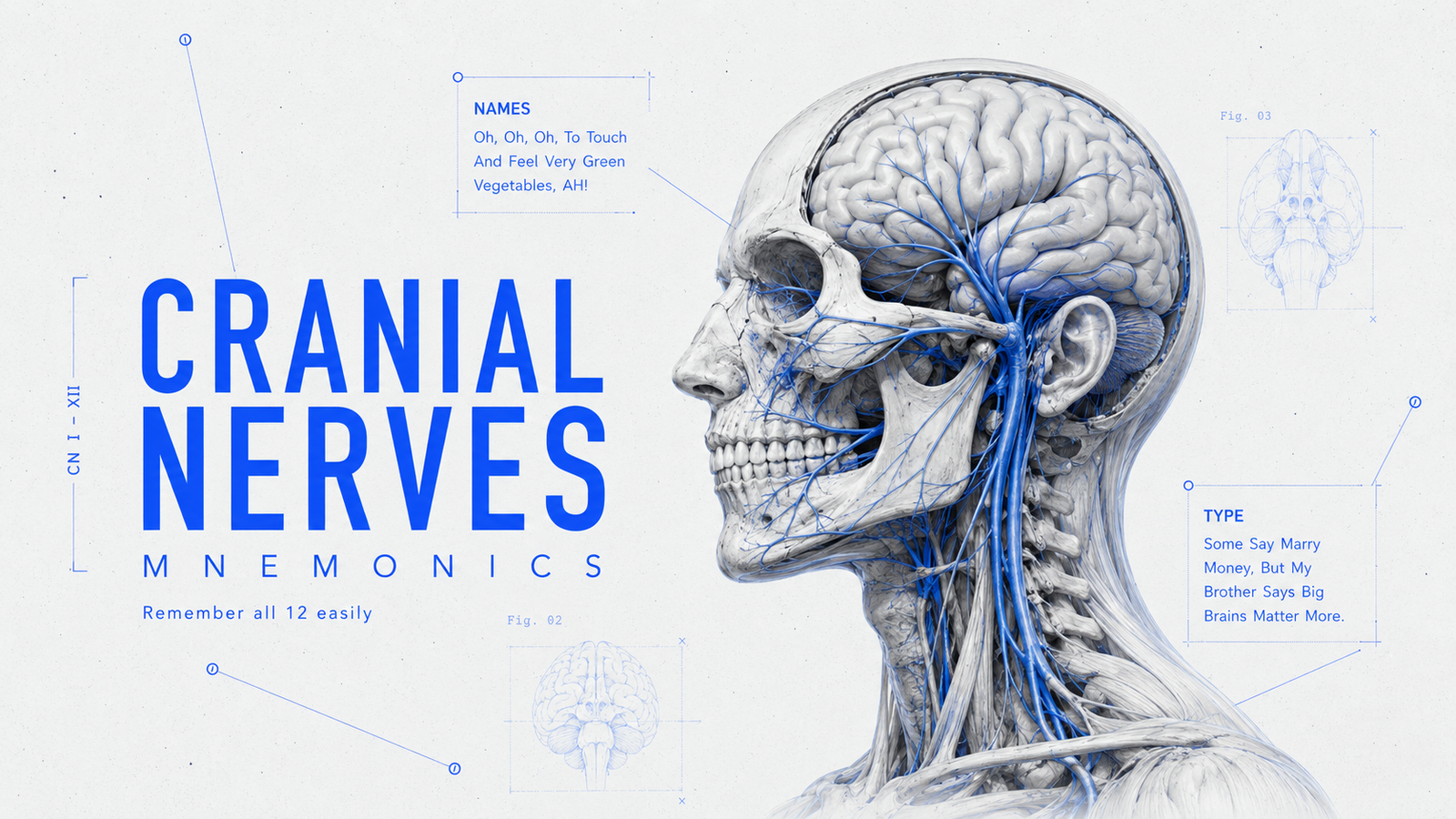
"On Old Olympus Towering Top, A Finn And German Viewed Some Hops."
Olfactory – Optic – Oculomotor – Trochlear – Trigeminal – Abducens – Facial – Auditory (Vestibulocochlear) – Glossopharyngeal – Vagus – Spinal accessory – Hypoglossal.
This is the version most Indian medical colleges teach, and it's the fastest way to avoid the classic NEET PG trap of mixing up IV and VI.
Mnemonic 2: Sensory, Motor, or Both
"Some Say Marry Money, But My Brother Says Big Brains Matter More."
Each word's first letter tells you the function:
| Nerve | Mnemonic word | Function |
|---|---|---|
| I Olfactory | Some | Sensory |
| II Optic | Say | Sensory |
| III Oculomotor | Marry | Motor |
| IV Trochlear | Money | Motor |
| V Trigeminal | But | Both |
| VI Abducens | My | Motor |
| VII Facial | Brother | Both |
| VIII Vestibulocochlear | Says | Sensory |
| IX Glossopharyngeal | Big | Both |
| X Vagus | Brains | Both |
| XI Accessory | Matter | Motor |
| XII Hypoglossal | More | Motor |
This mnemonic alone answers a whole category of one-liner questions: "Which cranial nerve is purely sensory?" or "Which cranial nerves are classified as mixed?"
The Foramina Table Examiners Love
Skull base foramina questions ("Which structure passes through foramen ovale?") are a NEET PG anatomy staple because they're unambiguous — one correct answer, no room for debate. Know this table cold:
| Foramen | Structures |
|---|---|
| Cribriform plate | CN I (olfactory fila) |
| Optic canal | CN II, ophthalmic artery |
| Superior orbital fissure | CN III, IV, V1, VI, superior ophthalmic vein |
| Foramen rotundum | CN V2 (maxillary) |
| Foramen ovale | CN V3 (mandibular) |
| Foramen spinosum | Middle meningeal artery (not a cranial nerve — a favourite distractor) |
| Internal acoustic meatus | CN VII, VIII |
| Jugular foramen | CN IX, X, XI (cranial root), internal jugular vein |
| Hypoglossal canal | CN XII |
| Foramen magnum | Spinal root of CN XI, medulla, vertebral arteries |
High-yield distractor: Foramen spinosum carries the middle meningeal artery, not a nerve — a common wrong-answer bait in single-best-answer questions.
Clinical Correlations: Where NEET PG Actually Tests You
Isolated fact recall ("CN VII is the facial nerve") rarely appears alone anymore. The exam prefers a clinical vignette that forces you to localize the lesion. These are the correlations worth memorizing cold:
CN III (Oculomotor) palsy
Ptosis, eye deviated "down and out," and pupil involvement is the key differentiator: a dilated, non-reactive pupil suggests a compressive cause (classically a posterior communicating artery aneurysm), while a pupil-sparing palsy points to an ischemic cause (classically diabetic microvascular disease).
CN IV (Trochlear) palsy
Vertical diplopia, worse on looking down and in (e.g., reading or walking downstairs). Patients often develop a compensatory head tilt away from the affected side.
CN VI (Abducens) palsy
Convergent squint with failure of lateral gaze. Because CN VI has the longest intracranial course, it's the classic "false localizing sign" of raised intracranial pressure — tested repeatedly across Medicine and Surgery.
CN VII (Facial) — UMN vs LMN
The single most-repeated cranial nerve question in NEET PG. An upper motor neuron lesion spares the forehead (bilateral cortical representation lets the frontalis still work), while a lower motor neuron lesion — Bell's palsy — involves the entire half of the face, forehead included.
CN VIII (Vestibulocochlear)
Sensorineural hearing loss, tinnitus, and vertigo at the cerebellopontine angle points to vestibular schwannoma (acoustic neuroma) — a recurring Surgery/ENT crossover question.
CN X (Vagus)
Recurrent laryngeal nerve involvement causes hoarseness; on phonation, the uvula deviates toward the normal side (away from the lesion).
CN XII (Hypoglossal)
On protrusion, the tongue deviates toward the side of an LMN lesion — a direction rule that's easy to reverse under exam pressure, so drill it deliberately.
How to Remember Cranial Nerves Without Cramming
Rote memorization of 12 names fades under exam stress. What sticks is linking each nerve to its one clinical giveaway — the pupil in CN III, the forehead in CN VII, the head tilt in CN IV. Build the name-order mnemonic first, then attach one clinical sign to each nerve rather than trying to hold the whole table in your head at once.
Practice What You’ve Learned
Reading a mnemonic once doesn't make it exam-ready — recall under time pressure does. If you want to test this topic in an MCQ format, cranial nerves shows up regularly in Reflex's daily TROCAR anatomy rounds, alongside the rest of high-yield NEET PG anatomy.
Practise this on Reflex
Turn what you just read into recall with 14 years of tagged PYQs.
About the author
Stay ahead in your preparation
Get expert tips, exam updates, and high-yield insights delivered straight to your inbox.
No spam. Unsubscribe anytime.
More in Subject Notes
View all → Anatomy
Erb's Palsy and Klumpke's Palsy: The Brachial Plexus Injuries NEET PG Tests Every Cycle
 Microbiology
Malaria Life Cycle for NEET PG: Species, Smear Morphology, Complications and Treatment
How the malaria parasite moves between mosquito and human, what separates the species on a smear, and how diagnosis, complications and treatment follow from the life cycle.
 Physiology
Oxygen-Hemoglobin Dissociation Curve for NEET PG: Every Shift Explained
Why the oxygen-hemoglobin dissociation curve is sigmoid, what moves it right or left, and how to apply each shift to fetal hemoglobin, stored blood, altitude and carbon monoxide poisoning.
 Pharmacology
Cholinergic Drugs for NEET PG: Classification, Receptors and Organophosphate Poisoning
A working classification of cholinergic drugs, the receptors behind each effect, which drug fits which clinical scenario, and how to answer organophosphate poisoning questions.