Erb's Palsy and Klumpke's Palsy: The Brachial Plexus Injuries NEET PG Tests Every Cycle
By Dr. Utsav Bhattacherjee, MBBS, MBA · 2 Sept 2026 · 10 min read
Last updated: 23 Sept 2026
On this page
Erb's palsy and Klumpke's palsy are two of the most frequently tested named syndromes in NEET PG Anatomy, and they're almost always tested as a pair — the exam wants you to distinguish which trunk is involved, what mechanism produces each, and what the resulting posture looks like. Get the pattern down once and both become fast, reliable marks.
The Brachial Plexus, Briefly
The brachial plexus is formed from the ventral rami of C5–T1, organized into roots → trunks → divisions → cords → branches. For injury questions specifically, the trunks matter most: the upper trunk (C5–C6), middle trunk (C7), and lower trunk (C8–T1). Erb's and Klumpke's palsy are, at their core, injuries to opposite ends of this trunk sequence — which is exactly why they produce near-opposite clinical pictures.
Erb's Palsy: Upper Trunk (C5–C6)
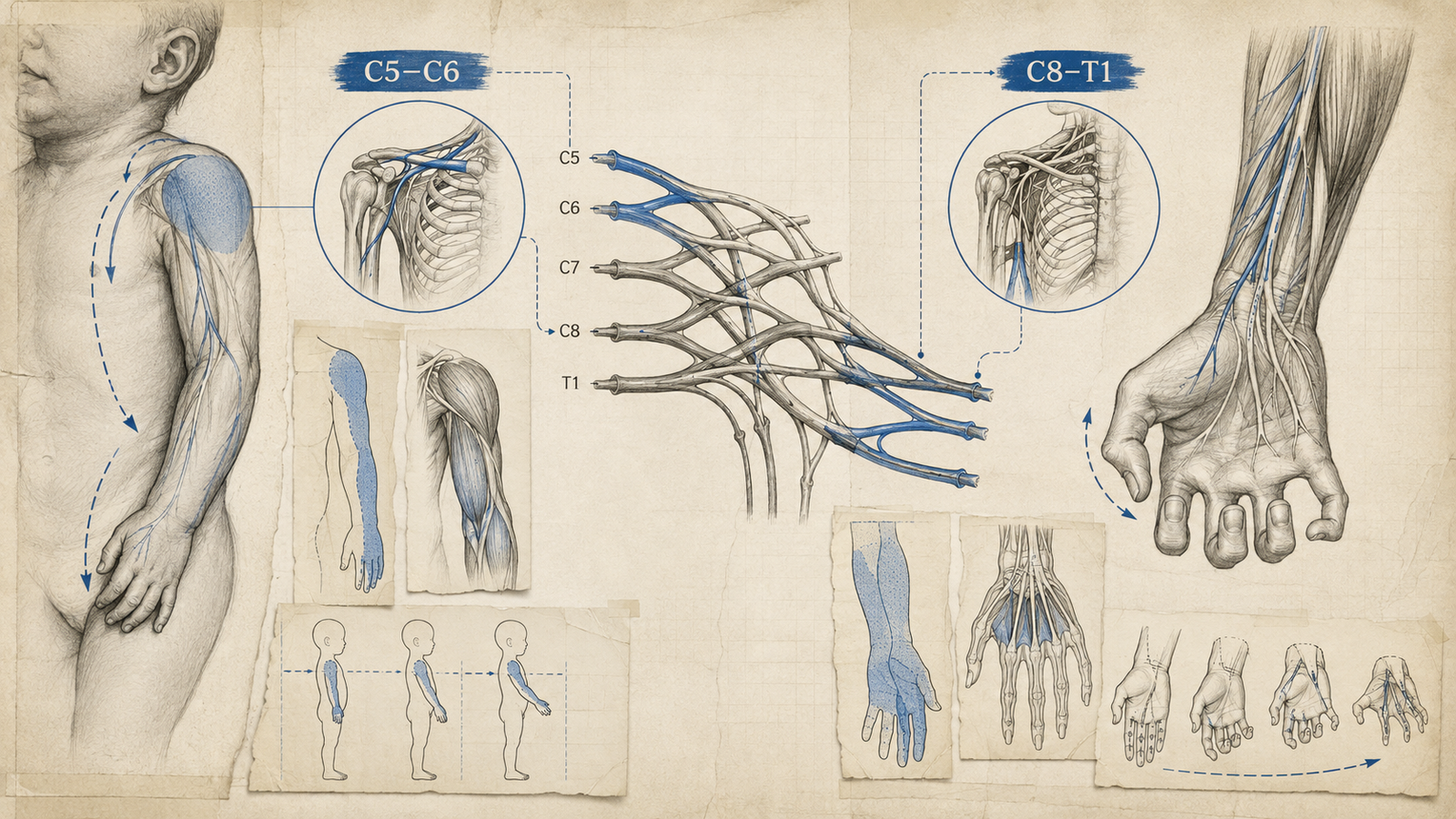
Erb's palsy results from injury to the upper trunk, formed by C5 and C6. The classic mechanism is excessive widening of the angle between the neck and shoulder — in newborns, this happens with shoulder dystocia during a difficult delivery; in adults, the equivalent injury pattern shows up in motorcycle accidents and falls where the shoulder is forced down while the head is forced to the opposite side.
The "waiter's tip" position is the sign to recognise on sight: the arm hangs adducted and internally rotated, the elbow is extended, the forearm is pronated, and the wrist is flexed — as though the patient is holding out a hand for a tip, palm facing backward. This posture follows directly from which muscles lose their nerve supply.
Muscles affected: deltoid and teres minor (axillary nerve) → loss of abduction; biceps and brachialis (musculocutaneous nerve) → loss of flexion and supination; supraspinatus and infraspinatus (suprascapular nerve) → loss of initial abduction and external rotation. Every one of these traces back to C5–C6.
Klumpke's Palsy: Lower Trunk (C8–T1)
Klumpke's palsy is the mirror-image injury — damage to the lower trunk, formed by C8 and T1. The mechanism is excessive upward pulling on an abducted arm — classically a breech delivery where the arm is pulled upward to deliver the body, or in adults, a sudden grab at something overhead while falling.
The "claw hand" is the corresponding sign: paralysis of the intrinsic hand muscles (the small muscles of the hand, innervated by C8–T1 via the ulnar and median nerves) leaves the long flexors and extensors of the fingers unopposed, producing hyperextension at the MCP joints and flexion at the IP joints.
The detail examiners love to add: Klumpke's palsy is often accompanied by Horner's syndrome — ptosis, miosis, and anhidrosis on the same side — because the T1 root carries sympathetic fibres destined for the head and neck, and a T1 avulsion injury takes those fibres out along with the lower trunk. A vignette combining claw hand with drooping of the eyelid and a constricted pupil is describing Klumpke's palsy specifically, not just a generic lower plexus injury.
Erb's vs Klumpke's: Side by Side
| Erb's Palsy | Klumpke's Palsy | |
|---|---|---|
| Roots/trunk | C5–C6, upper trunk | C8–T1, lower trunk |
| Mechanism | Shoulder forced down, head forced away (shoulder dystocia, falls) | Arm pulled sharply upward (breech delivery, grabbing while falling) |
| Classic posture | "Waiter's tip" — adducted, internally rotated, extended elbow | "Claw hand" — hyperextended MCPs, flexed IPs |
| Associated finding | None classically paired | Horner's syndrome (ptosis, miosis, anhidrosis) |
| Relative frequency | Far more common | Rarer |
Other Named Nerve Injuries Worth Knowing Alongside These
Brachial plexus questions often sit next to, or get confused with, injuries to individual peripheral nerves arising from it. Five are worth keeping straight:
- Long thoracic nerve — injury (classically during axillary lymph node dissection or a blow to the chest wall) paralyses serratus anterior, producing a winged scapula.
- Axillary nerve — injury (classically with surgical neck of humerus fracture or anterior shoulder dislocation) paralyses deltoid and teres minor, with sensory loss over the "regimental badge" area of the lateral shoulder.
- Radial nerve — injury (classically mid-shaft humerus fracture, or compression against a hard surface during sleep, hence "Saturday night palsy") produces wrist drop.
- Median nerve — a high lesion produces the "hand of benediction" (or "Pope's blessing") when attempting to make a fist, since the muscles flexing the index and middle fingers are lost while the ring and little finger (ulnar-supplied) still flex.
- Ulnar nerve — a distal lesion (at the wrist) produces a more pronounced claw hand than a proximal lesion, since the flexor digitorum profundus to the ring and little fingers is spared with a proximal injury but lost with a distal one — a genuinely counterintuitive detail (the "ulnar paradox") that examiners specifically test.
Note the distinction worth holding onto: Klumpke's claw hand comes from a plexus-level injury affecting both median and ulnar contributions to the hand; an isolated ulnar nerve lesion produces a similar-looking but mechanistically distinct claw hand from a single-nerve injury further down the arm.
For the same morphology-to-diagnosis recognition skill applied elsewhere in Pathology, see our guide to types of necrosis, and for how much of the paper Anatomy carries overall, our subject-wise weightage breakdown.
Practise this on Reflex
Turn what you just read into recall with 14 years of tagged PYQs.
FAQ
Frequently asked questions
The questions aspirants ask most about this topic.
Erb's palsy affects the upper trunk (C5–C6) and produces the "waiter's tip" posture, typically from shoulder dystocia or a fall forcing the shoulder down and head away. Klumpke's palsy affects the lower trunk (C8–T1) and produces a claw hand, and is often accompanied by Horner's syndrome.
The T1 nerve root carries sympathetic fibres bound for the head and neck. A T1 avulsion severe enough to cause Klumpke's palsy frequently damages these fibres too, producing ptosis, miosis, and anhidrosis on the same side.
Shoulder dystocia during a difficult delivery, where excessive lateral traction on the neck and shoulder during birth stretches or tears the upper trunk of the brachial plexus.
Erb's palsy is substantially more common. Klumpke's palsy is rarer, especially in isolation without any upper trunk involvement.
A distal ulnar nerve lesion at the wrist produces a more pronounced claw hand than a proximal lesion at the elbow, because a proximal injury also denervates flexor digitorum profundus to the ring and little fingers, which paradoxically reduces the clawing.
About the author
Stay ahead in your preparation
Get expert tips, exam updates, and high-yield insights delivered straight to your inbox.
No spam. Unsubscribe anytime.
More in Subject Notes
View all → Anatomy
Cranial Nerves Mnemonics for NEET PG: Names, Foramina & Clinical Correlations
Master all 12 cranial nerves for NEET PG — names, types, foramina, and the clinical signs examiners actually test.
Malaria Life Cycle for NEET PG: Species, Smear Morphology, Complications and Treatment
How the malaria parasite moves between mosquito and human, what separates the species on a smear, and how diagnosis, complications and treatment follow from the life cycle.
Oxygen-Hemoglobin Dissociation Curve for NEET PG: Every Shift Explained
Why the oxygen-hemoglobin dissociation curve is sigmoid, what moves it right or left, and how to apply each shift to fetal hemoglobin, stored blood, altitude and carbon monoxide poisoning.
Cholinergic Drugs for NEET PG: Classification, Receptors and Organophosphate Poisoning
A working classification of cholinergic drugs, the receptors behind each effect, which drug fits which clinical scenario, and how to answer organophosphate poisoning questions.