Nasal Polyps for NEET PG: Antrochoanal vs Ethmoidal Polyp, Samter Triad and Treatment
Reflex · 11 Nov 2026 · 9 min read
Last updated: 11 Nov 2026
On this page
A single pale mass in one nostril of a teenager and bilateral masses in an asthmatic adult are both called nasal polyps. They behave very differently, and the difference is the heart of this topic. This page sorts the two apart, then covers the Samter triad and the treatment of each.
Key Takeaways
Nasal polyps are the visible sign of chronic rhinosinusitis with nasal polyps (CRSwNP), which means at least 12 weeks of symptoms.
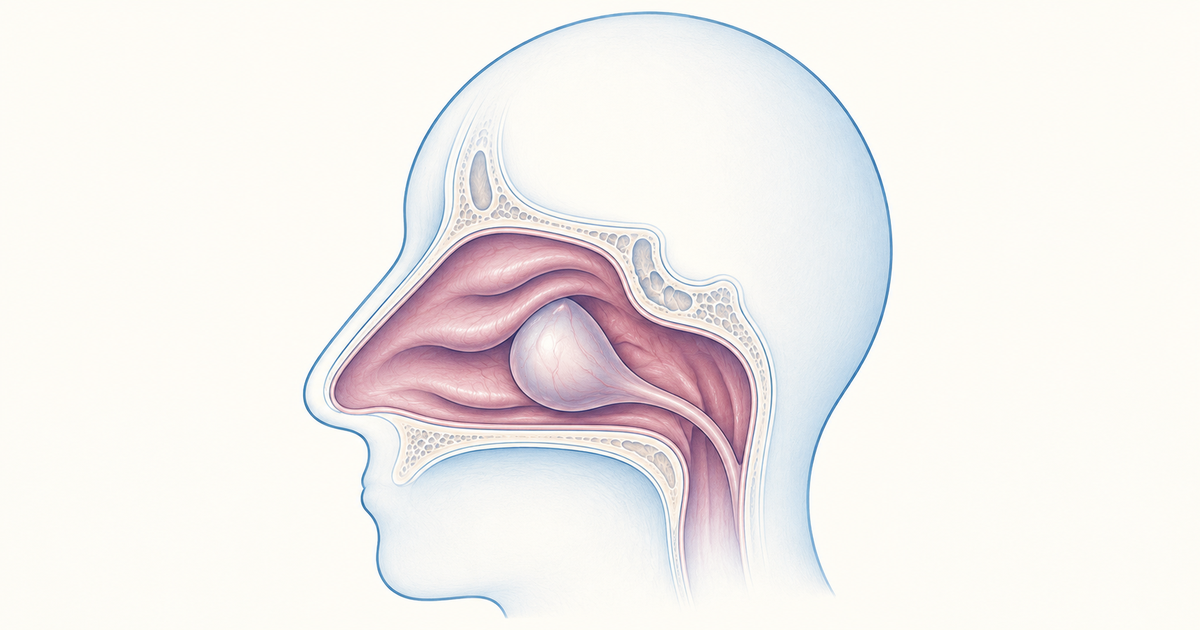
An antrochoanal (Killian) polyp is usually a single, unilateral mass that arises in the maxillary sinus, exits through the ostium and reaches the choana. Patients are mainly adolescents and young adults.
Ethmoidal polyps are typically bilateral, more eosinophilic, and more likely to recur, especially with asthma or aspirin intolerance.
Three features define the Samter triad: nasal polyps, asthma, and a reaction when aspirin or another COX-1 inhibitor is taken.
Antrochoanal polyps need surgery with complete removal of the sinus base. Bilateral polyposis starts with intranasal steroids and saline, with surgery and biologics reserved for uncontrolled disease.
What are nasal polyps?
Nasal polyps are a feature of chronic rhinosinusitis (CRS), defined as symptoms lasting at least 12 weeks: nasal obstruction, rhinorrhoea, facial pressure or pain, and reduced smell. CRS is split into CRS without polyps and CRS with nasal polyps (CRSwNP) on endoscopy or imaging (CRSwNP antibody therapy review, 2026). Reduced smell is a common feature of CRSwNP, while facial pain or pressure is the main complaint without polyps (systematic review of polymorphisms in CRSwNP).
CRS affects roughly 5 to 12% of adults, and polyps are found in about a quarter of them (CRSwNP T-cell review, 2026). Most polyps arise in the clefts of the osteomeatal complex (metallothionein study, BMC Immunology).
How do nasal polyps look under the microscope?
Polyp tissue shows epithelial damage, a thickened basement membrane, and an oedematous stroma that is sometimes fibrotic, with fewer vessels and glands than normal mucosa (PMC2848203).
What drives the inflammation?
In type 2 disease, epithelial alarmins (TSLP, IL-25 and IL-33) switch on IL-4, IL-5 and IL-13. The result is eosinophilic inflammation, local IgE, mucus hypersecretion and oedema (PMC13719825). Type 2 disease accounts for about 80% of Western CRSwNP cohorts, while Asian cohorts are more heterogeneous, with more Th1 and Th17 activity (PMC13630790). Do not assume that every polyp is eosinophilic.
Associated conditions include allergic and non-allergic rhinitis, allergic fungal sinusitis, aspirin intolerance, asthma, cystic fibrosis, and primary ciliary dyskinesia, including Kartagener syndrome (PMC2848203).
Antrochoanal polyp: the single-sided polyp
An antrochoanal polyp (ACP, also called a Killian polyp) is a benign, usually unilateral and solitary mass. It arises in the maxillary sinus, passes through the true or accessory ostium into the nasal cavity, and reaches the nasopharynx through the choana (case series and review, 2025). Its cause remains unclear, and most patients are adolescents or young adults (paediatric endoscopic management, 2013).
ACPs make up about 4 to 6% of all nasal polyps. In a series of 200 cases, 50% were left-sided, 48.5% right-sided and 1.5% bilateral (analysis of 200 cases). Bilateral ACP is therefore rare but real, so "usually unilateral" is the safe wording.
Allergy and cause
ACP is usually described as non-allergic, but the cause is unresolved. In the 200-case series, 35% of patients had positive skin tests, so atopy cannot be excluded in an individual (PMC2689564).
Symptoms and examination
The typical complaint is unilateral nasal obstruction, worse on expiration, with rhinorrhoea, snoring, headache, bleeding and sometimes smell loss (PMC2689564). In a paediatric series of 36 patients aged 9 to 17, obstruction occurred in 100%, rhinorrhoea in 72.2%, snoring or sleep apnoea in 66.6%, headache in 41.6%, epistaxis in 27.7% and anosmia in 19.4% (PMC3665376).
Endoscopy shows a white mass in the middle meatus with a stalk running to the accessory ostium. A white, egg-shaped mass may be seen behind the uvula (PMC2689564).
Imaging and histology
CT shows a hypodense mass filling the maxillary sinus and passing through the middle meatus to the choana. On MRI the lesion is T1 hypointense and T2 hyperintense, with peripheral enhancement of the cystic part (PMC2689564).
Histology shows a central cystic cavity in the antral part and an oedematous, sparsely cellular stroma. Inflammation and eosinophils are fewer than in bilateral ethmoidal polyps (PMC2689564).
Antrochoanal vs ethmoidal polyp: comparison table
The table below puts the two polyp types side by side. Ethmoidal polyps here mean the typical bilateral polyps of CRSwNP.
| Feature | Antrochoanal polyp | Ethmoidal polyp (bilateral CRSwNP) |
|---|---|---|
| Side and number | Usually unilateral and solitary; bilateral is rare | Typically bilateral and multiple |
| Origin | Maxillary sinus, through the ostium to the choana | Most polyps arise in the clefts of the osteomeatal complex |
| Typical age | Adolescents and young adults; median 19 years in one comparison | Older: median 32 (non-eosinophilic) and 42 years (eosinophilic) in the same comparison |
| Inflammation | Fewer eosinophils; neutrophil-leaning, type 1-leaning endotype | More inflammation and eosinophil infiltration |
| CT disease score | Lower; median 4 | Higher; median 11 and 19 |
| Association | Usually described as non-allergic; cause unresolved | Asthma, aspirin intolerance, allergic fungal sinusitis, cystic fibrosis |
| Main treatment | Surgery, with complete removal of the sinus base | Medical therapy first; endoscopic sinus surgery and biologics for uncontrolled disease |
| Recurrence | Reported rates vary widely; linked to incomplete excision | Recurs after surgery, especially with asthma, aspirin intolerance or marked eosinophilia |
Sources for the table: antrochoanal polyp column (PMC12341571 for side, origin, association, treatment and recurrence; PMC8569026 for age, inflammation and CT score); ethmoidal polyp column (PMC2689564 for side and inflammation; PMC2848203 for origin and association; PMC8569026 for age and CT score; PMC13630790 for treatment and recurrence).
The age and CT figures come from one study that compared ACP with bilateral nasal polyps, so treat them as a pattern rather than fixed cut-offs (PMC8569026).
A memory aid for antrochoanal polyp
This aid is our own, not from a source. ACP = Antrum, Adolescent, Alone. It starts in the Antrum, it is seen in the Adolescent or young adult, and it is usually Alone (one side, one polyp). If a description fits bilateral, multiple polyps in an asthmatic adult, think ethmoidal instead.
Samter triad (aspirin-exacerbated respiratory disease)
A patient has the Samter triad when CRS with nasal polyps and asthma coexist with a reaction to aspirin or another COX-1 inhibitor. The condition tends to start late, in the third or fourth decade, and is often non-atopic. Rhinitis usually precedes asthma by one to five years (Kennedy, Stoner and Borish review).
Mechanism
COX-1 inhibition is associated with overproduction of cysteinyl leukotrienes. The reaction is not IgE-mediated, selective COX-2 inhibitors are generally tolerated, and reactions appear 30 to 90 minutes after a dose (PMC5108840).
Prevalence depends on the population studied. It ranges from 0.6 to 2.5% of asthmatics to 14.9% of severe asthmatics, and 8.7% of CRSwNP patients in one review (PMC5108840).
Diagnosis and management
Diagnosis rests on a graded oral aspirin challenge. Management combines avoiding aspirin and other NSAIDs, intranasal and inhaled steroids, and leukotriene modifiers or zileuton. Aspirin desensitisation slows polyp regrowth (PMC5108840).
Surgery alone does not cure it. In one study, 37% needed revision surgery at 5 years and 89% at 10 years (PMC5108840).
Woakes syndrome is a separate, rare entity: severe recurrent polyposis with broadening of the nasal pyramid (systematic review, 2025).
Treatment of nasal polyps
The polyp type decides the approach: surgery is the treatment for an antrochoanal polyp, whereas bilateral polyposis is managed with medicines first.
Surgery for antrochoanal polyp
Complete removal, including the implantation base in the maxillary sinus, limits recurrence. The gold-standard approach is functional endoscopic sinus surgery (FESS) (PMC12341571). In the 200-case series, 86% had FESS, 12% had a Caldwell-Luc operation and 2% had polypectomy alone (PMC2689564).
Caldwell-Luc gives complete removal but can cause cheek anaesthesia and swelling, and it endangers developing teeth in children (PMC3665376). One paediatric technique is uncinectomy followed by middle meatal antrostomy. The polyp origin is dissected from the sinus and the nasopharyngeal part is removed through the mouth (PMC3665376).
In one series, recurrence was 22.22% (6 of 27 patients) at a mean of 22 months, and incomplete excision was associated with it (PMC12341571). Published rates vary widely.
Medical therapy for bilateral nasal polyps
Standard care is intranasal corticosteroids, saline irrigation, short courses of systemic corticosteroids and endoscopic sinus surgery. Biologics are an add-on for disease that stays uncontrolled despite appropriate medical and surgical treatment (PMC13630790).
Three biologic targets have trial evidence:
- Dupilumab (anti-IL-4 receptor alpha): SINUS-24 and SINUS-52 improved polyp score, congestion, CT score and SNOT-22, and reduced rescue steroids and surgery (PMC13630790).
- Mepolizumab (anti-IL-5): the SYNAPSE trial reduced polyp burden and the need for surgery (PMC13630790).
- Omalizumab (anti-IgE): POLYP 1 and 2 improved polyp size, congestion and smell. Polyps recur after stopping (PMC13630790).
Nasal polyps in children
Nasal polyps are rare under 10 years of age. In children, cystic fibrosis is the leading cause, and any child with CRSwNP should therefore be tested to exclude CF. Primary ciliary dyskinesia is another cause: polyps occur in about 10% of children and 75% of adults with it (nasal polyps in children).
First-line treatment in children is saline irrigation and intranasal steroids. Mometasone and fluticasone have systemic bioavailability below 1% (PMC8620101).
Unilateral nasal mass: what else to think of
A unilateral mass should not be called a polyp by default. In ACP series the differential includes angiofibroma, olfactory neuroblastoma, meningoencephalocele, haemangioma, inverted papilloma, lymphoma and rhabdomyosarcoma (PMC2689564).
In children the list adds meningocele, dermoid, nasal glioma and nasopharyngeal carcinoma (PMC8620101). For the other common nasal presentation, bleeding, see the revision page on epistaxis.
Self-test: nasal polyps
Try these before reading the answers below them.
- A 16-year-old has a unilateral obstructed nostril and a white mass behind the uvula. Which polyp is this?
- Which surgical option is troublesome in children because of developing teeth?
- Which three conditions make up the Samter triad?
Answers: (1) antrochoanal polyp; (2) Caldwell-Luc; (3) nasal polyps, asthma and aspirin (COX-1 inhibitor) reactions. Draw the comparison table from memory once, then check it against the version above. For more practice, use the ENT nose and sinuses practice questions.
Conclusion
Nasal polyps split into two clinical pictures. The antrochoanal polyp is a solitary, mostly unilateral lesion of young patients that starts in the maxillary sinus and is cured by complete surgical removal. Ethmoidal polyps are bilateral, eosinophil-rich and recurrent, and they sit within the wider picture of CRSwNP, asthma and the Samter triad. Learn the table as a contrast, keep the differentials of a unilateral mass in mind, and test yourself with the NEET PG question bank.
Practise this on Reflex
Turn what you just read into recall with 14 years of tagged PYQs.
FAQ
Frequently asked questions
The questions aspirants ask most about this topic.
An antrochoanal (Killian) polyp is a benign, usually unilateral and solitary mass that arises in the maxillary sinus, passes through the ostium into the nasal cavity and reaches the nasopharynx through the choana. The cause is unclear, and most patients are adolescents or young adults.
Ethmoidal polyps usually occur on both sides as a component of chronic rhinosinusitis with nasal polyps. They show more inflammation and eosinophils and higher CT scores than an antrochoanal polyp, and they tend to recur, especially with asthma or aspirin intolerance.
The Samter triad combines chronic rhinosinusitis with nasal polyps, asthma, and a reaction to aspirin or another COX-1 inhibitor. It is also called aspirin-exacerbated respiratory disease and usually starts in the third or fourth decade.
Treatment is surgical. Complete removal, including the implantation base in the maxillary sinus, limits recurrence, and functional endoscopic sinus surgery is the gold standard. Caldwell-Luc gives complete removal but can cause cheek numbness and swelling and endangers developing teeth in children.
Standard care is intranasal corticosteroids, saline irrigation, short courses of systemic corticosteroids and endoscopic sinus surgery. Biologics such as dupilumab, mepolizumab and omalizumab are add-on options for disease that stays uncontrolled despite appropriate medical and surgical treatment.
Cystic fibrosis. It is the most common cause of nasal polyps in children, and nasal polyps are rare under 10 years of age. Primary ciliary dyskinesia is another associated cause.
Stay ahead in your preparation
Get expert tips, exam updates, and high-yield insights delivered straight to your inbox.
No spam. Unsubscribe anytime.
More in Subject Notes
View all → ENT
Cholesteatoma for NEET PG: Safe vs Unsafe CSOM, Complications and Surgery
A revision guide to cholesteatoma: how it differs from safe CSOM, how it forms, which complications it causes, how it is imaged, and how canal wall up and canal wall down surgery compare.
 ENT
Epistaxis for NEET PG: Little's Area, Woodruff's Plexus, and the Management Ladder
 ENT
Rinne and Weber Test for NEET PG: Reading the Hearing Loss Pattern Correctly
The two tests are simple individually; the exam rewards reading them together and landing on conductive versus sensorineural without hesitation. The combined pattern, why the direction is easy to get backwards, and how audiometry confirms it.
 Ophthalmology
Types of Glaucoma for NEET PG: Open-Angle vs Angle-Closure vs Congenital
A revision guide to glaucoma types: how primary open-angle, primary angle-closure and congenital glaucoma differ in angle, presentation, optic disc and treatment.