NEET PG 2026: Complete Preparation Guide, Exam Pattern, Syllabus & Strategy to Crack It
By Dr. Utsav Bhattacherjee, MBBS, MBA · 5 May 2026 · 10 min read
Last updated: 23 Sept 2026
On this page
Every year, over 2 lakh MBBS graduates sit for one exam that decides the next 3 years of their life.
NEET PG.
One rank number. One shot. 74,000+ seats across every government and private medical college in India.
The difference between MD Medicine at a top government college and a DNB seat at a private hospital can be a few hundred marks. The difference between those marks is almost always preparation strategy — not intelligence, not luck.
This guide gives you everything: what NEET PG 2026 looks like, what it tests, which subjects matter most, and exactly how to prepare for it from wherever you are right now.
Key Takeaways
- NEET PG 2026 is 180 MCQs in 3.5 hours with -1/3 negative marking — random guessing is mathematically harmful, so only attempt a question if you can eliminate at least one wrong option.
- Medicine, Surgery, and Obs & Gynae together account for nearly 50% of the paper — master these three subjects first before anything else.
- Since 2023, NEET PG has shifted toward clinical case-based questions; roughly 30% of questions are direct concept repeats from PYQs, but the remaining 70% require applying concepts to new scenarios.
- PSM carries more weight in NEET PG (8–10%) than most candidates expect and should not be left as an afterthought.
- Your preparation timeline should scale to what you have — 9–12 months for full-depth prep, 4–6 months with a compressed but complete cycle, and under 2 months for a pure high-yield, mock-heavy sprint.
What is NEET PG?
NEET PG (National Eligibility cum Entrance Test — Postgraduate) is India's single largest postgraduate medical entrance exam.
It is conducted by the National Board of Examinations in Medical Sciences (NBEMS) and determines admission to:
- MD (Doctor of Medicine) programs
- MS (Master of Surgery) programs
- PG Diploma programs
- DNB (Diplomate of National Board) programs
Across government medical colleges, private medical colleges, deemed universities, and DNB hospitals throughout India.
Did you know? NEET PG replaced multiple state and institution-level PG entrance exams when it was introduced. Today, a single score determines your admission across 74,000+ seats in India — making it one of the most high-stakes exams in the country.
NEET PG 2026 Exam Pattern
Before building your preparation strategy, understand exactly what you are walking into.
Key Details
- 180 Multiple Choice Questions
- 3.5 hours (210 minutes)
- Single Best Response (SBR) format
- Computer Based Test (CBT)
- English language only
- Negative marking: -1/3 per wrong answer
- Single session exam
Scoring System
| Answer Type | Marks |
|---|---|
| Correct answer | +1 mark |
| Wrong answer | -0.33 marks (1/3 negative) |
| Unattempted | 0 marks |
Critical strategy point: The -1/3 negative marking means random guessing is mathematically harmful. Every question you attempt should have at least a 40% confidence level behind it. Unattempted questions score 0 — wrong answers score negative. This changes how you approach uncertain questions completely.
NEET PG 2026 Syllabus
The NEET PG syllabus covers the complete MBBS curriculum as defined by the National Medical Commission (NMC) — all 19 subjects.
All 19 Subjects
- Anatomy
- Physiology
- Biochemistry
- Pathology
- Pharmacology
- Microbiology
- Forensic Medicine & Toxicology
- General Medicine
- General Surgery
- Obstetrics & Gynaecology
- Paediatrics
- Orthopaedics
- Ophthalmology
- ENT
- Dermatology & STD
- Psychiatry
- Anaesthesia
- Radio-diagnosis
- Community Medicine (PSM)
The syllabus is vast. The strategy is knowing which parts of the syllabus generate the most questions.
NEET PG Subject-Wise Weightage 2026
Based on PYQ analysis across the last 5 years of NEET PG papers:
| Subject | Approx. Questions | Weightage | Priority |
|---|---|---|---|
| Medicine | 36–44 | 18–22% | P1 |
| Surgery | 28–36 | 14–18% | P1 |
| Obs & Gynae | 24–30 | 12–15% | P1 |
| Community Medicine (PSM) | 16–20 | 8–10% | P2 |
| Pathology | 20–26 | 10–13% | P2 |
| Pharmacology | 16–20 | 8–10% | P2 |
| Microbiology | 12–16 | 6–8% | P2 |
| Anatomy | 10–14 | 5–7% | P2 |
| Physiology | 8–12 | 4–6% | P2 |
| Paediatrics | 6–10 | 3–5% | P3 |
| Forensic Medicine | 6–10 | 3–5% | P3 |
| Ophthalmology | 4–6 | 2–3% | P3 |
| ENT | 4–6 | 2–3% | P3 |
| Orthopaedics | 4–6 | 2–3% | P3 |
| Dermatology | 2–4 | 1–2% | P3 |
| Psychiatry | 2–4 | 1–2% | P3 |
| Anaesthesia | 2–4 | 1–2% | P3 |
| Radiology | 2–4 | 1–2% | P3 |
| Biochemistry | 2–4 | 1–2% | P3 |
The top 3 subjects — Medicine, Surgery, and OBG — account for nearly 50% of the paper. If you master these three, you are already halfway to a competitive score before touching any other subject.
High-Yield NEET PG Topics: Subject by Subject
This is built from PYQ pattern analysis — not predictions. These are the topics NBEMS has tested repeatedly.
Medicine (18–22%) — Start Here
NEET PG 2026 Medicine questions are increasingly clinical. Direct recall questions are being replaced by case-based scenarios.
Cardiology
- Heart failure — HFrEF vs HFpEF classification, NYHA grading, treatment ladder
- Acute coronary syndromes — STEMI vs NSTEMI, thrombolytic criteria, primary PCI
- ECG patterns — LBBB, RBBB, complete heart block, WPW, axis deviation
- Valvular heart disease — mitral stenosis (most common in India), aortic stenosis, management
Nephrology
- Nephrotic vs nephritic syndrome — features, causes, investigations
- Glomerulonephritis types — IgA nephropathy, MCD, FSGS, MPGN, RPGN
- CKD — staging (KDIGO), complications, indications for dialysis
- Renal tubular acidosis types
Endocrinology
- Diabetes mellitus — DKA vs HHS comparison, insulin regimens, complications (micro and macro)
- Thyroid disorders — hypothyroidism vs hyperthyroidism, Graves' disease, thyroid storm
- Adrenal disorders — Cushing's syndrome (causes, dexamethasone suppression), Addison's disease
- MEN syndromes 1, 2A, 2B
Neurology
- Stroke — ischaemic vs haemorrhagic, tPA eligibility, NIHSS score
- Seizure classification — 2017 ILAE classification, treatment by seizure type
- Movement disorders — Parkinson's disease (pathology, dopaminergic drugs), Huntington's, Wilson's
- Demyelinating diseases — MS (types, McDonald criteria), Guillain-Barré (ascending paralysis, CSF)
- Meningitis — CSF findings for bacterial vs viral vs TB vs fungal
Pulmonology
- COPD — GOLD classification, management, non-invasive ventilation indications
- Asthma — severity, step-up therapy, status asthmaticus
- Pleural effusion — Light's criteria, causes of transudate vs exudate
- Tuberculosis — drug regimens, MDR-TB, DOTS, immune reconstitution
Rheumatology
- SLE — ACR/EULAR 2019 criteria, lupus nephritis WHO classes
- Rheumatoid arthritis — diagnostic criteria, DMARDs (methotrexate first line), biologics
- Crystal arthropathies — gout (urate crystals, negative birefringence), pseudogout
Gastroenterology
- Liver cirrhosis — Child-Pugh score, MELD score, complications (SBP, HRS, HE)
- IBD — Crohn's vs UC (this table appears in almost every paper)
- Viral hepatitis — hepatitis B serology interpretation (HBsAg, anti-HBs, HBeAg, anti-HBc)
- GI bleeding — upper vs lower, management protocol
Surgery (14–18%)
GI Surgery
- Appendicitis — Alvarado score, management, Meckel's diverticulum
- Intestinal obstruction — mechanical vs paralytic ileus, causes by age, management
- Colorectal carcinoma — right vs left-sided features, Duke's staging, TNM, screening
Hepatobiliary
- Gallstones — types, complications, Charcot's triad, Mirizzi syndrome
- Liver abscess — amoebic vs pyogenic (classic comparison question)
- Carcinoma pancreas — head vs body/tail presentation, CA 19-9, Whipple's procedure
Thyroid Surgery
- Thyroid carcinoma — papillary (most common, psammoma bodies), follicular, medullary (calcitonin, MEN2), anaplastic
- Complications of thyroidectomy — recurrent laryngeal nerve injury (voice change), hypoparathyroidism (tetany)
Breast
- Carcinoma breast — risk factors, staging, surgical options, sentinel lymph node biopsy
- BRCA1 vs BRCA2 — cancer associations, prophylactic surgery
Trauma
- ATLS protocol — primary survey, ABCDE, classes of haemorrhage
- Damage control surgery — when and why
- Head injury — GCS scoring, management of raised ICP, CT indications (Canadian criteria)
Urology
- BPH — IPSS score, medical management (alpha blockers, 5-alpha reductase inhibitors), TURP
- Renal cell carcinoma — triad, paraneoplastic syndromes, treatment
- Bladder carcinoma — transitional cell carcinoma, risk factors, cystoscopy
Obstetrics & Gynaecology (12–15%)
Obstetrics
- Normal labour — stages, Bishop score, partograph interpretation
- Preeclampsia and eclampsia — diagnostic criteria, severe features, magnesium sulphate protocol
- Antepartum haemorrhage — placenta previa vs abruption placentae
- Postpartum haemorrhage — 4 T's (tone, trauma, tissue, thrombin), management stepladder
- Preterm labour — tocolytics, antenatal corticosteroids, PPROM management
Gynaecology
- Cervical carcinoma — FIGO 2018 staging, colposcopy, HPV vaccination
- Endometrial carcinoma — risk factors (unopposed oestrogen), staging, management
- Ovarian tumours — Meigs syndrome, tumour markers, dermoid cyst
- PCOS — Rotterdam criteria, management of infertility, insulin resistance
- Contraception — OCP types and contraindications, IUCD, emergency contraception
Community Medicine / PSM (8–10%)
PSM carries significantly more weight in NEET PG than in INI-CET. Do not underestimate it.
High-yield areas
- Biostatistics — sensitivity, specificity, PPV, NPV, likelihood ratios, NNT, study designs (RCT, cohort, case-control)
- National Health Programs — NHM, RNTCP, NVBDCP, RCH — current targets and recent updates
- Vaccines — NIS schedule, cold chain, types (live attenuated vs killed), AEFI
- Nutrition — PEM, deficiency diseases, RDA, nutritional assessment methods (Gomez, IAP classification)
- Epidemiology — disease burden, herd immunity, outbreak investigation steps
- Health indices — IMR, MMR, TFR, life expectancy — current India values
PSM tip: PSM questions in NEET PG are heavily current-affairs-linked. National program updates, new vaccine additions, and revised health targets get tested. Stay updated with recent NHM guidelines.
Pathology (10–13%)
High-yield areas
- Anaemia — iron deficiency vs thalassemia vs sideroblastic (peripheral smear is key)
- Leukaemia — ALL vs AML vs CML vs CLL markers and clinical features
- Lymphoma — Hodgkin's (Reed-Sternberg cells, types) vs Non-Hodgkin's
- Tumour markers — CEA, AFP, β-hCG, PSA, CA-125, CA 19-9
- Granulomas — caseating vs non-caseating causes
- Coagulation disorders — haemophilia A vs B, DIC, von Willebrand disease
- Renal pathology — glomerular diseases on electron microscopy and immunofluorescence
Pharmacology (8–10%)
High-yield areas
- Antiepileptics — drug-specific side effects (valproate teratogenicity, phenytoin zero-order kinetics)
- Antimicrobials — mechanism, spectrum, resistance, adverse effects
- Cardiovascular drugs — antihypertensives by mechanism, antiarrhythmics (Vaughan Williams)
- Autonomic pharmacology — alpha/beta agonists and blockers, clinical applications
- Drug interactions and contraindications — these appear every year
The Most Important Shift in NEET PG 2026
Since 2023, NEET PG has been moving steadily toward clinical case-based questions.
In NEET PG 2025, approximately 30% of questions were direct concept repeats from previous years. The remaining 70% required applying concepts to new clinical scenarios.
This means two things:
1. PYQs are necessary but not sufficient Solve PYQs to understand patterns and build your foundation. But do not stop there — practise applying those concepts to unseen clinical vignettes.
2. Understanding beats memorisation A student who memorises that "methotrexate causes hepatotoxicity" will answer one question. A student who understands methotrexate's mechanism, monitoring, and reversal will answer five different questions about it across different formats.
The NEET PG paper rewards the doctor who thinks, not just the student who remembers.
NEET PG 2026 Preparation Strategy
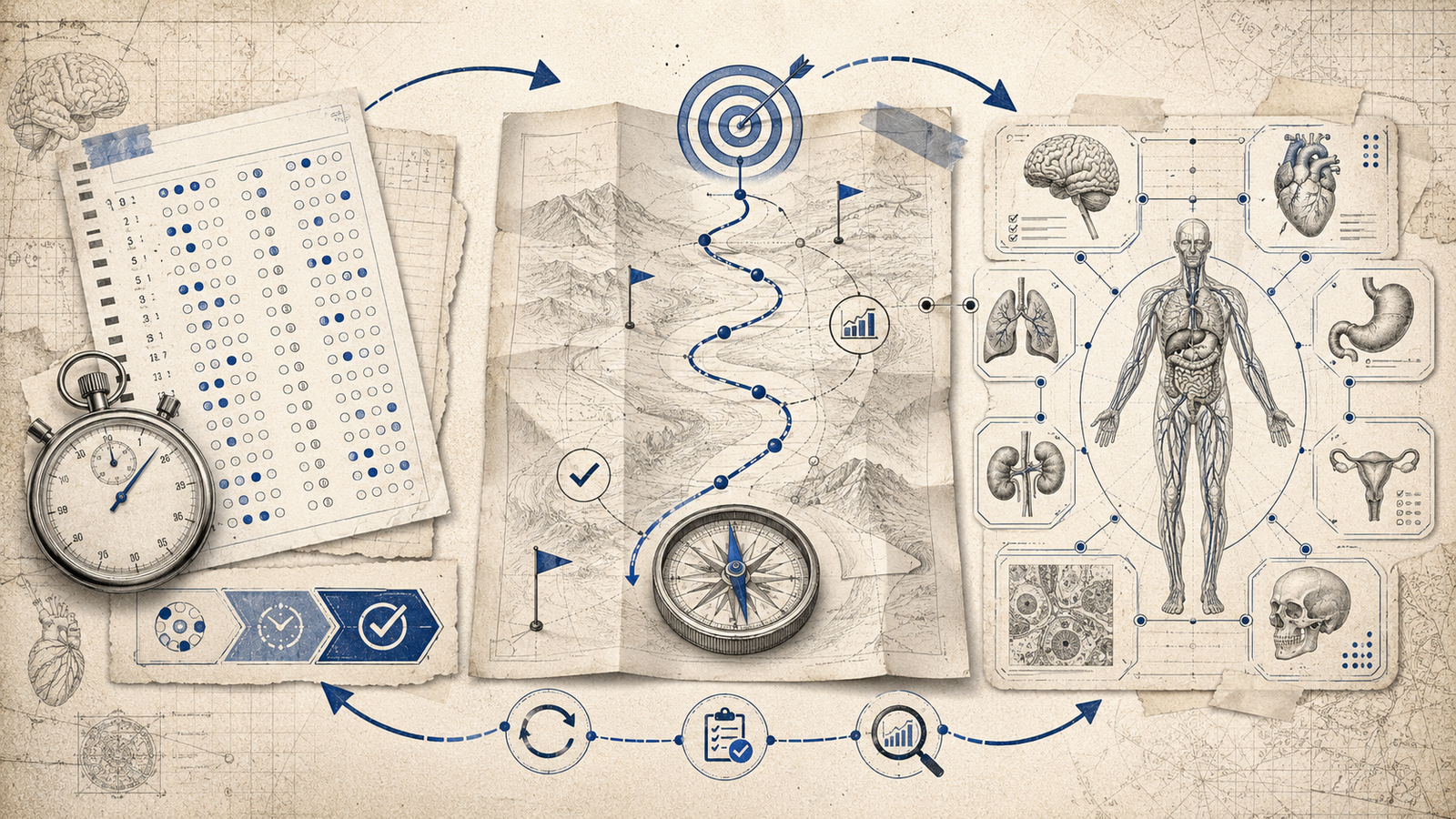
The Five-Step NEET PG Preparation Method
If You Have 9–12 Months
Phase 1 — Foundation (Month 1–3)
- Subject order: Medicine → Surgery → OBG → Pathology → Pharmacology
- Read standard resources once — understand, do not memorise
- Solve subject-wise PYQs alongside each subject — not after finishing it
- Target: 1 subject completed + PYQs solved every 3–4 weeks
Phase 2 — Consolidation (Month 4–7)
- Complete remaining subjects: Microbiology, Anatomy, Physiology, PSM, all short subjects
- Increase daily MCQ count to 80–100 questions
- Start taking subject-wise timed tests
- Build short notes for high-yield topics — 1 page per topic maximum
Phase 3 — Mock Tests (Month 8–10)
- Attempt 2–3 full-length mock tests per week (200 Qs, timed, negative marking on)
- Review every wrong answer — understand why, not just what
- Track weak subjects and allocate extra revision time
Phase 4 — Final Revision (Month 11–12)
- Revise only from short notes — no new material
- One full mock every 2 days
- Focus on clinical integration and image-based questions
If You Have 4–6 Months
Compress the timeline — do not skip phases.
- Start directly with high-yield subjects: Medicine, Surgery, OBG
- Solve PYQs from Day 1 — PYQs are your syllabus filter
- Begin mocks from Month 3 — earlier than comfortable, but necessary
- PSM revision in Month 4 — do not leave it for the last week
- Months 5–6: pure revision and mock tests, no new subjects
If You Have Less Than 2 Months
- Only high-yield topic revision — no textbook reading
- 100+ MCQs daily, all timed
- Full mock test every 3 days
- Error log review every evening without exception
- Short subjects: solve PYQs only, 30–45 minutes per subject
5 Mistakes That Kill NEET PG Ranks
1. Starting With Short Subjects
Forensic Medicine, Dermatology, and Anaesthesia together make up 5% of the paper. Starting here feels productive. It is not. Start with Medicine.
2. Reading Without Solving MCQs
Theory without MCQ practice is preparation that never gets tested. Solve subject-wise questions alongside every topic you read — not after finishing the subject.
3. Ignoring PSM
Most candidates treat PSM as an afterthought. At 8–10% of the paper, one poorly prepared PSM means losing 16–20 marks. That can drop your rank by thousands.
4. Taking Mocks Without Reviewing Them
A mock test you do not review is a waste of 3.5 hours. The value is entirely in the post-test analysis — which topics were wrong, why they were wrong, and what to revise.
5. Changing Resources Mid-Preparation
Switching apps, books, or notes when you feel stuck is one of the most common preparation errors. It creates the feeling of progress without the reality of it. Pick your resources. Stick to them.
NEET PG Negative Marking: How to Handle It
The -1/3 penalty changes everything about how you approach uncertain questions.
The math:
- Attempt 4 questions with no idea which is correct → statistically expect 1 right, 3 wrong → net score: 1 - 1 = 0 marks
- Leave those 4 questions → net score: 0 marks
- They are equivalent. Random guessing does not help.
The strategy:
- If you can eliminate 2 options confidently → attempt (50% chance is mathematically positive)
- If you can eliminate 1 option → borderline, use judgement
- If you have no idea about any option → leave it
Train this decision in mocks — not on exam day. Build the habit of rapid triage: confident attempt, educated guess, or skip. This skill alone separates top-1000 rankers from the rest.
Frequently Asked Questions
How many questions are in NEET PG 2026?
NEET PG 2026 has 180 multiple choice questions to be answered in 3.5 hours (210 minutes). All questions are Single Best Response (SBR) format. There is -1/3 negative marking for wrong answers.
Which subject has the highest weightage in NEET PG?
Medicine has the highest weightage at 18–22%, followed by Surgery (14–18%) and Obstetrics & Gynaecology (12–15%). Together these three subjects account for nearly 50% of the paper.
How many months does it take to prepare for NEET PG?
Most successful candidates prepare for 9–12 months. It is possible to crack NEET PG in 6 months with focused preparation. Less than 4 months requires an extremely high-yield, mock-heavy strategy with no time for comprehensive reading.
Is PSM important for NEET PG?
Yes — more so than for INI-CET. PSM carries 8–10% in NEET PG. Biostatistics, national health programs, and vaccine schedules are the highest-yield areas. Do not neglect it.
How many PYQs repeat in NEET PG?
Approximately 30% of NEET PG questions in recent sessions were direct concept repeats from previous years. This makes PYQ practice non-negotiable. However, the remaining 70% requires applying concepts to new clinical scenarios — so PYQs alone are not sufficient.
Does NEET PG have negative marking?
Yes. A correct answer scores +4 and a wrong one −1, so the gap between them is five marks. INI-CET penalises wrong answers too, at −1/3 against +1 — a milder ratio, but the attempt-or-skip judgement matters in both papers.
What is the best app for NEET PG preparation?
The best app is one with a comprehensive PYQ bank, timed mock tests, and detailed explanations. REFLEX provides 10,000+ NEET PG and AIIMS PYQs with an 80% strike rate, subject-wise filtering, full-length timed mocks, and topper notes — at the most affordable price point among all NEET PG prep platforms.
Final Takeaway
NEET PG 2026 is not an intelligence test — it is a preparation test. The candidates who crack it are not the ones who read the most books. They are the ones who understood the pattern, prioritised the right subjects, practised relentlessly with MCQs, and showed up on exam day with a clear head and a tested strategy.
The syllabus is manageable. The pattern is predictable. The rank you want is achievable.
Start with Medicine. Solve PYQs from Day 1. Build short notes as you go. Take mocks regularly. Review every wrong answer. Revise more than you read.
REFLEX is built for exactly this — a PYQ bank with an 80% strike rate, AIIMS and NEET PG papers in one place, timed mocks, and topper notes. Everything you need, nothing you don't.
Believe in your preparation. Trust the process. Keep pushing forward.
Keep cracking this one, champ.
Practise this on Reflex
Turn what you just read into recall with 14 years of tagged PYQs.
About the author
Stay ahead in your preparation
Get expert tips, exam updates, and high-yield insights delivered straight to your inbox.
No spam. Unsubscribe anytime.
More in Exam Guide
View all → Exam Guide
UPSC CMS Exam: Eligibility, Pattern, Syllabus, and How Selection Works
UPSC CMS recruits medical officers for central and Delhi civic services. Here are the eligibility rules, age limit, exam pattern, syllabus, selection stages and how it compares with NEET PG.
 Exam Guide
DNB Full Form in Medical: Course, Admission, and How It Compares With MD/MS
DNB stands for Diplomate of National Board, a postgraduate qualification from NBEMS. Here is how admission, training and the exit exam work, and how DNB compares with MD/MS.
 Exam Guide
INI-CET November 2026: How to Use Your Last 30 Days, Week by Week
 Exam Guide