NEET PG Normalisation Explained: What a Single-Shift Exam Changes for Your Rank
By Dr. Utsav Bhattacherjee, MBBS, MBA · 7 Jun 2026 · 13 min read
Last updated: 23 Sept 2026
On this page
For the first time, NEET PG 2026 will be conducted as a single-shift examination from the very beginning, as confirmed by NBEMS and mandated by the Supreme Court of India.
That sounds like a procedural detail. It is not. It is the most significant structural change to NEET PG in over a decade, and it changes the meaning of your mock test scores, your rank predictions, your subject prioritisation, and your psychological approach to exam day. With normalisation gone your raw total is your score, so a NEET PG score calculator built on the 720-mark scheme now tells you exactly where an attempt lands.
Most coverage of this shift has been news-style — describing the Supreme Court order and stopping there. This blog goes further. It explains exactly what a single-shift NEET PG looks like operationally, how the end of normalisation changes how your raw score translates into your rank, and the specific adjustments you should make to your preparation strategy with 85 days left to 30th August 2026.
If you've been preparing assuming the two-shift framework from 2024 still applies, you're calibrating to the wrong exam.
Key Takeaways
- NEET PG 2026 will be conducted in a single shift nationwide, following a May 2025 Supreme Court order that ended the two-shift, normalised-score format used in 2024.
- With no normalisation, your raw score is your final score — mock test predictions become more direct, silly errors cost you the full mark with no statistical cushion, and the top of the merit list becomes more tightly contested.
- The marking scheme (+4/−1), duration (3 hours 30 minutes), syllabus, and subject weightage carry over unchanged — the one structural change since single-shift began is the question count and marks ceiling, which moved to 180 questions and 720 marks partway through this cycle. Beyond that, only how your score converts to rank has changed.
- Practical adjustments that follow: anchor prep to raw-score targets (not normalised estimates), prioritise mock analysis and silly-error reduction, build single-block exam stamina, and submit your application within the first 72 hours for better centre allocation.
- Single-shift exams also mean more exam centres are needed nationwide and concentrated server load at exam time, so early application and careful exam-day logistics matter more than before.
What is the NEET PG 2026 Single-Shift Exam?
A single-shift exam means all candidates across the country sit for the same exam, with the same question paper, at the same time, on the same day.
For NEET PG 2026, that day is 30th August 2026, and the exam will be conducted in a single sitting nationwide. Over two lakh aspirants will write the identical 200-question paper simultaneously, with their performance compared on a like-for-like basis.
Contrast this with what happened in 2024:
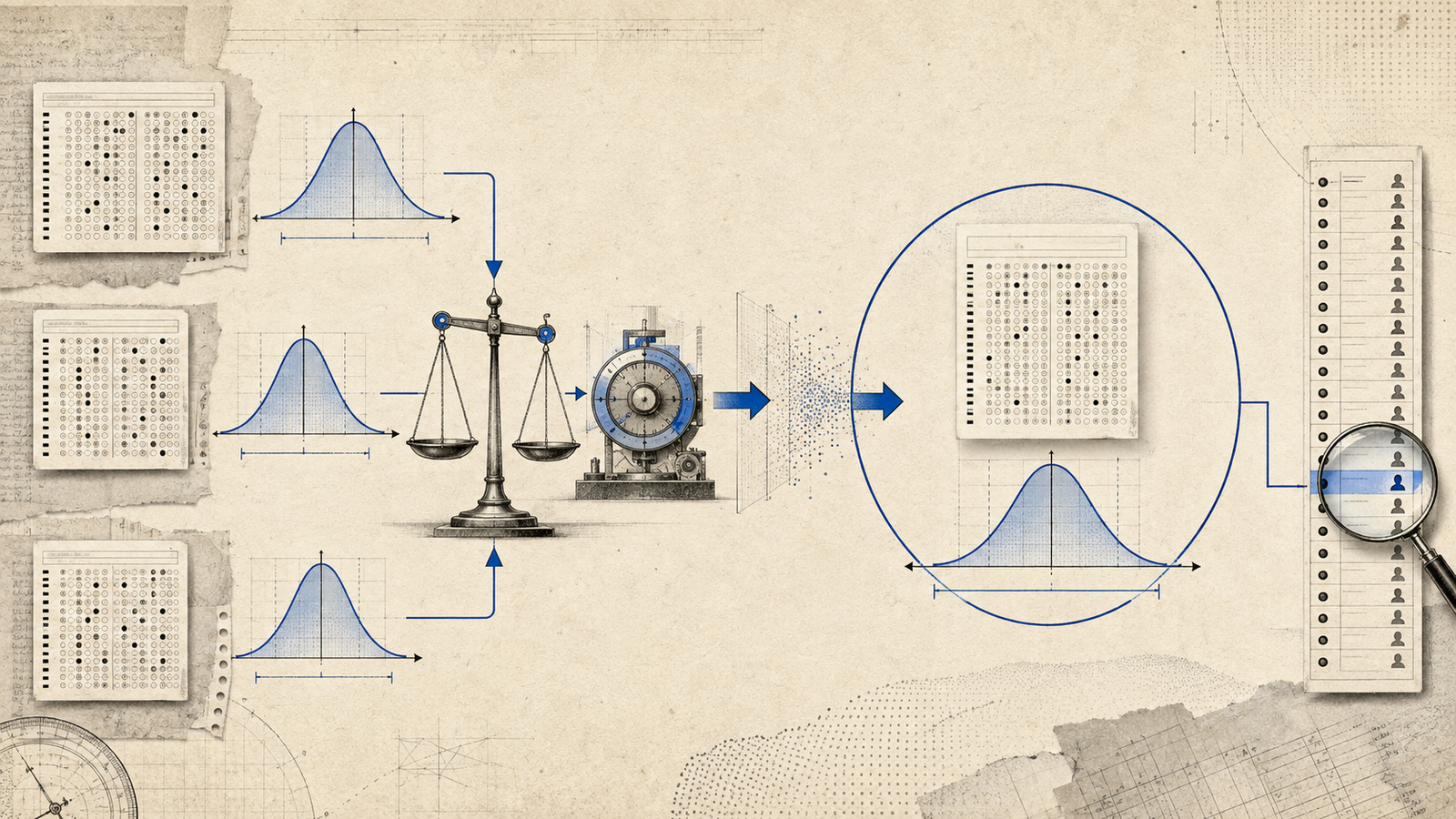
In NEET PG 2024, the exam was conducted in two shifts — a morning shift and an afternoon shift, with different sets of questions for each. Because the question papers were different, the difficulty levels could vary between the two batches. To address this, NBEMS applied a normalisation formula to statistically adjust scores across shifts. This process drew sustained criticism from aspirants who argued it was opaque, mathematically inconsistent, and unfair to candidates assigned the harder shift.
In NEET PG 2026, none of this happens. One paper. One sitting. One ranking system. Your raw score is your final score.
Why NEET PG 2026 Is Now Single-Shift: The Supreme Court Order
The shift to a single-shift format isn't an NBEMS decision — it's a Supreme Court directive.
In May 2025, the Supreme Court of India directed the National Board of Examinations in Medical Sciences (NBEMS) to conduct NEET PG in a single shift, ending the two-shift format that had been operational. The court observed that two question papers can never be of identical difficulty, and any normalisation methodology to adjust between them introduces arbitrariness in a high-stakes ranking examination.
The directive followed petitions from the United Doctors Front (UDF) and a group of NEET PG aspirants who challenged the two-shift system on grounds of fairness and transparency. The court noted that while normalisation may be applied in exceptional circumstances, it should not be the routine method of conducting a national-level competitive examination year after year.
NEET PG 2025 was conducted in a single shift following this order. NEET PG 2026 is the first cycle where the single-shift format is the announced default from the start, with no normalisation provision in the system.
How Single-Shift NEET PG Is Different from Two-Shift NEET PG
The differences go well beyond logistics. Here's a side-by-side comparison.
| Dimension | Two-Shift (2024) | Single-Shift (2026) |
|---|---|---|
| Number of question papers | 2 different sets | 1 common paper |
| Candidates per batch | ~50% of total | 100% of total |
| Difficulty variation between batches | Inevitable | None |
| Normalisation applied | Yes (controversial) | No |
| Raw score vs final score | Different (after normalisation) | Identical |
| Cross-shift comparison disputes | Common | Not possible |
| Number of exam centres required | Lower | Significantly higher |
| Server load at exam time | Distributed across shifts | Concentrated in one window |
| Re-exam demands based on shift difficulty | Recurring issue | Eliminated |
| Rank predictability from mock score | Less reliable | More direct |
The single most important shift in this table is the third row: difficulty variation between batches becomes zero.
In 2024, a candidate scoring 580 in the afternoon shift might rank differently from a candidate scoring 580 in the morning shift, depending on the normalisation outcome. In 2026, every 580 is the same 580 — same paper, same scoring, same standing.
This sounds obvious but it has deep implications for how you should approach your preparation.
The End of Normalisation in NEET PG: What This Means for Your Score
Normalisation, in the NEET PG 2024 framework, was a statistical adjustment applied across two shifts to ensure that candidates from a more difficult shift weren't penalised relative to those from an easier shift. The formula factored in mean scores, standard deviations, and percentile rankings of each shift.
The output was a normalised score that often differed — sometimes by 5–15 marks — from the raw score a candidate had actually obtained.
In NEET PG 2026, this process does not exist.
What that means in practice:
- Your raw score = your final score. The number you see on the answer key analysis is the number that determines your rank.
- Mock test scores translate more directly to expected ranks. In 2024, a mock score of 600 might have been interpreted as a likely rank of 5,000–8,000 depending on normalisation assumptions. In 2026, that 600 maps to a more predictable rank band because the rank-to-score correlation is no longer being mediated by a statistical adjustment.
- No more "I got the harder shift" defence. Aspirants in 2024 who underperformed in the harder shift could partially attribute the result to normalisation effects. In 2026, no such attribution is available. Your performance is your performance.
- Cut-offs become structurally more competitive at the top. In a normalised system, the highest performers across shifts were spread across two papers. In a single-shift system, every top-100 contender is competing on the exact same set of questions. Margins at the top tighten.
- The merit list is genuinely a merit list. This is the deepest change. Whatever else can be debated about NEET PG 2026, the ranking system is now as transparent as it has ever been.
5 Practical Implications of NEET PG 2026 Single-Shift Exam for Aspirants
Beyond the structural change, here is what single-shift exam means for your day-to-day preparation.
Implication 1: Mock Test Score Interpretation Must Be Recalibrated
If you've been using mock test rank predictors built on 2024 normalisation logic, those predictions are now outdated.
In 2024, a mock score of 580 might have been mapped to "Likely rank 8,000–12,000 after normalisation." In 2026, that same 580 maps to a tighter, more direct prediction because no statistical layer is applied.
What to do: Use mock test predictors that have been recalibrated for the post-2025 single-shift framework. Older rank predictors will systematically over-estimate or under-estimate your projected rank.
Reflex's mock test platform, for instance, recalibrated its NEET PG rank prediction model after the 2025 single-shift exam to reflect the new direct-score-to-rank mapping. If your current platform hasn't done this, your projections are based on a different exam.
Implication 2: The Top 1,000 Race Becomes Tighter
In two-shift exams, the highest performers were distributed across two question papers, and the top ranks emerged from a normalisation-mediated comparison. The very top of the merit list — typically the candidates competing for top branches at AIIMS, JIPMER, and PGI — could be partially influenced by which shift they appeared in.
In single-shift, the top 1,000 candidates are competing on the exact same paper. The difference between rank 100 and rank 500 will likely be smaller in score terms than it was in 2024, because every margin is now real, not statistical.
What to do: If you're targeting a top-1,000 rank, focus on minimising silly errors more than on adding new topics. In the top band, two careless mistakes can shift you by 200 ranks. Error logs and mock analysis matter more than ever.
Implication 3: Time Management Pressure Is Unchanged But More Visible
Single-shift doesn't change the time given for the exam — it's still 200 questions in 3 hours 30 minutes. The pressure per question (~63 seconds) remains the same.
What changes is that every candidate is solving the exact same questions under the exact same pressure. There's no "easier shift had more straightforward questions" comparison to fall back on.
What to do: Practice with full-length mock tests that mirror the 3 hours 30 minutes single-block format. The mock score you walk away with is, more than ever, the score you should expect on exam day.
Implication 4: Examination Centre Allocation Will Be More Competitive
A two-shift exam can use the same centre twice in one day, doubling the effective capacity. A single-shift exam needs every candidate seated simultaneously, which means roughly twice the centres are required nationwide.
NBEMS will allocate centres based on the order of city preferences you submit during application. If you submit your preferences late, you may be allocated a centre several cities away from your home.
What to do: Submit your NEET PG 2026 application form within the first 48–72 hours of it opening. Centre allocation in single-shift systems is meaningfully more first-come-first-served than in two-shift systems.
Implication 5: Server Load and Technical Risks Are Concentrated
In a two-shift exam, the platform's server load is distributed across morning and afternoon batches. In a single-shift system, the entire candidate base is logged in within the same window.
NBEMS is widely understood to be reinforcing its server capacity and exam centre infrastructure for 2026, particularly after the NEET UG 2026 paper leak earlier this year prompted a broader review of medical entrance exam security.
What to do: Reach your exam centre well in advance. Carry physical copies of your admit card and identity documents. If you face a technical issue at the centre, raise it immediately with the invigilator — this is documented and considered if any post-exam grievance is filed.
What Doesn't Change in NEET PG 2026 Despite the Single-Shift Format
Equally important to understand: most of NEET PG hasn't changed at all. Don't over-correct your strategy based on the single-shift announcement.
Unchanged elements:
- Number of questions:180 MCQs
- Total marks:720
- Marking scheme: +4 for correct, –1 for incorrect
- Exam duration: 3 hours 30 minutes
- Mode: Computer-based test (CBT)
- Subjects: 19 subjects across Pre-clinical, Para-clinical, and Clinical categories
- Syllabus: Identical to 2025
- Subject-wise weightage: Substantially the same — Medicine, Surgery, Pathology, Pharmacology, and OBGY remain the highest-weight subjects
- Question style: Clinical vignettes, image-based questions, "next best step" management questions — all unchanged from recent years
The exam you're preparing for is the same exam in terms of content and structure. What's different is how your performance translates into your rank.
How to Adjust Your NEET PG 2026 Strategy for a Single-Shift Exam
With 85 days to go from 6th June to 30th August 2026, here are the strategy adjustments that follow from the single-shift change.
1. Anchor Your Preparation to Raw Score Targets
Set a target raw score, not a target normalised score. If your goal is a rank under 5,000, study the actual raw-score-to-rank distribution from NEET PG 2025 (the first single-shift exam) and back-calculate your target.
As a rough guide based on 2025 trends:
- Rank under 1,000: target raw score 620+
- Rank under 5,000: target raw score 540+
- Rank under 10,000: target raw score 490+
- Rank under 20,000: target raw score 440+
These are directional benchmarks based on 2025 patterns. Treat them as targets, not guarantees — 2026 may shift slightly based on overall candidate performance.
2. Prioritise Mock Test Analysis Over Mock Test Volume
In a single-shift exam, your mock score is closer to your real score than ever before. This makes mock analysis more valuable per mock taken.
Instead of running 15 rapid mocks, run 8–10 well-analysed mocks. After each mock:
- Tag every wrong answer by topic and type (diagnosis / management / mechanism)
- Identify whether the error was conceptual or careless
- Maintain a running error log
- Repeat the topics where you have multiple errors
Two well-analysed mocks teach you more than five rushed ones. This was always true. In a single-shift framework where every mark counts, it's even more true.
3. Focus on Silly-Error Reduction in the Final 30 Days
In two-shift exams, normalisation softened the impact of small errors at the margins. In single-shift, it doesn't.
A candidate making 5 careless errors on questions they actually knew loses 25 marks. In 2024, that 25 might have been partially recovered by favourable normalisation. In 2026, those are 25 absolute marks lost.
The fix: In your last 30 days, run weekly "error-only" sessions where you re-solve the questions you've previously got wrong in mocks. This is the highest ROI activity in the final phase.
4. Build a Single-Block Test-Taking Stamina
Even though the exam structure is "single shift," what most aspirants find hardest is the 3 hours 30 minutes of continuous concentration. There are no breaks. You can't get up. You can't reset.
The fix: From mid-July onwards, take at least 2 full-length mock tests per week in single-sitting format — no pauses, no phone checks, no music. Build the mental stamina now. Your concentration in the last 45 minutes of mock 7 is what determines your last 45 minutes on 30th August.
5. Plan Application and Centre Allocation Early
The form is yet to open as of 6th June 2026, but when it does, treat the first 72 hours as your application window. Single-shift centre allocation rewards early submission.
When you fill the form:
- List 3–4 city preferences, including at least one second-tier city near your home
- Submit complete documentation in the first attempt
- Confirm payment with screenshots and download the receipt
A centre 50 km from home, in a city you didn't expect, is a meaningful disadvantage compared to a candidate writing in their own city. The form-submission timing materially affects this allocation.
Potential Risks and Operational Challenges of Single-Shift NEET PG
Single-shift exam is fairer in principle, but it isn't without operational complexity. These are the risks aspirants should be aware of.
Risk 1: Centre allocation pressure. With twice as many centres needed, some candidates may be assigned to less convenient locations. This affects travel and exam-day logistics. Mitigation: apply early and list realistic preferences.
Risk 2: Server stress at exam start. All candidates logging in simultaneously creates a load spike. Mitigation: reach the centre 90 minutes before the start time as advised, follow invigilator instructions, and document any technical issues immediately.
Risk 3: Single point of failure for paper integrity. With one paper for the entire country, the security of the question bank is paramount. NBEMS is widely understood to have strengthened its security protocols after the NEET UG 2026 paper leak. Aspirants should rely only on official communications via natboard.edu.in for any updates.
Risk 4: No fallback if the exam is disrupted. In a two-shift system, an issue in one shift could be isolated. In a single-shift system, any major disruption affects the entire candidate base. Mitigation here is primarily NBEMS's, not yours — but as a candidate, be ready for the possibility (low but non-zero) that a contingency could affect scheduling.
These risks don't undermine the case for single-shift. They simply mean candidates should plan with a wider buffer for the unexpected.
Frequently Asked Questions
Will NEET PG 2026 be in single shift or two shifts?
NEET PG 2026 will be conducted in a single shift on 30th August 2026. This is in line with the Supreme Court of India's May 2025 order directing NBEMS to end the two-shift format. NEET PG 2026 is the first officially announced single-shift cycle from the start.
Will normalisation be applied to NEET PG 2026 scores?
No. Since NEET PG 2026 is a single-shift exam with one common question paper for all candidates, no normalisation will be applied. Your raw score will be your final score, and your rank will be calculated directly from that score.
How does single-shift NEET PG affect my rank?
Your rank in NEET PG 2026 will be a direct reflection of your raw score relative to all other candidates. There is no statistical adjustment between shifts because there is only one shift. This makes the ranking system more transparent and the score-to-rank correlation more predictable.
How is single-shift NEET PG different from two-shift NEET PG?
In two-shift NEET PG (used in 2024), candidates were divided into morning and afternoon batches, each writing a different question paper, with scores normalised across shifts. In single-shift NEET PG (2025 onwards), all candidates write the same paper at the same time, with no normalisation applied. The single-shift format eliminates difficulty variation between batches.
Does single-shift NEET PG mean more candidates per exam centre?
It means a higher total number of exam centres are required, since all candidates have to be seated simultaneously rather than across two batches. Individual centre capacity is similar — what changes is that NBEMS needs to arrange more centres overall, which can sometimes affect centre allocation if you don't apply early.
What is the NEET PG 2026 exam pattern?
NEET PG 2026 consists of 180 multiple-choice questions to be attempted in 3 hours 30 minutes, with a total of 720 marks. The marking scheme is +4 for each correct answer and –1 for each incorrect answer. The exam is conducted in a computer-based test (CBT) mode in a single shift.
Do I need to change my preparation strategy because of single-shift?
The content of your preparation does not need to change — the syllabus, exam pattern, and question style are unchanged. What changes is how you interpret mock test scores (no more normalisation guesswork), how you prioritise silly-error reduction (every mark counts directly), and how early you submit your application form (for better centre allocation).
Does single-shift NEET PG make the exam more competitive?
Structurally, yes — particularly at the top of the merit list, where every candidate is now competing on the exact same paper. There's no "easier shift" advantage to be gained. However, this is also more meritocratic. Your rank reflects your actual performance against actual peers, not a normalisation-mediated comparison.
When was single-shift NEET PG introduced?
The Supreme Court directed NBEMS to conduct NEET PG in a single shift in May 2025, applicable to NEET PG 2025 onwards. NEET PG 2026 is the second cycle under this format and the first to be announced as single-shift from the start of the application cycle.
Will the NEET PG 2026 syllabus change because of single-shift?
No. The single-shift format affects only the conduct of the exam, not the content. The NEET PG 2026 syllabus is identical to NEET PG 2025. The subject-wise weightage, question types, and high-yield topics all remain substantially the same.
What This Means for Your Next 85 Days
The single-shift format is a structural fairness change. It rewards aspirants whose preparation is genuinely strong and removes the lottery element that some candidates relied on in earlier two-shift years.
That is good news if you've been preparing seriously. It is harder news if you were hoping a favourable normalisation would lift your rank.
The strategic implications are clear:
- Trust your raw score in mocks more than ever
- Reduce silly errors because every mark is absolute
- Build single-block stamina for the 3 hours 30 minutes ahead
- Apply early when the form opens, for better centre allocation
- Don't over-correct — the content of your preparation stays the same
The next 85 days are not about adjusting your knowledge base for single-shift. They are about adjusting your expectations and behaviour to a system where every mark you earn is the mark you keep.
If you'd like to see where you stand on the recalibrated, single-shift, raw-score-to-rank scale, Reflex's free NEET PG diagnostic mock test is now aligned to the 2026 framework. The score it gives you, and the projected rank that follows, are based on the post-normalisation system — not the older two-shift estimates that most rank predictors still use.
The exam on 30th August will be the cleanest, most direct test of your preparation that NEET PG has ever been. Prepare accordingly.
Related reading on Reflex:
- NEET PG 2026 Registration Delay: Latest NBEMS Update & 7 Things to Keep Ready
- NEET PG 2026: The 90-Day Strategy for Final-Year MBBS Students & Interns
- Last 5 Years of NEET PG PYQs: What Actually Repeats and What Doesn't
- NEET PG Subject-Wise Weightage 2026: Where the Marks Come From
- NEET PG Mock Test Strategy: How Many, How Often, and How to Analyse
Practise this on Reflex
Turn what you just read into recall with 14 years of tagged PYQs.
About the author
Stay ahead in your preparation
Get expert tips, exam updates, and high-yield insights delivered straight to your inbox.
No spam. Unsubscribe anytime.
More in Exam Guide
View all → Exam Guide
UPSC CMS Exam: Eligibility, Pattern, Syllabus, and How Selection Works
UPSC CMS recruits medical officers for central and Delhi civic services. Here are the eligibility rules, age limit, exam pattern, syllabus, selection stages and how it compares with NEET PG.
 Exam Guide
DNB Full Form in Medical: Course, Admission, and How It Compares With MD/MS
DNB stands for Diplomate of National Board, a postgraduate qualification from NBEMS. Here is how admission, training and the exit exam work, and how DNB compares with MD/MS.
 Exam Guide
INI-CET November 2026: How to Use Your Last 30 Days, Week by Week
 Exam Guide