NEET PG Mock Test Strategy: How to Attempt, Review & Analyse Your Tests
By Dr. Utsav Bhattacherjee, MBBS, MBA · 10 Aug 2026 · 14 min read
Last updated: 23 Sept 2026
On this page
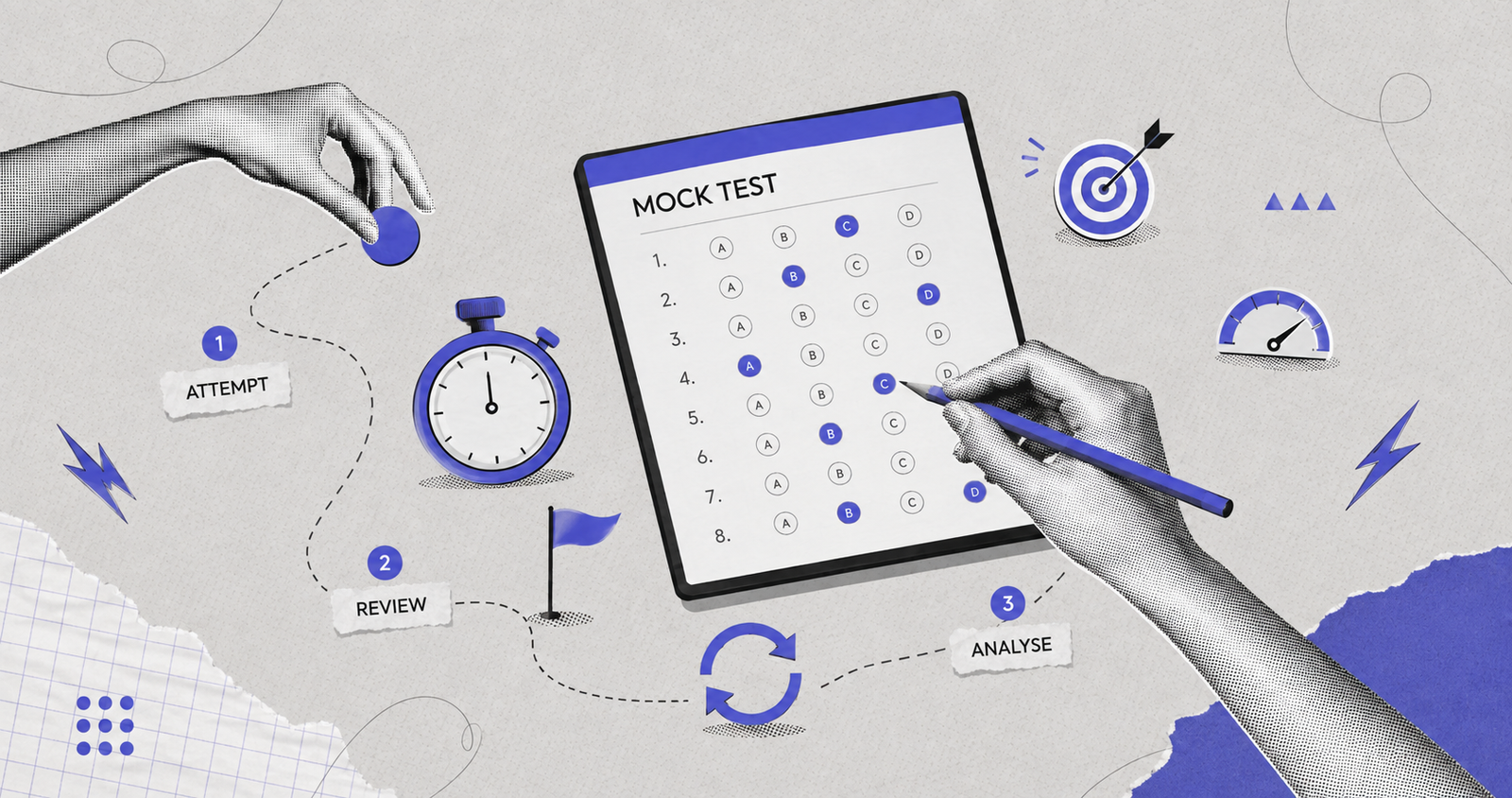
A NEET PG mock test is only as useful as what you do after it. Most aspirants take mocks, glance at the score, feel good or bad for an hour, and move on — and then wonder why their marks plateau. The students who improve treat every mock as a diagnostic tool, not a verdict. This guide lays out a complete NEET PG mock test strategy: how to attempt a test properly, how to review every question, and how to analyse your scores so each mock actually makes you better.
The single most important idea here: the score is the least valuable thing a mock test gives you. The analysis is where the marks are won.
Why mock tests matter in NEET PG preparation
NEET PG is not only a test of knowledge — it is a test of applying knowledge, accurately, under time pressure, across a long paper. You can know the syllabus and still underperform if you have never trained the exam itself. That is what mock tests build.
A good NEET PG mock test does four things a textbook cannot: it builds the mental stamina to stay sharp across a full-length paper, it trains your time management so you never leave questions unattempted, it exposes exactly which topics you are weak in, and it teaches you how the exam frames concepts you thought you knew. None of these come from reading. All of them come from taking mocks and analysing them.
When to start taking mock tests
You do not need to finish the entire syllabus before your first mock. Begin full-length timed mocks once you are a few subjects into your NEET PG study plan, and take them regularly through the rest of your preparation. Early mocks will feel uncomfortable — you will not know everything on them — and that discomfort is the point. Each one shows you what to fix next.
As the exam approaches, increase their frequency. In the final weeks, regular full-length mocks under exam-like conditions should be the backbone of your preparation, alongside revision. By then you are not learning new material — you are sharpening execution.
How to attempt a NEET PG mock test
How you take the test matters as much as the test itself. Treat every mock like the real exam.
Simulate real conditions. Sit the full paper in one timed block, without breaks, notes, or your phone. A mock taken casually in parts teaches you nothing about exam-day stamina or timing. The whole value is in the pressure.
Manage time deliberately. Do not spend three minutes on one hard question while ten easy ones wait unseen at the end. Move through the paper at a steady pace, mark difficult questions to return to, and make sure you see every question. Leaving marks on the table for questions you could have answered is the most avoidable loss in NEET PG.
Make a decision on every question. Attempt, flag-and-return, or educated-guess — but do not freeze. Since the NEET PG marking scheme carries negative marking, learn during mocks where your guessing helps and where it hurts, so your instinct on exam day is calibrated.
Do not check answers mid-test. Complete the whole paper first. The point is to reproduce exam conditions, and exam conditions do not include peeking.
How to review a NEET PG mock test
This is the part most aspirants skip, and it is where the real improvement lives. Reviewing a mock is not checking your score — it is going through the paper question by question.
Go through every question, not just the ones you got wrong:
- Wrong answers: identify the exact concept you missed, not just the right option. Go back to that topic in your notes or book and close the gap. A wrong answer you do not trace back is a wrong answer you will repeat.
- Correct-but-unsure answers: these are silent weaknesses. You got it right this time, but you guessed or were uncertain. Flag these and revise the concept — on exam day the same question might go the other way.
- Correct-and-confident answers: confirm your reasoning was actually right, not right by luck, then move on quickly.
A NEET PG mock test you do not review is a mock half-wasted. The review is where a test converts from a score into a study plan.
How to analyse your NEET PG mock test scores
Beyond individual questions, your mocks contain patterns — and analysing them tells you where to spend your remaining time. This is the difference between taking mocks and using them.
Track subject-wise performance across mocks. Which subjects consistently pull your score down? Those are where your next study hours should go. One weak high-yield subject can cost more marks than several strong ones can earn.
Separate the causes of lost marks. Every wrong answer falls into one of a few buckets, and each needs a different fix:
- Knowledge gaps — you did not know it. Fix: go study that topic.
- Silly mistakes — you knew it but misread or mis-clicked. Fix: slow down, read the full stem.
- Time pressure — you rushed or ran out of time. Fix: work on pacing in the next mock.
- Negative-marking losses — a guess that cost you. Fix: calibrate when guessing is worth it.
Knowing why you lost marks matters far more than knowing how many you lost. Two students can drop the same score for completely different reasons — and need completely different fixes.
Watch the trend, not the single score. One mock score means little. The direction across several mocks means everything. A steady climb says your strategy is working; a plateau says something needs to change. Judge yourself on the trend line, not on any one bad day — a single low mock is data, not a verdict. It also helps to know how marks translate into rank, so you are measuring your mocks against something real rather than a number in isolation.
Use accuracy, not just marks. How many of your attempted questions were correct? Low accuracy with high attempts means you are guessing too much; high accuracy with low attempts means you are too cautious and leaving marks behind. Both are fixable once you see them.
Turning mock analysis into action
Analysis is only useful if it changes what you do next. After each mock, your review should produce a short, concrete list: the two or three topics to revise this week, one execution habit to fix (pacing, reading stems, guessing discipline), and the weak subject to prioritise. Then take the next mock and check whether those fixes moved the numbers. That feedback loop — take, analyse, fix, retake — is what steadily pushes your score up. Mocks without this loop are just repeated measurement of a problem you never address.
How many mock tests should you take?
There is no magic number, but consistency matters more than volume. Regular mocks spread across your preparation, each one properly analysed, beat a last-minute pile of tests you never review. A smaller number of deeply-analysed mocks will improve your score more than a large number of glanced-at ones. The analysis is the work; the test is just what generates it.
Time Allocation Strategy
Efficient time management during the exam improves overall performance.
Recommended Approach
- First hour — attempt approximately 70–80 questions
- Second hour — maintain speed and accuracy
- Final hour — complete remaining questions and review flagged ones
Balancing speed and accuracy is essential.
Develop Intelligent Guessing Skills
Mock tests help you learn how to eliminate incorrect options and make logical decisions. Over time, this skill can improve your score significantly, and practice helps build confidence in decision-making.
Track Your Progress Over Time
Avoid focusing on a single test score. Instead, track trends across multiple mock tests.
What to Monitor
- Accuracy percentage
- Weak subjects
- Time management
- Score consistency
Monitoring progress helps identify long-term improvement.
Managing Stress During Mock Tests
Many students feel anxious after scoring low in mock tests. However, low scores during preparation are valuable learning opportunities — mock tests help reveal weaknesses before the actual exam. A calm and analytical mindset leads to faster improvement.
How to Use Mock Tests in the Final Two Months
During the last phase of preparation, mock testing should become more structured.
Final Phase Strategy
- Weekly full-length mock tests
- Detailed performance analysis
- Immediate revision of mistakes
- Creation of short revision notes
By the final weeks, most revision should come from analyzing previous mistakes.
Common Mock Test Myths to Avoid
- Waiting to complete the syllabus before attempting tests
- Assuming low scores mean poor preparation
- Expecting perfect accuracy before taking mock tests
Mock tests are designed to improve performance, not to judge readiness.
Creating a Personalized Mock Test Plan
Every student has different strengths and weaknesses. Your mock test schedule should match your preparation stage.
Suggested Framework
Foundation Phase
Timeline: 4–5 months before the exam Focus: Concept clarity Frequency: One mock every two weeks
Acceleration Phase
Timeline: 2–3 months before the exam Focus: Mixed subjects and time management Frequency: Weekly full-length mock
Final Phase
Timeline: Last 4–6 weeks Focus: Exam simulation and accuracy Frequency: Weekly grand test with detailed analysis
Consistency in testing leads to consistent improvement.
Final word
A NEET PG mock test is a diagnostic tool, not a scoreboard. Attempt each one under real conditions, review every question, and analyse your scores to find the patterns behind them — the weak subjects, the reasons for lost marks, the trend over time. Then act on what you find and take the next one. Followed this way, mocks become the single fastest way to raise your score in the months before the exam.
Build the habit one question at a time. Practise free NEET PG questions with explanations, organised by subject and difficulty, on our practice question bank — so that by the time you sit a full mock, the analysis is already second nature.
Practise this on Reflex
Turn what you just read into recall with 14 years of tagged PYQs.
FAQ
Frequently asked questions
The questions aspirants ask most about this topic.
Begin full-length timed mocks once you are a few subjects into your preparation, and take them regularly through the rest of it. Early mocks will feel hard — that discomfort is exactly what shows you where to improve.
Review every question, not just the wrong ones. Trace each wrong answer to the concept you missed, flag correct-but-unsure answers as silent weaknesses, and track subject-wise performance and the cause of each lost mark across mocks. The analysis matters more than the score.
There is no fixed number — consistency and analysis matter more than volume. A smaller set of mocks that you review deeply will improve your score more than many mocks you never analyse.
The single score matters far less than the trend across mocks and the analysis behind it. A rising trend shows your strategy is working; one low score is data to learn from, not a verdict on your preparation.
Identify them during review — separate genuine knowledge gaps from misreads and mis-clicks. Once you see how many marks silly mistakes cost you, slow down, read each full question stem, and treat careless errors as seriously as knowledge gaps.
Yes. You do not need to complete the syllabus first. Early mocks reveal your weak areas and build exam stamina, guiding the rest of your preparation rather than just measuring the end of it.
About the author
Stay ahead in your preparation
Get expert tips, exam updates, and high-yield insights delivered straight to your inbox.
No spam. Unsubscribe anytime.
More in Exam Guide
View all → Exam Guide
INI-CET November 2026: How to Use Your Last 30 Days, Week by Week
 Exam Guide
NEET PG 2026 Result Declared: Cutoff 262/720 & Scorecard
 Exam Guide
INI-CET Registration for January 2027: The Two-Stage Process, Documents, and Mistakes to Avoid
 Exam Guide