Top 7 Mistakes That Could Adversely Affect Your NEET PG Prep (And How to Avoid Them)
By Dr. Utsav Bhattacherjee, MBBS, MBA · 26 Apr 2026 · 8 min read
Last updated: 23 Sept 2026
On this page
Preparing for NEET PG is not just about studying harder — it's about studying smarter. Every aspirant begins with dreams of a great rank, a top college, and that proud white coat moment, but between that dream and exam day lies a journey filled with decisions, habits, and strategies. Here's the truth: success is often determined not by knowledge alone, but by avoiding the mistakes that silently reduce your performance.
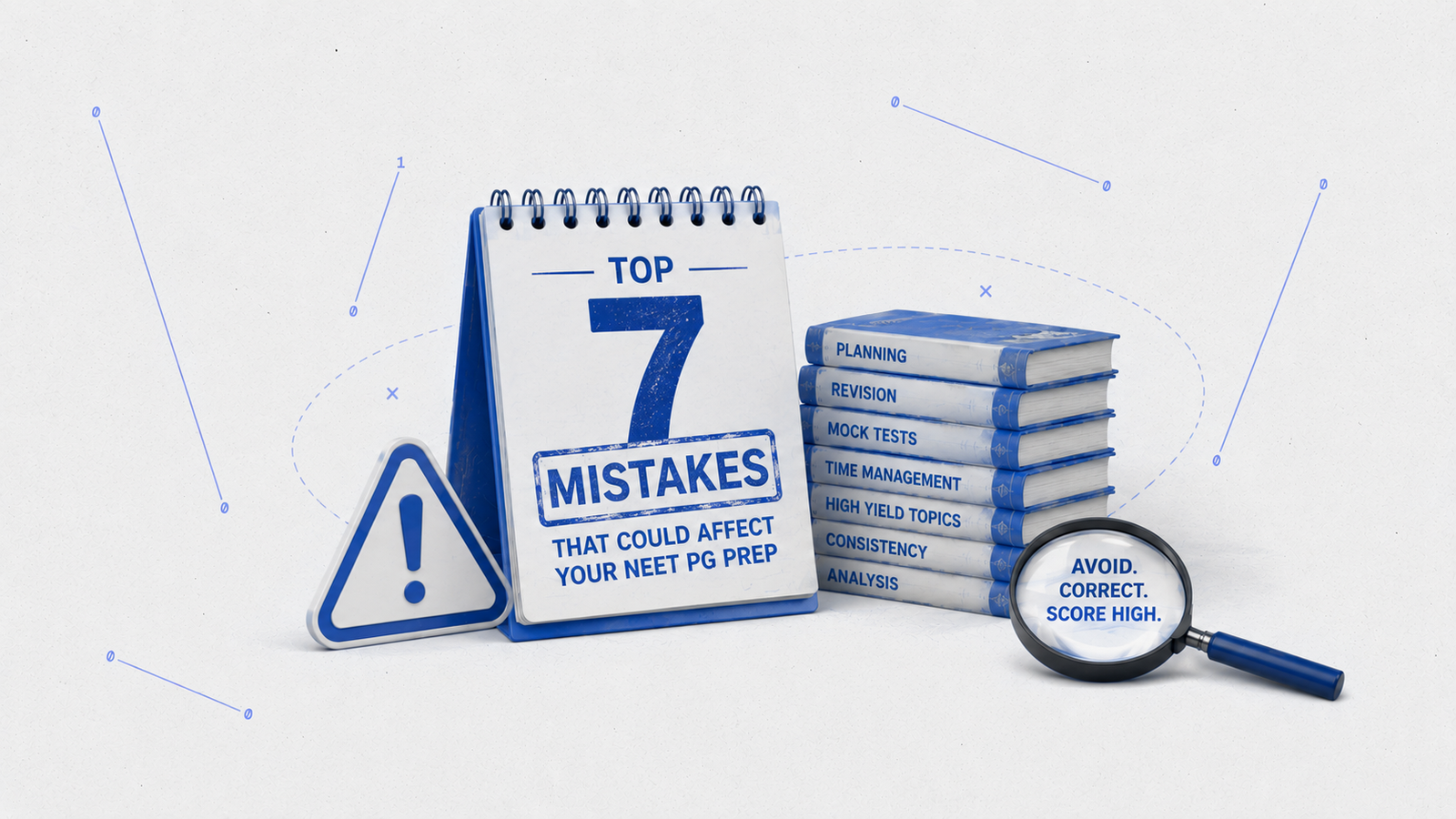
In this guide, we'll discuss the top 7 mistakes that could adversely affect your NEET PG preparation — and more importantly, how you can avoid them.
Key Takeaways
- Revision, not just study hours, is what protects retention — the 3R Rule (Read, Revise, Recall) and a monthly revision timetable help fight the forgetting curve.
- Structured study beats long unplanned hours — the 3-Block Strategy (Concept Study, Revision, MCQ Practice) with timers builds real productivity.
- Stick to one primary resource instead of chasing multiple platforms and notes, which leads to shallow learning and burnout.
- Mock tests (one every 7-10 days, analysed more than attempted) and Previous Year Questions are essential training tools, not optional extras.
- Health (6-7 hours of sleep, hydration, regular breaks) and self-confidence are as important to your score as content knowledge.
Ignoring Revision — The Silent Score Killer
One of the most common mistakes among NEET PG aspirants is underestimating revision. You may study extensively, attend lectures, and make notes — but without revision, retention drops quickly. NEET PG tests your recall under pressure, not just your understanding.
Why It Hurts
- The brain starts forgetting information within 24 hours without revision
- Lack of spaced repetition reduces accuracy in mock tests
- Poor revision increases anxiety and reduces confidence
How to Fix It
- Follow the 3R Rule: Read – Revise – Recall
- Create a monthly revision timetable
- Use tools that support quick recall and repetition
Special Tip: Solving Previous Year Questions (PYQs) regularly is one of the most effective revision methods.
Poor Time Management — Studying Without a Strategy
Many students measure productivity by study hours alone, but long hours without structure often lead to low efficiency. Time mismanagement is one of the biggest factors that negatively impacts NEET PG preparation.
Common Time Wasters
- Spending excessive time on a single topic
- Constantly switching between resources
- Over-revising strong subjects while ignoring weak ones
- Excessive time on social media or discussion groups
The Fix
Use the 3-Block Strategy:
- Concept Study
- Revision
- MCQ Practice
Additional tips:
- Use timers to control study sessions
- Allocate daily time for mock analysis
- Focus on productivity rather than duration
A structured schedule consistently beats long unplanned study hours.
Using Too Many Resources — The FOMO Trap
One of the fastest ways to slow down preparation is resource overload. Many aspirants try to follow multiple platforms, notes, and videos simultaneously, which leads to confusion, burnout, and shallow learning.
Why It’s Dangerous
- You spend more time collecting material than studying it
- Too many sources reduce retention
- Focus shifts away from core concepts
The Better Approach
- Choose one primary resource
- Use additional sources only when necessary
- Stay consistent with your chosen plan
Remember: Toppers don’t study everything — they revise the right material multiple times.
Skipping Mock Tests — Fear of Reality Check
Many aspirants delay mock tests because they feel unprepared, but mock tests are not a final evaluation — they are a training tool.
Why Avoiding Mocks Hurts
- You don’t develop time management skills
- Weak areas remain unidentified
- Exam temperament is not developed
How to Use Mock Tests Correctly
- Attempt one mock every 7–10 days
- Spend more time analysing than attempting
- Maintain a mistake journal
- Track progress monthly
Mock tests convert preparation into performance.
Ignoring Health and Rest — The Hidden Saboteur
During preparation, many students sacrifice sleep and health in the name of productivity, but this approach reduces efficiency and increases burnout.
Scientific Facts
- Sleep improves memory consolidation
- Dehydration reduces focus and attention
- Burnout decreases motivation and emotional stability
Healthy Study Habits
- Sleep 6–7 hours daily
- Maintain regular meals and hydration
- Take short breaks every 90 minutes
- Include light physical activity
NEET PG preparation requires endurance, not exhaustion.
Neglecting Previous Year Questions (PYQs) — Ignoring the Blueprint
Previous Year Questions are one of the most reliable indicators of exam trends, and ignoring them is a major mistake in NEET PG preparation.
Why PYQs Are Essential
- Many questions repeat concepts from previous exams
- They reveal frequently tested topics
- They improve exam-oriented thinking
How to Use PYQs Effectively
- Solve topic-wise PYQs after completing each subject
- Analyse every option carefully
- Track recurring mistakes
- Use structured practice platforms when possible
PYQs provide the clearest roadmap for exam preparation.
Doubting Yourself — The Most Dangerous Mistake
NEET PG preparation is not only academic — it is psychological. Self-doubt can disrupt consistency and reduce performance.
Why It’s Harmful
- It reduces motivation
- It increases procrastination
- It creates unnecessary stress
How to Build Confidence
- Focus on daily progress
- Surround yourself with supportive peers
- Revisit your long-term goals
- Track improvements regularly
Confidence grows through consistent action.
Quick Recap — Top 7 Mistakes to Avoid
- Ignoring revision
- Poor time management
- Using too many resources
- Skipping mock tests
- Ignoring health and rest
- Neglecting PYQs
- Doubting yourself
Avoiding these mistakes significantly improves your performance.
How Smart Tools Can Support Your Preparation
Modern preparation tools can help streamline your workflow by:
- Organizing topic-wise questions
- Tracking performance
- Identifying weak areas
- Supporting structured revision
Using the right tools consistently can make preparation more efficient.
Frequently Asked Questions
What is the biggest mistake NEET PG aspirants make in their preparation?
Ignoring revision is one of the most common and costly mistakes. Studying extensively without a structured revision plan causes retention to drop quickly, since the brain starts forgetting information within 24 hours without revision.
How often should I take mock tests for NEET PG?
Attempt one mock test every 7-10 days, and spend more time analysing your mistakes than attempting the test itself. Maintaining a mistake journal and tracking progress monthly turns mock tests from a stressful exercise into a genuine training tool.
Should I use multiple resources or stick to one for NEET PG prep?
Stick to one primary resource and use additional sources only when necessary. Following multiple platforms, notes, and videos simultaneously leads to confusion, burnout, and shallow learning — toppers revise the right material multiple times rather than trying to study everything.
Why are Previous Year Questions (PYQs) important for NEET PG?
PYQs are one of the most reliable indicators of exam trends, since many questions repeat concepts from previous exams. Solving topic-wise PYQs after completing each subject, analysing every option, and tracking recurring mistakes gives you the clearest roadmap for what to prioritise.
How much sleep do I need during NEET PG preparation?
Aim for 6-7 hours of sleep daily, along with regular meals, hydration, short breaks every 90 minutes, and some light physical activity. Sacrificing sleep and health for extra study hours reduces efficiency and increases the risk of burnout.
How do I stop doubting myself during NEET PG preparation?
Focus on daily progress rather than the distance still to cover, surround yourself with supportive peers, revisit your long-term goals, and track improvements regularly. Confidence grows through consistent action, not through eliminating doubt entirely.
Final Thoughts
NEET PG preparation is challenging, but manageable with the right strategy — you don't need to be perfect, you need to be consistent. Avoid the common mistakes covered above, revise regularly, practice smartly, and maintain confidence throughout your journey.
Your dream seat is achievable — stay focused and keep moving forward.
Practise this on Reflex
Turn what you just read into recall with 14 years of tagged PYQs.
About the author
Stay ahead in your preparation
Get expert tips, exam updates, and high-yield insights delivered straight to your inbox.
No spam. Unsubscribe anytime.
More in Exam Guide
View all → Exam Guide
UPSC CMS Exam: Eligibility, Pattern, Syllabus, and How Selection Works
UPSC CMS recruits medical officers for central and Delhi civic services. Here are the eligibility rules, age limit, exam pattern, syllabus, selection stages and how it compares with NEET PG.
 Exam Guide
DNB Full Form in Medical: Course, Admission, and How It Compares With MD/MS
DNB stands for Diplomate of National Board, a postgraduate qualification from NBEMS. Here is how admission, training and the exit exam work, and how DNB compares with MD/MS.
 Exam Guide
INI-CET November 2026: How to Use Your Last 30 Days, Week by Week
 Exam Guide