Psoriasis for NEET PG: Auspitz, Koebner and Woronoff Signs, Plus the Treatment Ladder
Reflex · 4 Nov 2026 · 14 min read
Last updated: 4 Nov 2026
On this page
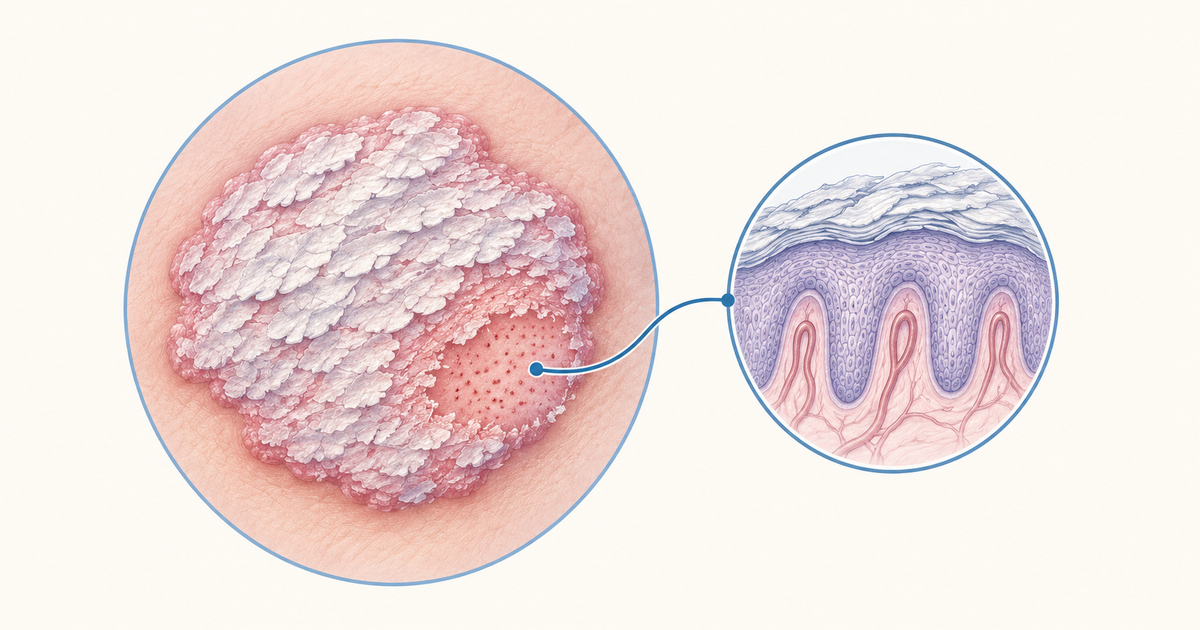
Psoriasis is a chronic, immune-mediated skin disease. It produces well-defined red plaques with silvery scale, and its signs map neatly onto its histology. If you can explain why a scraped plaque bleeds, why a scratch grows a new lesion and why a pale ring appears as a plaque heals, you already understand most of the disease.
This guide covers the three named signs, the clinical types, the histology behind them, how severity is graded, and the treatment ladder from emollients to biologics.
Key Takeaways
Auspitz sign: scraping the scale gives pinpoint bleeding, because dilated dermal capillaries sit just under a thinned epidermis over the papillae.
Koebner phenomenon: new lesions appear at sites of skin injury, and the new lesions look the same clinically and histologically as the disease.
Woronoff ring: a pale halo around a plaque that is regressing with treatment, so it points to response and not to a new problem.
Types: plaque psoriasis is by far the commonest form; guttate, inverse, erythrodermic and pustular forms need to be told apart by pattern.
Severity: mild disease means BSA, PASI and DLQI all at 10 or below; moderate-to-severe means BSA or PASI above 10 with DLQI above 10.
Ladder: topicals, then phototherapy, then conventional systemics (methotrexate, ciclosporin, acitretin), then biologics and targeted agents.
What is psoriasis?
Psoriasis is a chronic inflammatory skin disease in which keratinocytes turn over too quickly and the skin thickens and scales. Plaque psoriasis is the most common pattern in every racial group, according to DermNet. A narrative review in PMC puts plaque disease at roughly 80 to 90 percent of cases.
The disease is not only cutaneous. Joint involvement (psoriatic arthritis) is estimated to affect anywhere from under 10 percent to about 40 percent of patients, and about one in five of those with joint disease present with the joints first, as summarised in the same review. The wide range is itself a fact worth remembering: no single prevalence figure is reliable.
Diagnosis is mainly clinical. A biopsy is kept for atypical presentations, which is why the bedside signs below matter.
Signs of plaque psoriasis: Auspitz, Koebner and Woronoff
Three signs are worth learning as a set, because each one reflects a different layer of the pathology. The table gives the pattern, then the sections below add the detail.
| Sign | What you see | Underlying mechanism | Caution |
|---|---|---|---|
| Auspitz sign | Pinpoint bleeding after the scale is removed | Dilated, tortuous papillary capillaries under a thinned suprapapillary epidermis | Not specific to psoriasis |
| Koebner phenomenon | New lesions along sites of trauma | Isomorphic response to injury | Patient may be negative at one time and positive later |
| Woronoff ring | Pale halo around a plaque | Seen as plaques regress on treatment | Cause not firmly established; evidence is weaker |
Auspitz sign
The Auspitz sign is pinpoint bleeding when the dry scale of a plaque is scraped off. DermNet and the PMC review both attribute it to dilated, twisting capillaries in the papillary dermis lying beneath a thin epidermis.
Think of it as the clinical twin of the histology: the epidermis over each dermal papilla is thin, so removing the scale tears open the capillary beneath. The sign is not unique to psoriasis; it has also been described in actinic keratosis and Darier disease, according to an Actas Dermo-Sifiliograficas article. The same article questions whether Auspitz himself described it, which is trivia, not something to build an answer on.
A related bedside observation is the "candle-grease" quality of the scale, where the silvery scale scrapes off like wax. This is a textbook description, so treat it as a qualitative pattern and pair it with the Auspitz sign when you work through a stem.
Koebner phenomenon
The Koebner phenomenon, also called the isomorphic response, is the appearance of new lesions at sites of skin injury. DermNet lists cuts, abrasions and sunburn as typical triggers. "Isomorphic" means that the new lesions are identical to the disease, both clinically and under the microscope, as the StatPearls entry describes it.
The sign is not fixed in a patient. Someone can be Koebner-negative for years and become positive later. The phenomenon is also not unique to psoriasis; vitiligo, lichen planus and warts are the other diseases usually grouped with it in textbooks, which makes it useful for comparison rather than for diagnosis.
A practical point: if a stem describes linear plaques along a scratch or surgical scar in a known psoriatic, name the phenomenon first and the disease second.
Woronoff ring
The Woronoff ring is a pale, blanched halo of fairly constant width around a psoriatic plaque that is regressing, usually after phototherapy or topical treatment. The evidence base is thinner here: descriptions come from a paper on the Woronoff ring in PMC, a reference summary of Woronoff's ring and a case report of the ring after adalimumab, which suggests it may reflect treatment response.
The PMC paper describes a hypopigmented ring around regressing lesions. Its cause was long unexplained, and older explanations involved prostaglandins. For revision, remember one idea: a Woronoff ring means the plaque is healing, not spreading.
Types of psoriasis: plaque psoriasis and its variants
Plaque psoriasis dominates, but the minor types carry the distinct clues and the different management. The percentages below come from the PMC overview; clinical features come from DermNet.
| Type | Approximate share | Key features |
|---|---|---|
| Chronic plaque | 80 to 90% | Well-defined plaques with silvery scale on elbows, knees, lower back and scalp |
| Guttate | Under 2% | Many small drop-like plaques, often 2 to 3 weeks after a group A streptococcal infection; often clears over months |
| Inverse (flexural) | 3 to 7% | Smooth, well-defined patches in folds and genitals; often complicated by Candida |
| Erythrodermic | About 1% | Widespread redness; triggers include antimalarials, abrupt steroid withdrawal, excess UV and infection |
| Pustular (generalised, palmoplantar) | Not quantified | Sterile pustules within the epidermis |
Other patterns include scalp, sebopsoriasis and palmoplantar disease. DermNet also separates small plaque disease (plaques under 3 cm) from chronic plaque disease (over 3 cm).
Nail changes are worth a separate line. Pitting is the most common finding and comes from the nail matrix, while the oil-drop (salmon) patch arises from the nail bed. Onycholysis, yellowing and ridging also occur, and nail disease is associated with inflammatory arthritis, as per DermNet.
Histology of plaque psoriasis and how it explains the signs
Each histological finding has a clinical counterpart, and learning them as pairs removes the need to memorise two separate lists. The correlations below draw on the PMC overview and histopathology reviews of psoriasiform dermatoses.
| Histological finding | Clinical correlate or description |
|---|---|
| Hyperkeratosis with parakeratosis | Thick, silvery scale |
| Loss of the granular layer | Dry scale that detaches easily |
| Regular acanthosis with elongated rete ridges | Raised, thickened plaque |
| Thin suprapapillary plates over dilated, tortuous vessels | Auspitz sign |
| Neutrophils in the parakeratotic stratum corneum (Munro microabscess) | Collections of neutrophils within the scale layer |
| Neutrophilic micropustules in the spinous layer (spongiform pustule of Kogoj) | Collections of neutrophils within the epidermis, below the scale |
| Dermal infiltrate of leukocytes | Redness and warmth |
Uninvolved skin looks normal under the microscope. Spongiform pustules are not exclusive to psoriasis; they also appear in acute generalised exanthematous pustulosis, as noted in the StatPearls chapter on generalised pustular psoriasis.
Triggers and drugs that worsen psoriasis
Knowing the triggers helps you both explain a flare and avoid causing one. DermNet lists streptococcal tonsillitis and other infections (including HIV), skin injury, sunburn, dry skin, obesity, smoking, heavy alcohol use, stress and stopping oral or strong topical steroids. Sunlight usually helps; only a minority worsen with sun.
Several drug groups are listed as triggers or aggravators: lithium, antimalarials, NSAIDs, ACE inhibitors and angiotensin receptor blockers, terbinafine and immunotherapy. Beta-blockers are commonly listed too, but the evidence is not uniform, and one case-control study summarised in the PMC overview did not find a link.
DermNet's page on drug-induced psoriasis draws a useful distinction:
- Drug-induced: appears in people without a prior history and clears when the drug is stopped.
- Drug-aggravated: persists in people with a personal or family history.
The first step is to stop the offending drug when possible, though this is not always feasible (lithium is the usual example). Topical steroids have also been reported to trigger a pustular episode.
Grading severity: PASI, BSA and DLQI
Severity guides the treatment step, and the EuroGuiDerm S3 guideline sets explicit thresholds. PASI was introduced in 1978, ranges from 0 to 72, and combines body surface area with erythema, induration and scaling. DLQI measures quality of life.
| Category | Criteria |
|---|---|
| Mild | BSA 10 or below, and PASI 10 or below, and DLQI 10 or below |
| Moderate-to-severe | (BSA above 10 or PASI above 10) and DLQI above 10 |
| Particularly severe | PASI 20 or above, DLQI 15 or above, rapid deterioration, or severe hand, foot, scalp, face, nail or genital disease |
A mild case is upgraded when it involves visible areas, scalp, genitals, palms or soles, when two or more fingernails show onycholysis or onychodystrophy, when itch leads to scratching, or when plaques resist treatment. So a patient with a small BSA can still be treated as moderate-to-severe.
Treatment goals in the same guideline: PASI 75 at the end of induction at minimum, with PASI 90, an absolute PASI below 2, or DLQI of 1 or less as the desired target. Response is checked at 10 to 12 weeks for fast-acting drugs and 16 to 24 weeks for slower ones.
Treatment ladder for psoriasis
The ladder runs from topicals through phototherapy and conventional systemics to biologics. Move up when the current step fails, when severity or site demands it, or when contraindications close a door. The sources used are DermNet's treatment page, the Latin America guideline and the EuroGuiDerm guideline.
| Step | Options | Notes |
|---|---|---|
| 1. Topicals | Emollients, keratolytics (urea, salicylic acid), topical steroids, vitamin D analogues, coal tar, short-contact dithranol, calcineurin inhibitors, tazarotene | Steroid potency matched to site |
| 2. Phototherapy | NB-UVB, PUVA | 2 to 3 sessions a week for about 20 to 30 treatments |
| 3. Conventional systemics | Methotrexate, ciclosporin, acitretin; also apremilast and others | Dose and monitoring matter |
| 4. Biologics and targeted agents | TNF, IL-17, IL-12/23 and IL-23 inhibitors; deucravacitinib | Screen for TB first |
Step 1: topical therapy
Emollients help every patient. Keratolytics such as urea (5 to 40 percent) and salicylic acid (0.5 to 10 percent) lift scale. Topical steroids work, but potency must match the site: weak ones for the face, flexures and genitals, potent ones for palms and soles. Tachyphylaxis limits long-term use, and potent steroids on flexures cause atrophy.
Vitamin D analogues (calcipotriol, calcitriol, tacalcitol) are used up to a limit of 100 g per week, and calcipotriol with betamethasone is often a first choice for plaque disease.
Other options are coal tar, short-contact dithranol, calcineurin inhibitors (off-label, useful on thin skin), tazarotene, roflumilast 0.3 percent and tapinarof 1 percent.
For genital and flexural disease the Latin America guideline treats topical therapy as first line, with local irritation as the limit.
Step 2: phototherapy
Narrowband UVB suits thin plaque and guttate disease, with sessions two to three times a week over roughly 20 to 30 treatments. It is considered safe in pregnancy with folic acid. PUVA is reserved for thick plaques and hand and foot disease; it carries a higher skin cancer risk, so lifetime treatments are capped, and it is avoided in pregnancy and breastfeeding.
The Latin America guideline found no meaningful PASI 75 difference between NB-UVB and PUVA, and noted useful combinations: methotrexate with NB-UVB, and acitretin with PUVA. Access is the practical limit in remote areas.
Step 3: methotrexate, ciclosporin and acitretin
These three share a theme: each has a dose range, a monitoring routine and a pregnancy rule. The table collects them. Always read doses as guideline ranges, since different guidelines start at different points.
| Drug | Dose as reported | Monitoring and cautions | Pregnancy |
|---|---|---|---|
| Methotrexate | 15 mg once weekly, may rise to 20 mg, never above 25 mg (EuroGuiDerm); Latin America starts 7.5 to 15 mg weekly with a target of 15 to 20 mg | Blood count and liver enzymes; check renal function before starting; alcohol abstinence; folic acid 5 mg weekly, 24 hours after the dose | Effective contraception; avoid pregnancy during and for 3 months after |
| Ciclosporin | 2.5 to 5 mg/kg/day in 8 to 12 week courses (DermNet); 3 to 5 mg/kg/day, ideally no longer than 1 year (Latin America) | Blood pressure and renal function; hypertension, renal failure, infection, skin cancer | Permitted but may raise complication risk; not for breastfeeding |
| Acitretin | 0.3 to 0.7 mg/kg/day | Mucocutaneous dryness, liver and lipid effects | Contraindicated; contraception during and for at least 3 years after |
Methotrexate is a weekly drug. Daily dosing instead of weekly is a recognised and dangerous error, and subcutaneous injection is preferred above 15 mg or to avoid overdose, as per the EuroGuiDerm guideline. Patients with respiratory symptoms should be checked for alveolitis. Prolonged use can damage the liver, so watch liver enzymes.
Ciclosporin acts fast, which makes it useful for acute flares and severe disease. Its duration is deliberately limited because of nephrotoxicity. Acitretin is especially useful in palmoplantar disease, and both acitretin and ciclosporin are avoided as first-line choices in patients with dyslipidaemia, per the second EuroGuiDerm part.
Acitretin carries a long contraception window, so attach the number three years to the drug in your notes. Its other adverse effects (liver injury, raised triglycerides, dry mucosa and skin) are standard textbook content.
Apremilast, a PDE-4 inhibitor, is another oral option, and it carries nausea, diarrhoea and reports of suicidal behaviour. Fumaric acid esters, hydroxyurea, mycophenolate and sulfasalazine are less central.
Step 4: biologics and targeted therapy
Biologics are for moderate-to-severe disease after topical or systemic failure. The classes are best learned by target.
| Class | Agents |
|---|---|
| TNF-alpha inhibitors | Infliximab (IV), etanercept, adalimumab, certolizumab, golimumab |
| IL-17 inhibitors | Secukinumab, ixekizumab, brodalumab, bimekizumab |
| IL-12/23 inhibitor | Ustekinumab |
| IL-23 inhibitors | Guselkumab, risankizumab, tildrakizumab |
| TYK2 inhibitor (oral) | Deucravacitinib |
In the EuroGuiDerm network meta-analysis, infliximab, IL-17 inhibitors and IL-23 inhibitors (except tildrakizumab) were more likely to reach PASI 90 than ustekinumab, the three older anti-TNF agents and deucravacitinib. Etanercept was inferior to adalimumab, tildrakizumab and ustekinumab.
The French systemic guideline proposes methotrexate, adalimumab or ustekinumab as first systemic choices when there are no symptomatic comorbidities.
For very extensive disease (BSA above 50 percent) or a heavy disease burden, it suggests considering an IL-17 or IL-23 inhibitor, or infliximab.
Deucravacitinib is used after contraindication, intolerance or failure of a biologic.
Screen for tuberculosis before starting any biologic. Reactivation risk is very low with IL-17 and IL-23 inhibitors, so those are suggested when latent TB cannot be treated.
Special forms of psoriasis and special situations
Some patterns change the drug choice, as set out in the French and Latin America guidelines:
- Generalised pustular flare: spesolimab, an IL-36 receptor antibody; maintenance is spesolimab, a TNF inhibitor or an IL-17 inhibitor.
- Erythrodermic psoriasis: IL-17 inhibitor, IL-23 inhibitor or infliximab first line.
- Palmoplantar pustular disease: IL-17 inhibitor, IL-23 inhibitor or ciclosporin.
- Psoriasis with inflammatory bowel disease: TNF inhibitors, IL-12/23 or IL-23 inhibitors; IL-17 inhibitors are avoided.
- Recent or active cancer: NB-UVB, acitretin or methotrexate first line.
- Nail psoriasis: adalimumab, etanercept, guselkumab, infliximab, ixekizumab, risankizumab, secukinumab or ustekinumab, with a modified NAPSI below 10 as the target.
How to study psoriasis efficiently
Build one page that links sign, histology and drug. Draw the epidermis from memory with elongated rete ridges, thin suprapapillary plates and Munro microabscesses, then write the matching sign next to each feature. If a stem gives you pinpoint bleeding, think of the thin plate over the capillary; if it gives you a pale halo, think of regression.
For drugs, learn the classes by target and the three conventional systemics by their rule: methotrexate weekly with folic acid, ciclosporin short and watched for kidney and pressure, acitretin never in pregnancy.
Memory aid (a study device written for this guide, not a published mnemonic): "Methotrexate is weekly, folic acid follows the next day; acitretin never in pregnancy." It compresses three rules from the table above into one line.
Then test yourself on the dermatology questions in the papulosquamous disorders practice set and compare the pattern with pityriasis rosea, another scaly eruption you will need to separate from psoriasis.
For wider revision of the subject, the dermatology topic overview places psoriasis among the other conditions in the specialty.
Psoriasis revision summary
Psoriasis rewards structure. The Auspitz sign, the Koebner phenomenon and the Woronoff ring each reflect a different part of the disease, from capillaries to injury response to healing. Treatment then follows severity: topicals, phototherapy, a conventional systemic with careful monitoring, and biologics chosen by target and by special site.
Learn the Woronoff ring, the candle-grease scale and the acitretin adverse effects as descriptive patterns, and spend most of your revision time on the severity thresholds, the methotrexate dose limits and the pregnancy rules.
Practise this on Reflex
Turn what you just read into recall with 14 years of tagged PYQs.
FAQ
Frequently asked questions
The questions aspirants ask most about this topic.
The Auspitz sign is pinpoint bleeding that appears when the scale of a psoriatic plaque is scraped off. It happens because dilated, tortuous capillaries in the dermal papillae lie beneath a thinned epidermis. It is not specific to psoriasis and has also been described in actinic keratosis and Darier disease.
The Koebner phenomenon, or isomorphic response, is the appearance of new lesions of the same disease at sites of skin injury such as cuts, abrasions or sunburn. The new lesions look the same clinically and histologically as the original disease. A patient can be negative at one time and positive later.
A Woronoff ring is a pale, blanched halo of fairly constant width around a psoriatic plaque that is regressing after phototherapy or topical treatment. It has also been reported after biologic treatment and is read as a sign of response, not of spread.
In the EuroGuiDerm guideline, mild disease means BSA, PASI and DLQI all at 10 or below. Moderate-to-severe disease means BSA or PASI above 10 together with DLQI above 10. A mild case can be upgraded for visible, scalp, genital, palm or sole involvement, two or more affected fingernails, itch with scratching, or resistant plaques.
The EuroGuiDerm guideline gives 15 mg once weekly as the usual starting and maintenance dose, which can be raised to 20 mg and should not exceed 25 mg. Folic acid 5 mg is given once weekly, 24 hours after the methotrexate. Daily dosing by mistake is a known and dangerous error.
Lithium, antimalarials, NSAIDs, ACE inhibitors, angiotensin receptor blockers, terbinafine and immunotherapy are listed as triggers. Beta-blockers are commonly listed too, although one case-control study did not find a link. Stopping oral or strong topical steroids can also provoke a flare.
Stay ahead in your preparation
Get expert tips, exam updates, and high-yield insights delivered straight to your inbox.
No spam. Unsubscribe anytime.
More in Subject Notes
View all → Dermatology
Pityriasis Rosea for NEET PG: The Herald Patch, the Christmas-Tree Pattern and the Papulosquamous Differential
 Dermatology
 for NEET PG 2026: Bullous Disorders, Lichen Planus, Leprosy, and High-Yield Signs
Dermatology is 5 to 9 questions of pure pattern recognition. Pemphigus versus pemphigoid, the Koebner family, Ridley-Jopling and lichen planus pigmentosus — the topics that actually repeat.
 Anesthesia
ASA Physical Status Classification for NEET PG: Classes I to VI, Examples and the E Modifier
A clear walk through the ASA physical status classification: what each class means, example patients, the E modifier for emergencies, and the sorting mistakes to avoid.
 Psychiatry
Defense Mechanisms for NEET PG: Mature, Immature and Neurotic Defenses with One Example Each
Learn defense mechanisms as a ladder from pathological to mature, with one worked example per level, clear notes on projection and sublimation, and where Vaillant's scheme and the DMRS disagree.