Pityriasis Rosea for NEET PG: The Herald Patch, the Christmas-Tree Pattern and the Papulosquamous Differential
By Dr. Utsav Bhattacherjee, MBBS, MBA · 5 Oct 2026 · 10 min read
Last updated: 8 Oct 2026
On this page
Pityriasis rosea questions come down to recognising two lesions and ruling out one mimic. The lesions are the herald patch and the Christmas-tree rash that follows it, and the mimic that matters most is secondary syphilis. Get those three things right and the rest of the papulosquamous differential becomes a matter of comparing features.
What Pityriasis Rosea Is
Pityriasis rosea is an acute, self-limiting papulosquamous eruption, seen most often in adolescents and young adults. It does not need a cure because it clears by itself, typically within six to eight weeks, although the range is wider. Some patients report a mild illness beforehand, such as malaise or a sore throat. Reactivation of human herpesvirus 6 and 7 has been implicated as a cause, but that link rests on association rather than proof, and the condition is not regarded as meaningfully contagious. Exam questions focus almost entirely on how it looks and what it must be told apart from.
The Herald Patch
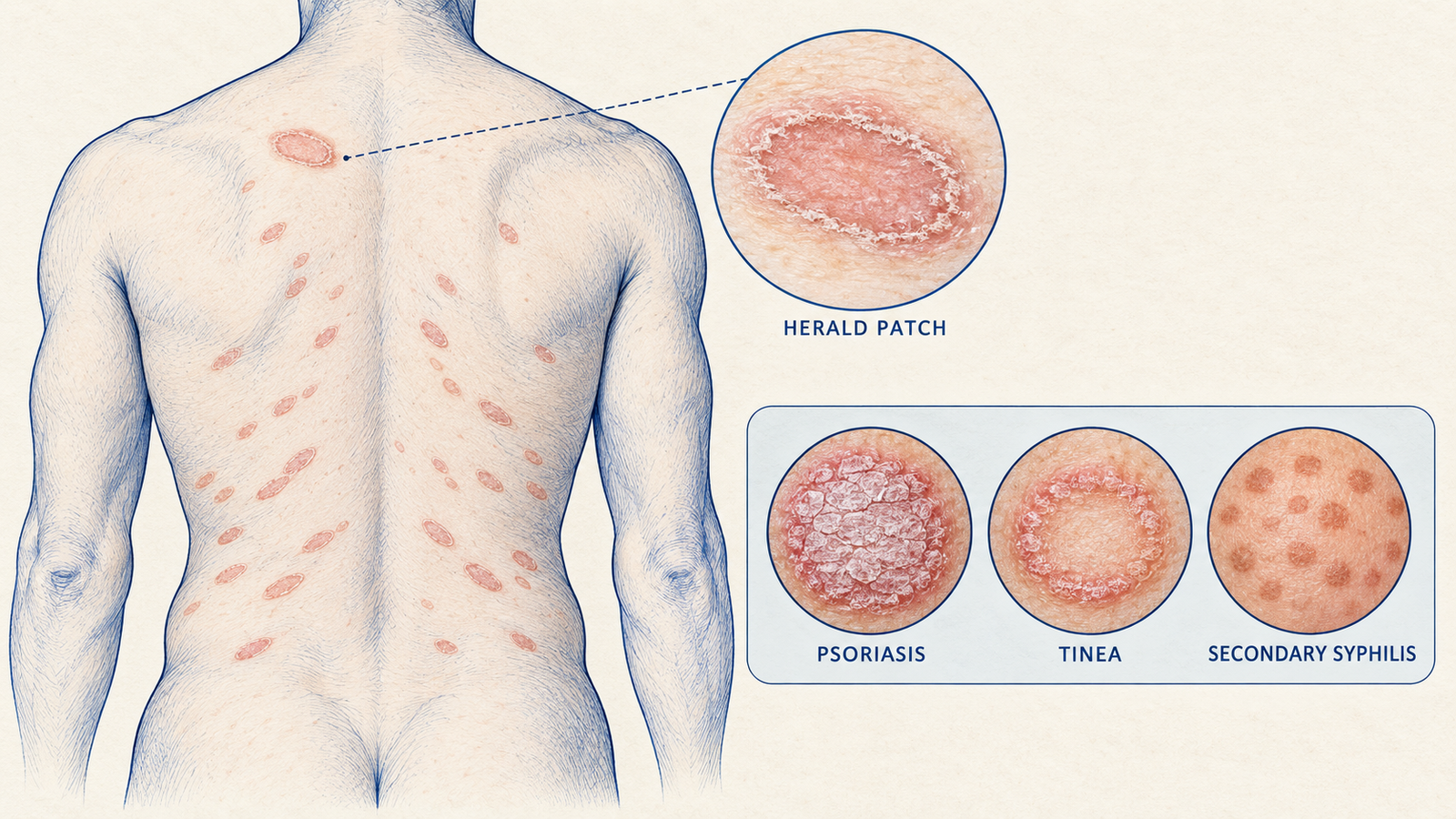
Most patients, though not all, first develop a single larger lesion called the herald patch or mother patch. It is an oval, pink to salmon-coloured plaque, usually on the trunk or proximal limbs, with a fine scale that is attached at the edge and free towards the centre. This ring of scale is called a collarette or trailing scale. At this stage it is often mistaken for ringworm. The generalised eruption follows days to a couple of weeks later.
The Secondary Eruption and the Christmas-Tree Pattern
The generalised rash is made of many smaller oval pink or tan macules and thin plaques, each with the same collarette scale, mainly on the trunk and proximal limbs. The long axis of each oval lies along the lines of skin cleavage, known as Langer's lines, which on the back run obliquely downward and outward from the spine. The result is a drooping, fir-tree arrangement called the Christmas-tree pattern. The face, palms and soles are usually spared, and that sparing is itself a clue, because secondary syphilis, the key mimic, characteristically does not spare the palms and soles.
Herald Patch or Ringworm?
The two are easy to confuse. A herald patch has scale that trails inward from the edge and leaves a smoother centre, while a typical ringworm lesion is a ring with an active, scaly, advancing border and central clearing. A KOH preparation settles the question quickly, because tinea shows fungal hyphae and pityriasis rosea does not, and it spares the patient a pointless course of antifungals.
Symptoms and Variants Worth Recognising
Itch is variable and often mild, though some patients are troubled by it. The inverse form affects the axillae, groin and flexures instead of the trunk. A papular form is described more often in children and in darker skin, and rarer vesicular, urticarial and purpuric forms exist. Atypical presentations are the ones most often confused with other diseases, which is why the diagnosis is clinical but should be revisited whenever the course is unusual.
Diagnosis
Pityriasis rosea is diagnosed clinically. A biopsy is rarely needed and shows only non-specific changes, such as focal parakeratosis, mild spongiosis, a perivascular lymphocytic infiltrate and extravasated red cells, so it cannot confirm the diagnosis. Tests are used mainly to exclude mimics. A KOH preparation excludes tinea corporis, and syphilis serology (VDRL or RPR, with confirmatory testing) is advised in sexually active patients, in anyone with palm or sole involvement, mucosal lesions or lymph node enlargement, and whenever the picture is atypical.
The Papulosquamous Differential
| Condition | Typical lesion | Where | Itch | Key clue |
|---|---|---|---|---|
| Pityriasis rosea | Oval pink macules with collarette scale, after a herald patch | Trunk and proximal limbs; face, palms and soles usually spared | Variable, often mild | Herald patch; Christmas-tree pattern |
| Psoriasis (plaque or guttate) | Well-demarcated red plaques with silvery scale | Extensor surfaces, scalp, nails | Mild to moderate | Auspitz sign; Koebner phenomenon; guttate form follows streptococcal infection |
| Lichen planus | Violaceous, flat-topped, polygonal papules | Flexor wrists, shins, mouth | Intense | Wickham striae; mucosal lesions |
| Secondary syphilis | Copper-coloured macules and papules | Generalised, including palms and soles | Usually absent | Mucous patches, generalised lymphadenopathy, positive serology |
| Tinea corporis | Annular plaque with central clearing and a scaly active edge | Any site, usually asymmetrical | Present | KOH shows hyphae |
| Pityriasiform drug eruption | Rash resembling pityriasis rosea | Trunk | Variable | Recent new drug (ACE inhibitors such as captopril are a classic cause); herald patch usually absent |
Pityriasis Rosea vs Secondary Syphilis
This is the comparison examiners return to most. In pityriasis rosea there is a herald patch, the palms and soles are spared, mucosal lesions are absent, lymph nodes are not generally enlarged and serology is negative. In secondary syphilis there is often no herald patch, the palms and soles are commonly involved, mucous patches or condylomata lata may be present, generalised lymph node enlargement is typical and serology is positive. If a vignette mentions palm and sole lesions, think of syphilis first.
The Pityriasis Family
The word pityriasis means fine scaling, and several unrelated conditions carry it. Examiners like to mix them up, so keep the four main ones apart.
| Condition | Cause or setting | Appearance | Key clue |
|---|---|---|---|
| Pityriasis rosea | Probable HHV-6 and HHV-7 reactivation | Herald patch, then oval scaly macules | Christmas-tree pattern |
| Pityriasis versicolor | Malassezia yeast | Hypo- or hyperpigmented scaly macules on the trunk | KOH shows 'spaghetti and meatballs' hyphae and spores; yellowish fluorescence under Wood's lamp |
| Pityriasis alba | Children with atopic tendency | Ill-defined, hypopigmented, scaly patches, mostly on the face | Improves with moisturisers and settles by itself |
| Pityriasis rubra pilaris | Rare; inherited and acquired forms | Orange-red scaly plaques with follicular papules | Islands of sparing; palmoplantar keratoderma |
Pityriasis Rosea vs Guttate Psoriasis
Guttate psoriasis also produces a shower of small lesions on the trunk of a young person, which is why the two are confused. The scale is the best discriminator. Guttate lesions are small, round, drop-like pink papules with silvery scale that can show pinpoint bleeding when scraped (the Auspitz sign), while pityriasis rosea lesions are oval, carry a fine collarette scale and line up along the skin lines. Guttate psoriasis often follows a streptococcal sore throat, so a recent tonsillitis in the history points that way, and there is no herald patch.
Treatment
Most patients need only reassurance that the rash will clear without treatment, usually within a couple of months, and that it is neither dangerous nor a sign of internal disease. Emollients, a mild topical steroid or an oral antihistamine can ease itch. Narrowband UVB is sometimes used in extensive or very itchy cases. Evidence for antivirals such as acyclovir and for erythromycin is limited and inconsistent, so neither is standard treatment. Post-inflammatory pigment change can follow, especially in darker skin, and settles over months.
Children, Pregnancy and Darker Skin
In children the papular form is relatively more common. In darker skin, post-inflammatory hyperpigmentation or hypopigmentation is more noticeable after the rash clears, and the inverse and papular forms are reported more often. In pregnancy, small studies have linked cases in early pregnancy to a higher risk of miscarriage, so obstetric review is sensible, although the evidence is limited.
When It May Not Be Pityriasis Rosea
Reconsider the diagnosis if the rash lasts well beyond three months, recurs repeatedly, involves the palms and soles or the mucosa, comes with fever or generalised lymph node enlargement, or began after a new drug. Those features point towards secondary syphilis, a drug eruption, guttate psoriasis or lichen planus, and each has a different next step.
Exam Pearls
- Herald patch first, then the generalised rash days to a couple of weeks later.
- Oval lesions with collarette scale, long axes along Langer's lines: the Christmas-tree pattern on the back.
- Face, palms and soles are usually spared. If the palms and soles are involved, test for syphilis.
- Probable association with HHV-6 and HHV-7 reactivation, not proven.
- Self-limiting in about six to eight weeks, so treatment is symptomatic only.
- KOH excludes tinea; syphilis serology excludes the mimic that matters.
How Vignettes Are Built
Read for three clues: a single earlier patch, a rash along the skin lines on the trunk of a young person, and sparing of the palms and soles. A teenager with an oval scaly plaque on the abdomen, followed ten days later by a shower of smaller oval lesions on the back, has pityriasis rosea, and the next-step question is almost always reassurance, not a drug. If the vignette adds a sexual history, palm and sole lesions or generalised lymph nodes, the answer moves to secondary syphilis and the next step becomes serology.
For psoriasis, lichen planus and the bullous disorders mentioned above, see our dermatology high-yield topics guide, and for how much of the paper Dermatology carries, our subject-wise weightage breakdown.
Practise this on Reflex
Turn what you just read into recall with 14 years of tagged PYQs.
FAQ
Frequently asked questions
The questions aspirants ask most about this topic.
A single larger oval pink or salmon plaque with a collarette scale, usually on the trunk, that appears days to a couple of weeks before the generalised rash. It is also called the mother patch.
The oval lesions lie with their long axes along Langer's lines, which on the back run obliquely downward and outward from the spine, giving a drooping fir-tree arrangement.
Reactivation of human herpesvirus 6 and 7 has been implicated, though the evidence is associative rather than proven.
Pityriasis rosea has a herald patch, spares the palms and soles and has negative serology. Secondary syphilis commonly involves the palms and soles, may have mucous patches and generalised lymphadenopathy, and has positive serology.
It usually clears by itself within six to eight weeks. Treatment is symptomatic: emollients, a mild topical steroid or an antihistamine for itch.
In sexually active patients, when the palms and soles or the mucosa are involved, when lymph nodes are enlarged, and in any atypical presentation.
Pityriasis versicolor is a Malassezia yeast infection with hypo- or hyperpigmented scaly macules and a positive KOH preparation. Pityriasis rosea is a self-limiting eruption that begins with a herald patch.
About the author
Stay ahead in your preparation
Get expert tips, exam updates, and high-yield insights delivered straight to your inbox.
No spam. Unsubscribe anytime.
More in Subject Notes
View all → Dermatology
Dermatology for NEET PG 2026: Bullous Disorders, Lichen Planus, Leprosy, and High-Yield Signs
Dermatology is 5 to 9 questions of pure pattern recognition. Pemphigus versus pemphigoid, the Koebner family, Ridley-Jopling and lichen planus pigmentosus — the topics that actually repeat.
 Pediatrics
Kawasaki Disease for NEET PG: The Five Criteria, the 10-Day IVIG Window and the Coronary Risk
What counts as Kawasaki disease, why the 10-day IVIG window matters, how aspirin is used, and how coronary artery involvement is graded and followed.
 Pediatrics
Tetralogy of Fallot for NEET PG: One Septal Shift, Four Defects, and the Tet Spell
One shifted septum explains the four defects of Tetralogy of Fallot, the boot-shaped heart, the fading murmur and the stepwise management of a tet spell.
 Microbiology
Malaria Life Cycle for NEET PG: Species, Smear Morphology, Complications and Treatment
How the malaria parasite moves between mosquito and human, what separates the species on a smear, and how diagnosis, complications and treatment follow from the life cycle.