Burns for NEET PG: The Rule of Nines, Burn Depth and the Parkland Formula Worked Step by Step
By Dr. Utsav Bhattacherjee, MBBS, MBA · 5 Oct 2026 · 10 min read
Last updated: 8 Oct 2026
On this page
Burns questions reward the candidate who can do three things quickly: estimate the percentage of body surface burned, classify the depth, and calculate the first 24 hours of fluid. The rest of the topic, inhalation injury, topical agents and escharotomy, is a set of single facts that each point to one answer.
Step One: Estimate the Burned Surface Area
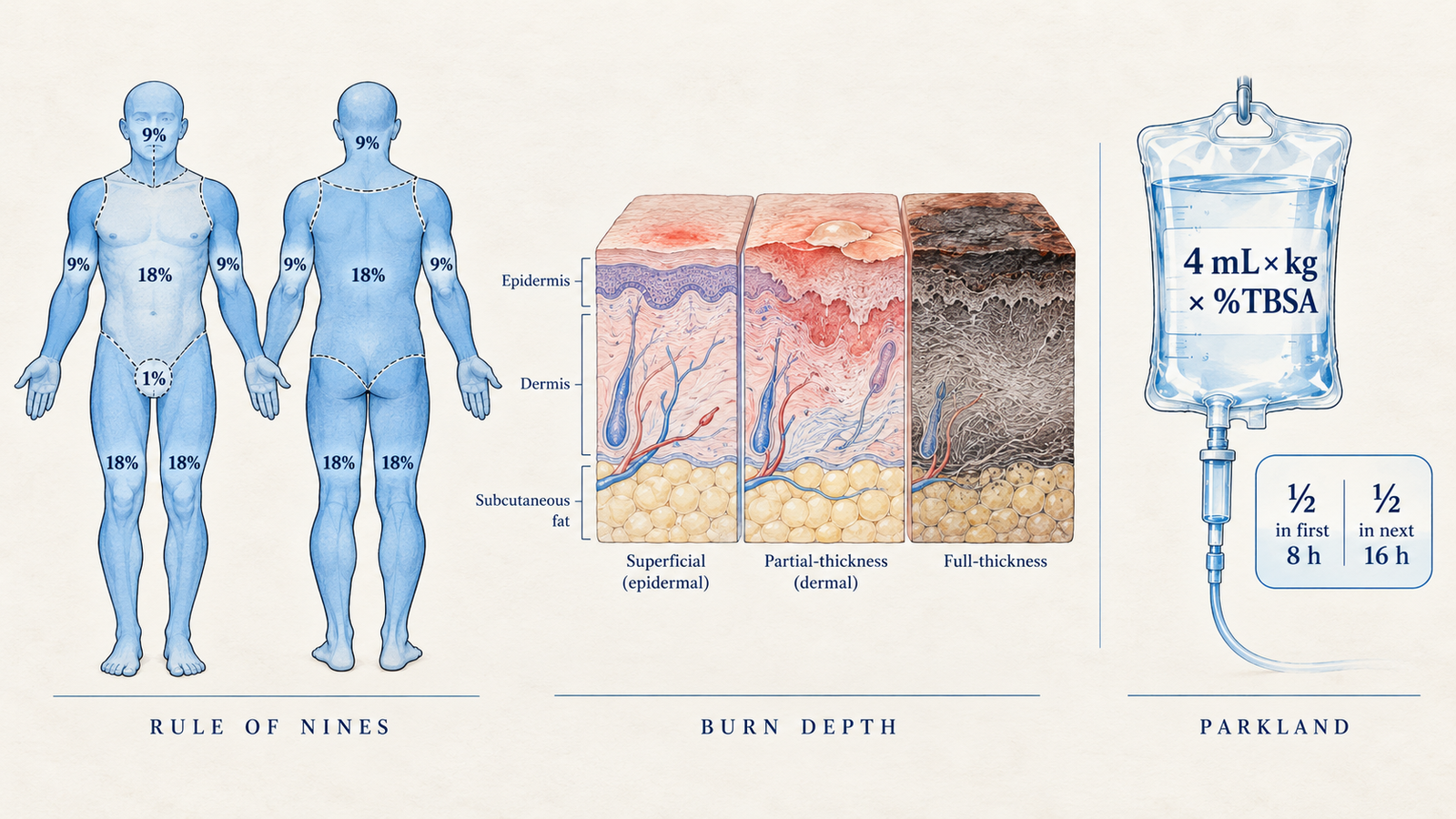
In adults the rule of nines divides the body into regions of 9 percent or multiples of it. Children have a proportionally larger head and smaller legs, so the Lund and Browder chart, which adjusts for age, is preferred for them. For small or patchy burns, the patient's own palm including the fingers is roughly 1 percent of body surface. Only partial-thickness and full-thickness burns are counted. Simple redness (a superficial burn) is left out of the percentage.
| Region (adult) | Percentage of body surface |
|---|---|
| Head and neck | 9 |
| Each upper limb | 9 |
| Front of trunk | 18 |
| Back of trunk | 18 |
| Each lower limb | 18 |
| Perineum | 1 |
Step Two: Classify the Depth
| Depth | Appearance | Sensation | Healing |
|---|---|---|---|
| Superficial (epidermal) | Red, dry, no blisters, blanches | Painful | About a week, no scar |
| Superficial partial-thickness | Pink, moist, blistered, blanches | Very painful | About two to three weeks, little scarring |
| Deep partial-thickness | Blotchy red or white, drier, slow or no blanching | Reduced | More than three weeks, with scarring; often needs grafting |
| Full-thickness | White, brown or black and leathery, no blanching | Painless (insensate) | Does not heal without grafting except in small areas; contracture |
The deciding feature between partial and full thickness is sensation. A full-thickness burn is painless because the nerve endings in the dermis are destroyed, while partial-thickness burns hurt. A burn that extends into fat, muscle or bone is sometimes called fourth degree.
Step Three: The Parkland Formula, Worked Out
The Parkland formula gives the crystalloid volume for the first 24 hours: 4 mL × body weight in kg × percentage of body surface burned, given as Ringer's lactate. Half is given in the first 8 hours, counted from the time of the burn and not from the time of arrival, and the other half over the next 16 hours. Formal intravenous resuscitation is usually started once a burn exceeds roughly 15 to 20 percent of body surface in adults, with a lower threshold in children.
Worked example: a 70 kg adult with 40 percent burns arrives 2 hours after the injury. The total is 4 × 70 × 40 = 11,200 mL over 24 hours. The first half, 5,600 mL, is due within 8 hours of the burn. Two of those hours have already passed, so 5,600 mL must run over the remaining 6 hours, which is about 933 mL per hour. The second half, 5,600 mL, then runs over 16 hours, which is 350 mL per hour.
| Period (from the time of the burn) | Volume | Rate in this example |
|---|---|---|
| Hours 0 to 8 | 5,600 mL | About 933 mL/h over the 6 hours still remaining |
| Hours 8 to 24 | 5,600 mL | 350 mL/h |
The formula is a starting point, not a prescription. The rate is adjusted every hour to urine output, aiming for about 0.5 mL/kg/h in adults and about 1 mL/kg/h in small children. The classic 4 mL factor can lead to over-resuscitation, often called fluid creep, with oedema, raised compartment pressures and breathing problems, so many centres start lower, for example with the modified Brooke estimate of 2 mL/kg per percent, and titrate to urine output. For the exam, the answer is still 4 mL. Children need more fluid per kilogram, and a body-surface-area formula (the Galveston formula) is used for them.
Resuscitation Formulae Compared
| Formula | First 24 hours | Note |
|---|---|---|
| Parkland | Ringer's lactate, 4 mL/kg per percent burned | Most widely used; colloid is added in the second 24 hours |
| Modified Brooke | Ringer's lactate, 2 mL/kg per percent burned | Lower volume; used by some centres to limit fluid creep |
| Evans | Crystalloid 1 mL plus colloid 1 mL per kg per percent burned | Includes colloid from the start |
| Galveston | Based on body surface area | Used in children |
Inhalation Injury and Carbon Monoxide
Suspect inhalation injury after a fire in an enclosed space, with facial burns, singed nasal hairs, soot in the mouth or sputum, hoarseness or stridor. These patients can lose the airway as oedema develops, so early intubation is the rule when the signs are present. Carbon monoxide poisoning often accompanies smoke inhalation. The patient may look normal, and a standard pulse oximeter reads falsely normal because it cannot tell carboxyhaemoglobin from oxyhaemoglobin. Treatment is 100 percent oxygen, which shortens the half-life of carboxyhaemoglobin from around four to six hours on room air to about an hour, and hyperbaric oxygen is kept for selected severe cases. Cyanide poisoning should also be considered after smoke inhalation in an enclosed space.
Escharotomy
A circumferential full-thickness burn forms a rigid eschar that does not stretch. As the tissue swells beneath it, the eschar acts like a tourniquet on a limb, causing the same ischaemia as a compartment syndrome, or it restricts ventilation when it encircles the chest. Escharotomy releases it with incisions through the eschar, classically along the medial and lateral sides of the limb. Fasciotomy is needed only if a deeper compartment syndrome develops, and the reasoning for it is covered in our guide to compartment syndrome.
Topical Agents and Their Classic Side Effects
| Agent | Notes | Classic side effect |
|---|---|---|
| Silver sulfadiazine | Broad-spectrum and painless, but penetrates eschar poorly | Transient leucopenia; avoid in sulfa allergy |
| Mafenide acetate | Penetrates eschar and cartilage, so useful on the ear; painful on application | Metabolic acidosis (carbonic anhydrase inhibition) |
| Silver nitrate (0.5 percent) | Does not penetrate eschar; stains surfaces black | Hyponatraemia and other electrolyte losses |
Systemic Effects and Complications
Major burns trigger a hypermetabolic state, so enteral feeding is started early, within the first day or so, with a high protein intake. Stress ulceration of the stomach or duodenum after burns is called Curling's ulcer, and prophylaxis is given. Infection is a leading later cause of death, with Pseudomonas classically linked to burn wounds. Hypothermia is a risk because the skin barrier is lost, so the patient is kept warm. In chronic non-healing burn scars, malignant change to squamous cell carcinoma is known as Marjolin's ulcer.
First Aid and When to Refer
Cool the burn under cool running water for about 20 minutes, remove clothing and jewellery, cover it with a clean non-adherent dressing or cling film, and keep the patient warm. Ice should not be used, because it causes further tissue injury. Burns of the face, hands, feet, genitalia or major joints, full-thickness burns, electrical or chemical burns, inhalation injury, and burns at the extremes of age usually need specialist burn-centre care.
Electrical and Chemical Burns, Briefly
Electrical burns often damage far more tissue beneath the skin than the surface suggests. The skin wounds mark where the current entered and left, and deep muscle injury can cause myoglobinuria and acute kidney injury, which is why a higher urine output is targeted and the heart is monitored. Chemical burns need prolonged irrigation with large volumes of water. Alkalis typically cause deeper injury than acids because of liquefactive necrosis, and hydrofluoric acid burns are treated with calcium gluconate.
Exam Pearls
- Count only partial- and full-thickness burns in the percentage.
- Parkland: 4 mL × kg × percent burned, as Ringer's lactate; half in the first 8 hours from the time of the burn.
- Titrate to urine output: about 0.5 mL/kg/h in adults.
- Full-thickness burns are painless and leathery.
- Pulse oximetry is falsely normal in carbon monoxide poisoning; give 100 percent oxygen.
- Mafenide causes metabolic acidosis, silver sulfadiazine causes leucopenia, and silver nitrate leaches electrolytes.
How Vignettes Are Built
Two question types dominate. The first is arithmetic: the vignette gives weight, burn size and time of arrival and asks for the fluid rate in the first 8 hours, so remember to count from the time of the burn, not from arrival. The second is recognition. A closed-space fire with a hoarse voice means securing the airway first, a painless, leathery, circumferentially burned limb means escharotomy, and a burns patient with metabolic acidosis on a topical agent points to mafenide.
For another surgical emergency worth knowing alongside burns, see our guide to hernia types, and for how much of the paper Surgery carries, our subject-wise weightage breakdown.
Practise this on Reflex
Turn what you just read into recall with 14 years of tagged PYQs.
FAQ
Frequently asked questions
The questions aspirants ask most about this topic.
A formula for the crystalloid volume needed in the first 24 hours after a major burn: 4 mL multiplied by body weight in kilograms multiplied by the percentage of body surface burned, given as Ringer's lactate.
From the time of the burn, not from the time the patient reached hospital. If the patient arrives late, the first-half volume must be given over the hours that remain of the first 8.
Only partial-thickness and full-thickness burns. Simple redness from a superficial burn is not included.
About 0.5 mL/kg/h in adults and about 1 mL/kg/h in small children. The calculated rate is adjusted up or down to meet this target.
It cannot distinguish carboxyhaemoglobin from oxyhaemoglobin, so the reading looks normal despite poor oxygen delivery. Treatment is 100 percent oxygen.
When a circumferential full-thickness burn of a limb threatens its circulation, or when a circumferential chest burn restricts ventilation. The incisions go through the eschar to release the constriction.
Mafenide acetate, because it inhibits carbonic anhydrase. It penetrates eschar well, which is why it is used on ear cartilage burns.
About the author
Stay ahead in your preparation
Get expert tips, exam updates, and high-yield insights delivered straight to your inbox.
No spam. Unsubscribe anytime.
More in Subject Notes
View all → Surgery
Compartment Syndrome for NEET PG: Why Pulselessness Is the Sign That Comes Last, Not First
 Surgery
Hernia Types and Classification for NEET PG
Direct vs indirect inguinal hernia, Hesselbach’s triangle, and why femoral hernias strangulate most.
 Pediatrics
Kawasaki Disease for NEET PG: The Five Criteria, the 10-Day IVIG Window and the Coronary Risk
What counts as Kawasaki disease, why the 10-day IVIG window matters, how aspirin is used, and how coronary artery involvement is graded and followed.
 Pediatrics
Tetralogy of Fallot for NEET PG: One Septal Shift, Four Defects, and the Tet Spell
One shifted septum explains the four defects of Tetralogy of Fallot, the boot-shaped heart, the fading murmur and the stepwise management of a tet spell.