Hernia Types and Classification for NEET PG
By Dr. Utsav Bhattacherjee, MBBS, MBA · 9 Jul 2026 · 2 min read
Last updated: 23 Sept 2026
On this page
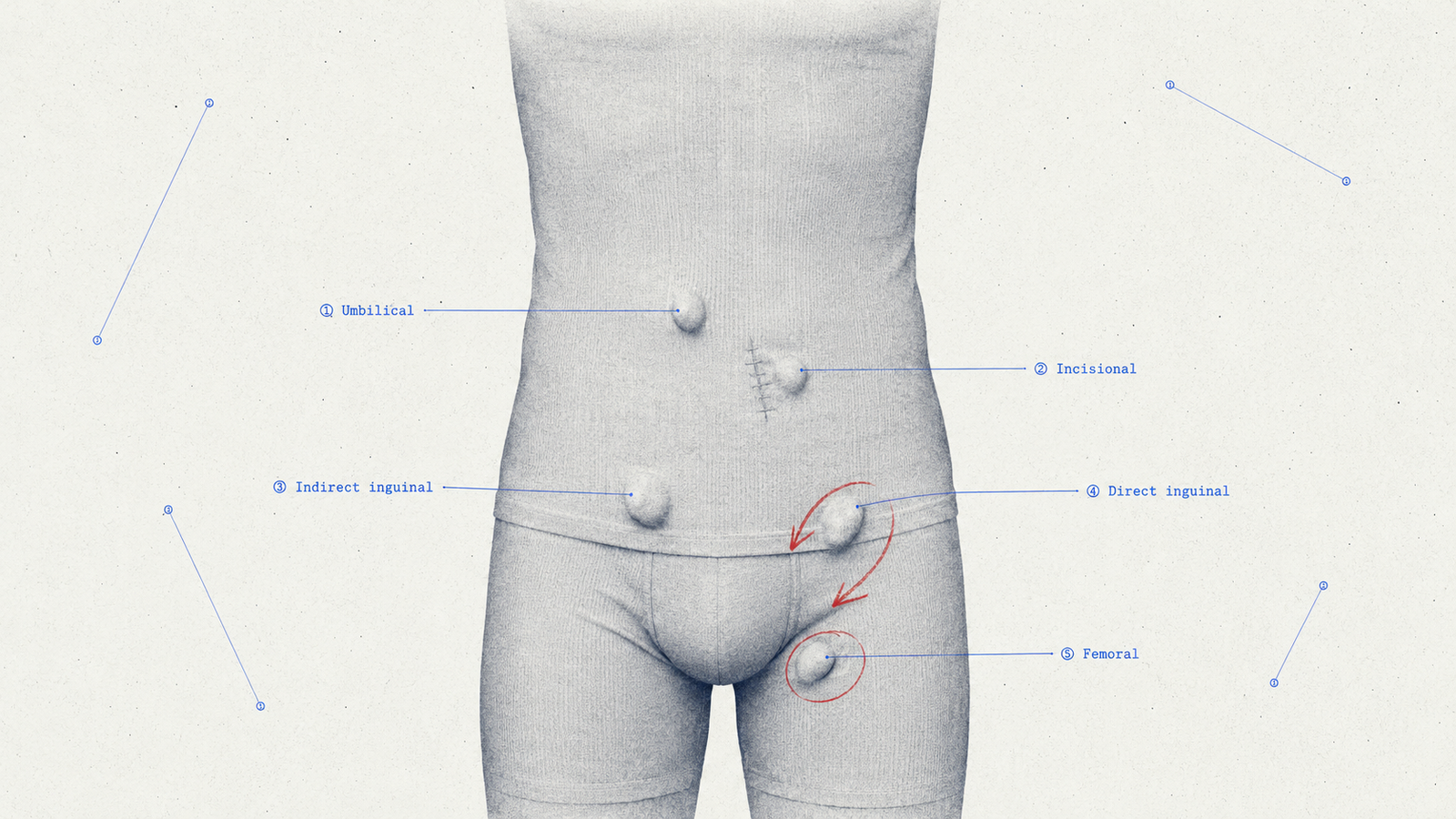
Hernia questions in NEET PG Surgery almost always come down to one core distinction — direct versus indirect inguinal hernia — tested through anatomy, clinical examination, or which one carries more risk. Get that distinction solid, and the rest of the classification falls into place around it.
The Major Hernia Types
| Type | Key feature |
|---|---|
| Indirect inguinal | Passes through the deep inguinal ring, lateral to the inferior epigastric vessels; typically congenital, following a patent processus vaginalis |
| Direct inguinal | Passes through Hesselbach’s triangle, medial to the inferior epigastric vessels; typically acquired, from a weakness in the posterior inguinal wall |
| Femoral | Passes below the inguinal ligament through the femoral canal; more common in females; highest strangulation risk of the common hernia types |
| Umbilical | Through the umbilical ring |
| Epigastric | Through the linea alba, above the umbilicus |
| Incisional | Through a previous surgical scar |
| Obturator | Rare; classically seen in elderly, thin women |
| Spigelian | Through the semilunar line, lateral to the rectus sheath |
Hesselbach’s Triangle
This triangle defines the boundary for a direct hernia:
- Lateral border: inferior epigastric vessels
- Medial border: lateral edge of the rectus abdominis
- Inferior border (base): inguinal ligament
A hernia bulging through this triangle, medial to the inferior epigastric vessels, is direct by definition.
Telling Direct and Indirect Apart Clinically
The classic bedside test is occlusion at the deep inguinal ring (roughly at the midpoint of the inguinal ligament): apply pressure there and ask the patient to cough or strain.
- Indirect hernia: controlled by pressure over the deep ring — the bulge doesn’t reappear until pressure is released.
- Direct hernia: not controlled by pressure over the deep ring — the bulge reappears anyway, since it’s coming through a different, more medial defect.
Why Femoral Hernias Are the Highest Risk
The femoral canal is a rigid, narrow space bounded by unyielding structures — the inguinal ligament, the pectineal ligament, and the femoral vein. That rigidity means a femoral hernia has little room to expand, which is exactly why it carries the highest risk of strangulation among the common hernia types, even though it’s less common overall than inguinal hernias.
Anatomy-to-clinical-exam questions like this are exactly what Reflex’s daily TROCAR Surgery rounds are designed to reinforce.
Practise this on Reflex
Turn what you just read into recall with 14 years of tagged PYQs.
FAQ
Frequently asked questions
The questions aspirants ask most about this topic.
Indirect hernias pass through the deep inguinal ring, lateral to the inferior epigastric vessels, and are typically congenital. Direct hernias pass through Hesselbach’s triangle, medial to the inferior epigastric vessels, and are typically acquired.
Femoral hernia, due to the rigid, narrow boundaries of the femoral canal.
The inferior epigastric vessels (lateral), the rectus abdominis (medial), and the inguinal ligament (inferior/base).
The wider female pelvis creates a comparatively larger and more accessible femoral canal, making it a more common route for femoral herniation than in males.
About the author
Stay ahead in your preparation
Get expert tips, exam updates, and high-yield insights delivered straight to your inbox.
No spam. Unsubscribe anytime.
More in Subject Notes
View all → Surgery
Burns for NEET PG: The Rule of Nines, Burn Depth and the Parkland Formula Worked Step by Step
 Surgery
Compartment Syndrome for NEET PG: Why Pulselessness Is the Sign That Comes Last, Not First
 Microbiology
Malaria Life Cycle for NEET PG: Species, Smear Morphology, Complications and Treatment
How the malaria parasite moves between mosquito and human, what separates the species on a smear, and how diagnosis, complications and treatment follow from the life cycle.
 Physiology
Oxygen-Hemoglobin Dissociation Curve for NEET PG: Every Shift Explained
Why the oxygen-hemoglobin dissociation curve is sigmoid, what moves it right or left, and how to apply each shift to fetal hemoglobin, stored blood, altitude and carbon monoxide poisoning.