Alvarado Score for Appendicitis: MANTRELS Points, Cut-offs and Limits for NEET PG
Reflex · 6 Nov 2026 · 13 min read
Last updated: 6 Nov 2026
On this page
The Alvarado score turns the bedside picture of acute appendicitis into a number out of 10. It does not replace clinical judgement or imaging, but it helps you decide who can be sent home, who needs observation, and who needs a surgeon or a scan.
This post walks through every MANTRELS item with its points, scores one illustrative patient step by step, compares the cut-points of 5 and 7, and then covers where the score stops being reliable. The aim is that you can rebuild the table from memory and also say what the number does and does not allow you to do.
If you are revising acute abdomen topics in Surgery, pair this with the notes on peptic ulcer and perforation, another cause of right-sided and upper abdominal pain.
Key Takeaways
The Alvarado score has eight items and a maximum of 10: tenderness in the right iliac fossa and leukocytosis score 2 each, and the other six items score 1 each.
The mnemonic MANTRELS covers three symptoms (Migration, Anorexia, Nausea/vomiting), three signs (Tenderness, Rebound, Elevated temperature) and two laboratory results (Leukocytosis, Shift to the left).
A low score (cut-point 5) is a good rule-out test: pooled sensitivity was 0.99 but specificity only 0.43.
A high score (cut-point 7) points to high risk and calls for surgical review or imaging, not automatic surgery.
The score performs worst in children, women of reproductive age, older adults and pregnancy, so imaging usually has to settle those cases.
Alvarado Score: Definition and Purpose
The Alvarado score is a clinical scoring system for suspected acute appendicitis that combines three symptoms, three signs and two laboratory results into a total of 10. In 1986 Alvarado presented it as a practical way to diagnose acute appendicitis early (Alvarado, Ann Emerg Med 1986, as cited in a 2026 paediatric review). Its appeal is that it needs no scan, only a history, an examination and a blood count.
Appendicitis itself is mainly a clinical diagnosis. The MSD Manual notes that with classic findings surgery should not wait for imaging, while atypical or equivocal presentations should be imaged promptly. A score gives structure to that decision.
Pathophysiology behind the score
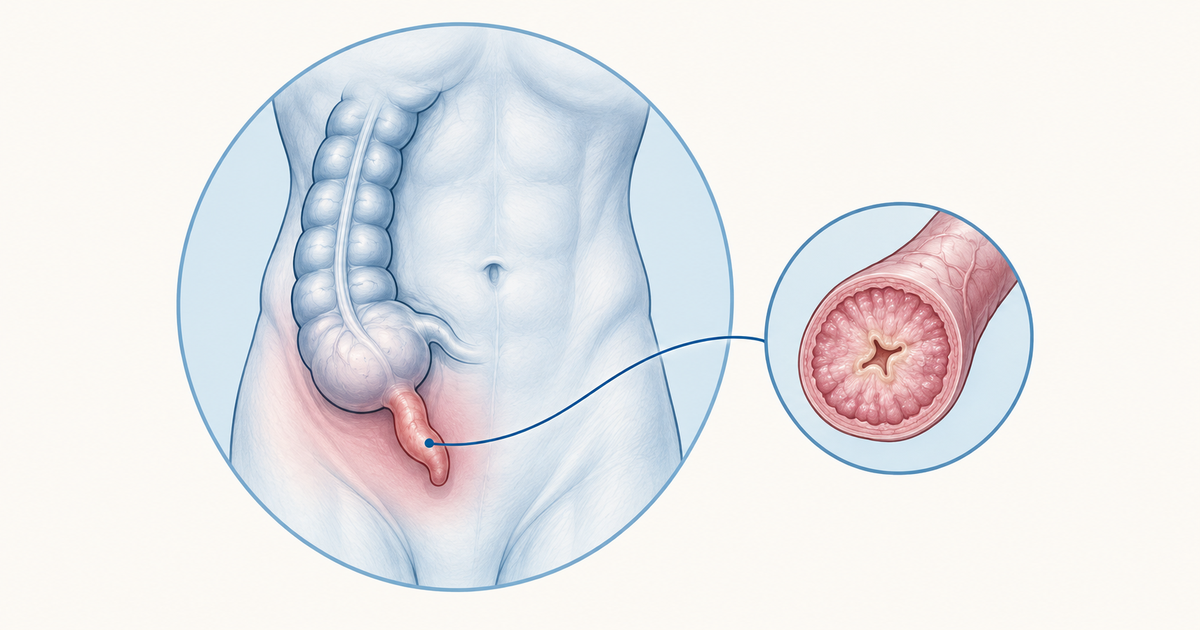
Luminal obstruction of the appendix, most often from lymphoid hyperplasia and less often from a fecalith, foreign body, tumour or worms, leads to distension, bacterial overgrowth, ischaemia and inflammation. Left alone, this progresses to necrosis, gangrene and perforation, and a contained perforation forms an abscess (MSD Manual).
The symptoms in MANTRELS follow this sequence. Pain starts in the epigastrium or around the umbilicus, then nausea, vomiting and anorexia appear, and after some hours the pain moves to the right lower quadrant and worsens on coughing and movement (same source).
Alvarado Score Points: The MANTRELS Mnemonic
MANTRELS gives the eight items in order, and the points are fixed by the original description (Alvarado, World J Emerg Surg 2016; Ethiopian cohort, Open Access Emerg Med 2023). Only two items carry 2 points, so remember those first and the rest are 1 each.
| Letter | Item | Points | Type |
|---|---|---|---|
| M | Migration of pain to the right iliac fossa | 1 | Symptom |
| A | Anorexia (can be inferred from urinary acetone) | 1 | Symptom |
| N | Nausea or vomiting | 1 | Symptom |
| T | Tenderness in the right iliac fossa | 2 | Sign |
| R | Rebound pain | 1 | Sign |
| E | Elevated temperature (about 37.3 C or above; sources differ on the exact boundary) | 1 | Sign |
| L | Leukocytosis (WBC above 10,000/mL) | 2 | Laboratory |
| S | Shift of neutrophils to the left | 1 | Laboratory |
The totals split neatly: symptoms 3, signs 4 and laboratory 3, giving 10. In Alvarado's 2016 description, a left shift means more than 5% band (stab) forms or more than 75% segmented neutrophils. The same paper allows direct rebound to be replaced by Rovsing, Dunphy, Markle or fist-percussion signs.
McBurney point and the signs behind T and R
Tenderness at McBurney point is the classic sign scored under T. It lies about one-third of the distance from the anterior superior iliac spine to the umbilicus, and the MSD Manual describes direct and rebound tenderness there.
A 2022 commentary (a letter to the editor) adds a useful point: tenderness at McBurney point marks where the pain is greatest, not where the appendix lies (Yale et al., World J Gastrointest Surg 2022). Early visceral pain is deep and poorly localised around T8 to T10, and it becomes sharply localised once the parietal peritoneum is involved.
Other bedside signs are not scored in MANTRELS but support the diagnosis:
- Rovsing sign: right lower quadrant pain when the left lower quadrant is palpated.
- Psoas sign: pain on passive extension of the right hip, described with a retrocecal appendix.
- Obturator sign: pain on passive internal rotation of the flexed right thigh.
Reported ranges for these three signs combined show sensitivity of only 0.16 to 0.27 but specificity of 0.86 to 0.89. A positive sign raises the likelihood of appendicitis, while a negative one does not rule it out (Yale et al., above).
How to Calculate the Alvarado Score: A Worked Example
The patient below is an illustrative teaching example, not a real case. It shows how to add the items without double counting.
Consider a 22-year-old man whose pain began around the umbilicus last night and has since moved to the right iliac fossa. He has lost his appetite and vomited once. The examination shows marked right iliac fossa tenderness without rebound pain. His temperature is 37.0 C, and the blood count shows a WBC of 13,000/mL with a neutrophil shift to the left on the differential.
| Item | Finding | Points |
|---|---|---|
| Migration | Yes | 1 |
| Anorexia | Yes | 1 |
| Nausea or vomiting | Yes | 1 |
| Tenderness RIF | Yes | 2 |
| Rebound | No | 0 |
| Elevated temperature | No (37.0 C) | 0 |
| Leukocytosis | Yes | 2 |
| Shift to the left | Yes | 1 |
| Total | 8 |
The score is 8 out of 10. Under Alvarado's 2016 bands, 7 to 8 is "probable appendicitis", and surgery can be considered, especially in a young man. If the differential were not available, the score would be 7, which still sits in the high-risk stratum.
Two habits prevent errors. Score absent findings as 0 rather than leaving them blank, and remember that tenderness and leukocytosis are worth double.
Alvarado Score Interpretation: Cut-offs of 5 and 7
There is no single universal interpretation table, so attribute each band to its source. A common risk grouping from the Ohle systematic review treats 1 to 4 as low, 5 to 6 as intermediate and 7 to 10 as high risk (Ohle et al., BMC Med 2011).
Alvarado's 2016 paper words the middle and upper bands in management terms:
- 5 to 6: compatible with appendicitis, a grey area. Observe and re-evaluate every 4 to 6 hours for 12 to 24 hours, with ultrasound or diagnostic laparoscopy if the picture is unchanged.
- 7 to 8: probable appendicitis. Consider surgery, especially in a young male, and exclude gynaecological causes in women.
- 9 to 10: very probable appendicitis.
- 3 to 4: observe and repeat tests, or image.
The words "compatible", "probable" and "very probable" belong to this paper, not to a guideline. In a large cohort reported in the WSES guidelines, every male with a score of 9 or more and every female with a score of 10 or more had appendicitis (Di Saverio et al., WSES Jerusalem guidelines 2020).
Cut-point 5 versus cut-point 7
The Ohle meta-analysis pooled studies at two cut-points, and the contrast is the central idea to learn: a low cut-point is sensitive, a higher one is more specific.
| Group | Cut-point 5 sensitivity / specificity | Cut-point 7 sensitivity / specificity |
|---|---|---|
| All patients | 0.99 / 0.43 | 0.82 / 0.81 |
| Men | 0.96 / 0.34 | 0.88 / 0.57 |
| Women | 0.99 / 0.35 | 0.86 / 0.73 |
| Children | 0.99 / 0.57 | 0.87 / 0.76 |
Source: Ohle et al., BMC Med 2011. Cut-point 5 compared 1 to 4 against 5 to 10 (28 studies), and cut-point 7 compared 1 to 6 against 7 to 10 (29 studies).
In the authors' conclusion, a score under 5 works well as a rule-out test, yet it "should not be used as the sole criterion for surgery in any patient group". A score of 7 or more marks high-risk patients who need surgical consultation or imaging.
What the WSES guideline recommends
According to the WSES 2020 guidelines, a cut-off below 5 excludes appendicitis well (sensitivity 99%) but is not specific enough to diagnose it. Clinical scores are recommended for excluding appendicitis in low-risk patients, which reduces imaging and negative explorations (recommendation 1.2.1, high quality, strong). Using the Alvarado score to confirm appendicitis in adults is suggested against (recommendation 1.3, weak).
For intermediate-risk patients, the guideline suggests timely systematic imaging. In high-risk patients under 40 (Alvarado 9 to 10, AIR 9 to 12 or AAS 16 or above), CT may be avoided before laparoscopy (Di Saverio et al., above).
A simple way to hold this: a low score rules out, a high score calls for review, and the middle zone means observe or image.
Alvarado Score Compared With RIPASA, AIR, AAS and PAS
Several other scores exist, and the differences are worth knowing in outline. The table lists what the sources support.
| Score | Key features | Notable points from sources |
|---|---|---|
| Alvarado | 8 items, 0 to 10, no CRP | Cut-point 5 rules out; 7 or more is high risk |
| RIPASA | 14 parameters, 3 to 16.5 | Below 7 low risk, 7.5 and above high risk |
| AIR | Includes CRP | WSES lists AIR and AAS as the best clinical predictors (recommendation 1.4) |
| AAS | Adult Appendicitis Score | 16 or above high risk, below 11 low risk; AUC 0.882 vs Alvarado 0.790 |
| PAS | Alvarado-like, paediatric; pain on cough, hopping or percussion replaces rebound | Cut-off 7 or above: sensitivity 80 to 95%, specificity 60 to 70% |
Sources: Di Saverio et al. 2020 and the paediatric review in Pediatric Reports 2026. In a randomised trial of low-risk patients, an AIR-based algorithm reduced imaging (19.2% vs 34.5%), admissions (29.5% vs 42.8%) and negative explorations (1.6% vs 3.2%).
In older adults, RIPASA at a cut-off above 8 gave a sensitivity of 78.5% and specificity of 85.7%, against 69.2% and 85.7% for the Alvarado score above 4. That difference was not statistically significant (p = 0.09) (geriatric cohort, 2022).
Limitations of the Alvarado Score by Population
The score was derived in a general adult setting, so it does not transfer equally to every patient. Cohort figures also vary widely with setting and cut-off, so do not average them.
In an Ethiopian adult cohort of 235 patients, sensitivity was 99.1% and specificity 55.6%. Female specificity was only 25%, against 80% in males (Open Access Emerg Med 2023). A retrospective series of 171 patients using a cut-off of 6 reported sensitivity of 94.62% and specificity of 87.80% (Open Access Emerg Med 2024).
| Population | What the sources report | Practical consequence |
|---|---|---|
| Children | Pooled validity inconclusive (Ohle); validation cohorts at 7 or above show sensitivity 72 to 88% and specificity 57 to 76% (2026 review); WSES suggests against diagnosing on clinical scores alone (weak) | Ultrasound first; do not rely on the score alone |
| Women | Over-predicts risk in the low stratum (RR 5.35, 95% CI 2.17 to 13.19); female specificity 25% vs 80% in one cohort | Consider gynaecological causes; image early |
| Older adults | Unreliable for separating complicated from uncomplicated disease; AUC 0.799 in one cohort; atypical presentations with milder pain and less local tenderness | Low threshold for imaging |
| HIV-positive patients | Less sensitive (WSES) | Do not be reassured by a lower score |
| Pregnancy | At cut-off 7, sensitivity 78.9% and specificity 80.0%; WSES recommends against diagnosis on symptoms and signs alone (very low quality, weak) | Graded-compression ultrasound first, MRI if ultrasound is inconclusive |
Sources: Ohle et al., WSES 2020, paediatric review 2026, geriatric cohort 2022 and the MSD Manual.
Ohle and colleagues found the score well calibrated in men, which explains why the numbers above look best for young male adults. A further weakness is the low reproducibility of several parameters (Open Access Emerg Med 2024).
Imaging and Management After Scoring
When the score does not settle the question, imaging does. The WSES guidelines recommend combining clinical parameters with ultrasound (recommendation 1.7, strong). Point-of-care ultrasound is preferred first-line when imaging is needed, in adults and children (Di Saverio et al.).
Reported accuracy from the same guideline helps you choose the test:
| Test | Sensitivity | Specificity |
|---|---|---|
| Ultrasound (overall) | 76% | 95% |
| Point-of-care ultrasound | 91% | 97% |
| CT (pooled adults and children) | 95% | 94% |
For adolescents and young adults with a negative ultrasound, low-dose contrast CT is preferred over standard-dose CT (WSES recommendation 1.11, high quality, strong; Di Saverio et al., above). Ultrasound uses no radiation, but bowel gas limits it (MSD Manual).
Treatment of confirmed disease is appendectomy, open or laparoscopic, with pre-operative intravenous antibiotics; third-generation cephalosporins are preferred, and antibiotics continue for about 4 days in perforation (MSD Manual). For uncomplicated appendicitis, the WSES guideline discusses an antibiotics-first approach, but in adults 27.4% had recurrence within one year in a meta-analysis it cites. The MSD Manual still recommends appendectomy, especially if an appendicolith is seen on CT.
A hernia is another cause of a tender groin or lower abdomen, so it helps to compare this presentation with hernia types and classification.
Common Mistakes When Using the Alvarado Score
Most errors come from reading the number as more than it is. Keep these points in mind when you work through a question or a case:
- Treating 5 as a diagnosis. A score of 5 or above has specificity of only 0.43 in the pooled data; it keeps the diagnosis open.
- Treating a low score as proof in every group. The rule-out value is established for adults in general, and it weakens in children, pregnancy and older adults.
- Forgetting the double-weighted items. Missing the 2 points for RIF tenderness or leukocytosis shifts the total by a whole risk band.
- Counting both rebound and a substitute sign. Rebound can be replaced by Rovsing, Dunphy, Markle or fist percussion, but it is still one item worth 1 point.
- Expecting a normal white count to exclude disease. The MSD Manual notes that WBC is often 12,000 to 15,000/mcL but that a normal count does not exclude appendicitis.
Practise the arithmetic with the GI surgery practice questions, scoring each stem item by item before you look at the options.
Conclusion
The Alvarado score is best remembered as a decision aid with two anchors. MANTRELS gives eight items worth 10 points, with RIF tenderness and leukocytosis counting double. A score under 5 argues strongly against appendicitis, a score of 7 or more marks high risk and warrants surgical review or imaging, and the middle range means observation or a scan.
Its limits matter as much as its points. In children, women, older adults and pregnancy, ultrasound or MRI carries more weight than the number. Rebuild the MANTRELS table from memory, score one patient end to end, and state the cut-point 5 versus 7 trade-off in one sentence, and you will have covered the topic.
Practise this on Reflex
Turn what you just read into recall with 14 years of tagged PYQs.
FAQ
Frequently asked questions
The questions aspirants ask most about this topic.
Each letter names one scored item: Migration of pain to the right iliac fossa, Anorexia, Nausea or vomiting, Tenderness in the right iliac fossa, Rebound pain, Elevated temperature, Leukocytosis and Shift of neutrophils to the left. Tenderness and leukocytosis are worth 2 points each, while the other six items are worth 1 point each, so the maximum is 10.
Only two: tenderness in the right iliac fossa and leukocytosis (WBC above 10,000/mL). All other items score 1 point.
A score below 5 is sensitive enough to exclude appendicitis in low-risk patients; the WSES 2020 guidelines quote a sensitivity of 99% for this cut-off. A pooled systematic review found specificity of only 0.43 at cut-point 5, so a score of 5 or more does not confirm the diagnosis.
Such a score places the patient in the high-risk group. At cut-point 7, the Ohle systematic review pooled a sensitivity of 0.82 and a specificity of 0.81, and its authors concluded that these patients need surgical consultation or imaging, not automatic surgery.
Not on its own. Pooled validity in children was inconclusive, and for children and pregnant patients the WSES guidelines suggest against making the diagnosis from clinical scores alone. Ultrasound is the usual first imaging test, with MRI in pregnancy if ultrasound is inconclusive.
Stay ahead in your preparation
Get expert tips, exam updates, and high-yield insights delivered straight to your inbox.
No spam. Unsubscribe anytime.
More in Surgery
View all → Surgery
Peptic Ulcer: Duodenal vs Gastric Ulcer, H. pylori and Perforation for NEET PG
A NEET PG revision guide to peptic ulcer: a duodenal vs gastric comparison table, H. pylori treatment, modified Johnson types, special ulcers, and the work-up and surgical management of a perforated ulcer.
 Surgery
Burns for NEET PG: The Rule of Nines, Burn Depth and the Parkland Formula Worked Step by Step
 Surgery
Compartment Syndrome for NEET PG: Why Pulselessness Is the Sign That Comes Last, Not First
 Surgery
Hernia Types and Classification for NEET PG
Direct vs indirect inguinal hernia, Hesselbach’s triangle, and why femoral hernias strangulate most.