Reflexes Mnemonic for NEET PG: Deep Tendon and Superficial Reflexes
By Dr. Utsav Bhattacherjee, MBBS, MBA · 26 May 2026 · 2 min read
Last updated: 23 Sept 2026
On this page
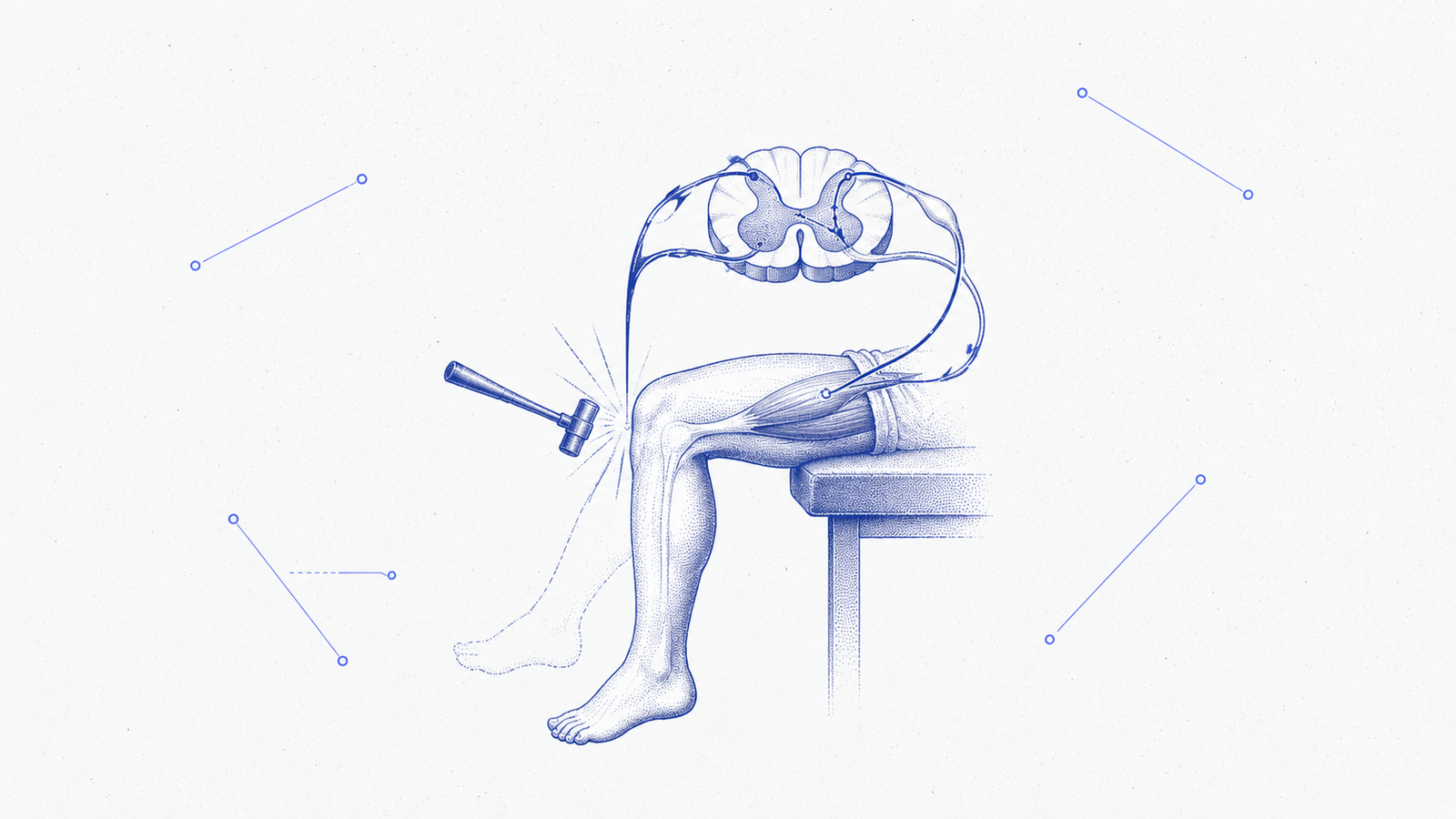
Reflex examination questions in NEET PG rarely ask you to just name a reflex — they ask you to place it on a nerve root, or read a pattern of reflex changes and localize a lesion. Both depend on knowing the root values cold.
Deep Tendon Reflexes and Their Root Values
| Reflex | Nerve root |
|---|---|
| Biceps | C5–C6 |
| Supinator (brachioradialis) | C5–C6 |
| Triceps | C7–C8 |
| Knee (patellar) | L2–L4 (mainly L3–L4) |
| Ankle (Achilles) | S1–S2 |
The classic root-value mnemonic: "1, 2 — buckle my shoe; 3, 4 — kick the door; 5, 6 — pick up sticks; 7, 8 — lay them straight."
- 1, 2 (S1–S2) → buckle my shoe → ankle jerk
- 3, 4 (L3–L4) → kick the door → knee jerk
- 5, 6 (C5–C6) → pick up sticks → biceps/supinator jerk
- 7, 8 (C7–C8) → lay them straight → triceps jerk
Superficial Reflexes
| Reflex | Nerve root / nerve |
|---|---|
| Corneal | Afferent: CN V (trigeminal); Efferent: CN VII (facial) |
| Abdominal | Upper: T7–T9; Lower: T10–T12 |
| Cremasteric | L1–L2 |
| Plantar (Babinski) | S1–S2 |
Reading the Reflex Pattern: UMN vs LMN
This is where the exam actually tests you — not the isolated root value, but what a pattern of reflex changes tells you about lesion location.
- Upper motor neuron (UMN) lesion: hyperreflexia (exaggerated deep tendon reflexes), an extensor (upgoing) plantar response — the Babinski sign — and often clonus.
- Lower motor neuron (LMN) lesion: hyporeflexia or areflexia, and a normal flexor (downgoing) plantar response — Babinski sign is absent, not present, in LMN lesions.
Reflexes are graded on a standard 0–4+ scale: 0 (absent), 1+ (diminished), 2+ (normal), 3+ (brisk/exaggerated), 4+ (very brisk, with clonus). A single reflex graded in isolation means little; the pattern across multiple reflexes, read alongside tone and power, is what localizes the lesion.
Reflex localization questions come up across Medicine, Surgery, and Physiology sections alike. Reflex’s daily TROCAR quiz mixes exactly this kind of cross-subject, pattern-recognition question into its subject-wise rounds.
Practise this on Reflex
Turn what you just read into recall with 14 years of tagged PYQs.
FAQ
Frequently asked questions
The questions aspirants ask most about this topic.
"1, 2 buckle my shoe (S1–S2, ankle), 3, 4 kick the door (L3–L4, knee), 5, 6 pick up sticks (C5–C6, biceps/supinator), 7, 8 lay them straight (C7–C8, triceps)."
An extensor (upgoing) plantar response indicates an upper motor neuron lesion. In a normal adult, the plantar response is flexor (downgoing).
No — UMN lesions cause hyperreflexia and an extensor plantar response; LMN lesions cause hyporeflexia/areflexia with a normal flexor plantar response.
About the author
Stay ahead in your preparation
Get expert tips, exam updates, and high-yield insights delivered straight to your inbox.
No spam. Unsubscribe anytime.
More in Subject Notes
View all → Physiology
Oxygen-Hemoglobin Dissociation Curve for NEET PG: Every Shift Explained
Why the oxygen-hemoglobin dissociation curve is sigmoid, what moves it right or left, and how to apply each shift to fetal hemoglobin, stored blood, altitude and carbon monoxide poisoning.
 Physiology
Tips to Score High in NEET PG/INICET Physiology
Master Physiology for NEET PG/INICET by focusing on conceptual clarity, active MCQ practice, and systematic revision.
 Microbiology
Malaria Life Cycle for NEET PG: Species, Smear Morphology, Complications and Treatment
How the malaria parasite moves between mosquito and human, what separates the species on a smear, and how diagnosis, complications and treatment follow from the life cycle.
 Pharmacology
Cholinergic Drugs for NEET PG: Classification, Receptors and Organophosphate Poisoning
A working classification of cholinergic drugs, the receptors behind each effect, which drug fits which clinical scenario, and how to answer organophosphate poisoning questions.