Tips to Score High in NEET PG/INICET Physiology
By Dr. Utsav Bhattacherjee, MBBS, MBA · 31 Jul 2025 · 12 min read
Last updated: 23 Sept 2026
On this page
Preparing for NEET PG/INICET Physiology can feel overwhelming at times. Many students either underestimate its importance or get stuck in overly theoretical preparation. But here's the truth: physiology is not just another subject — it's the foundation of clinical medicine. If you understand physiology well, you will naturally perform better in subjects like Medicine, Pathology, and Pharmacology.
I made this mistake early in my preparation too, but the lessons I learned later completely changed how I approached the subject. In this blog, I'll share practical and proven strategies that many toppers use to score high in Physiology.
Key Takeaways
- Physiology underpins clinical subjects like Medicine, Pathology, and Pharmacology — strong physiology concepts translate into better performance across the board.
- NEET PG/INICET physiology questions are concept-based, not memorization-based, so build conceptual clarity first through visualization and clinical linkage rather than rote learning.
- Active recall, spaced repetition, and solving 30–50 MCQs per chapter immediately after studying it cement retention far better than passive reading.
- High-yield systems — cardiovascular, renal, respiratory, endocrine, neuro, and GI physiology — deserve the most focused revision time.
- A mistake log, visual aids (diagrams, mnemonics, color-coding), and a consistent revision calendar are what separate toppers from students who just read through the syllabus once.
Why Strong Physiology Preparation Matters
NEET PG/INICET Physiology questions are rarely about memorization. They test conceptual understanding and the application of physiology to clinical scenarios. For example, electrolyte imbalance questions in Medicine require renal physiology, pharmacology drug actions require understanding of the autonomic nervous system, and surgical decision-making often depends on cardiac and respiratory physiology. If your physiology concepts are strong, you automatically perform better in many other subjects.
NEET PG Physiology Question Pattern
Typically, 15–20 questions in NEET PG relate directly or indirectly to Physiology, and most of these are concept-based rather than pure recall. High-yield systems include:
- Cardiovascular physiology
- Renal physiology
- Respiratory physiology
- Endocrine physiology
- Neurophysiology
- Gastrointestinal physiology
Tips to Score High in Physiology

1. Build Conceptual Clarity First
The biggest mistake students make is trying to memorize Physiology. Instead, visualize feedback mechanisms, understand why graphs behave the way they do, and connect concepts to clinical scenarios. Standard textbooks like Guyton or Ganong are excellent references. Many students prefer starting with coaching notes or video lectures and then revisiting textbooks for deeper understanding.
2. Use Active Recall and Spaced Repetition
Reading the same material repeatedly is not effective revision. Use active recall techniques instead — explain concepts aloud, test yourself frequently, and create flashcards (Anki works great). Combine this with spaced repetition to retain concepts long-term.
3. Solve MCQs Immediately After Studying
A powerful strategy is solving MCQs immediately after finishing a topic. Solve 30–50 MCQs per chapter, review both correct and incorrect answers, and focus on previous-year questions. Apps like REFLEX make it easier to practice topic-wise PYQs.
4. Link Physiology With Clinical Subjects
Physiology becomes much easier when connected to real-world clinical applications — for example, renal physiology links to acid-base disorders in Medicine, respiratory physiology to ventilator management, and endocrine physiology to disease mechanisms. This integration helps retain concepts longer.
5. Streamline Your Revision Strategy
As exams approach, revision quality matters more than quantity. Maintain a Physiology revision calendar, focus on high-yield topics, and use flowcharts and mind maps. Dedicate 1–2 hours weekly to Physiology even during clinical subject preparation.
6. Use Visual Aids
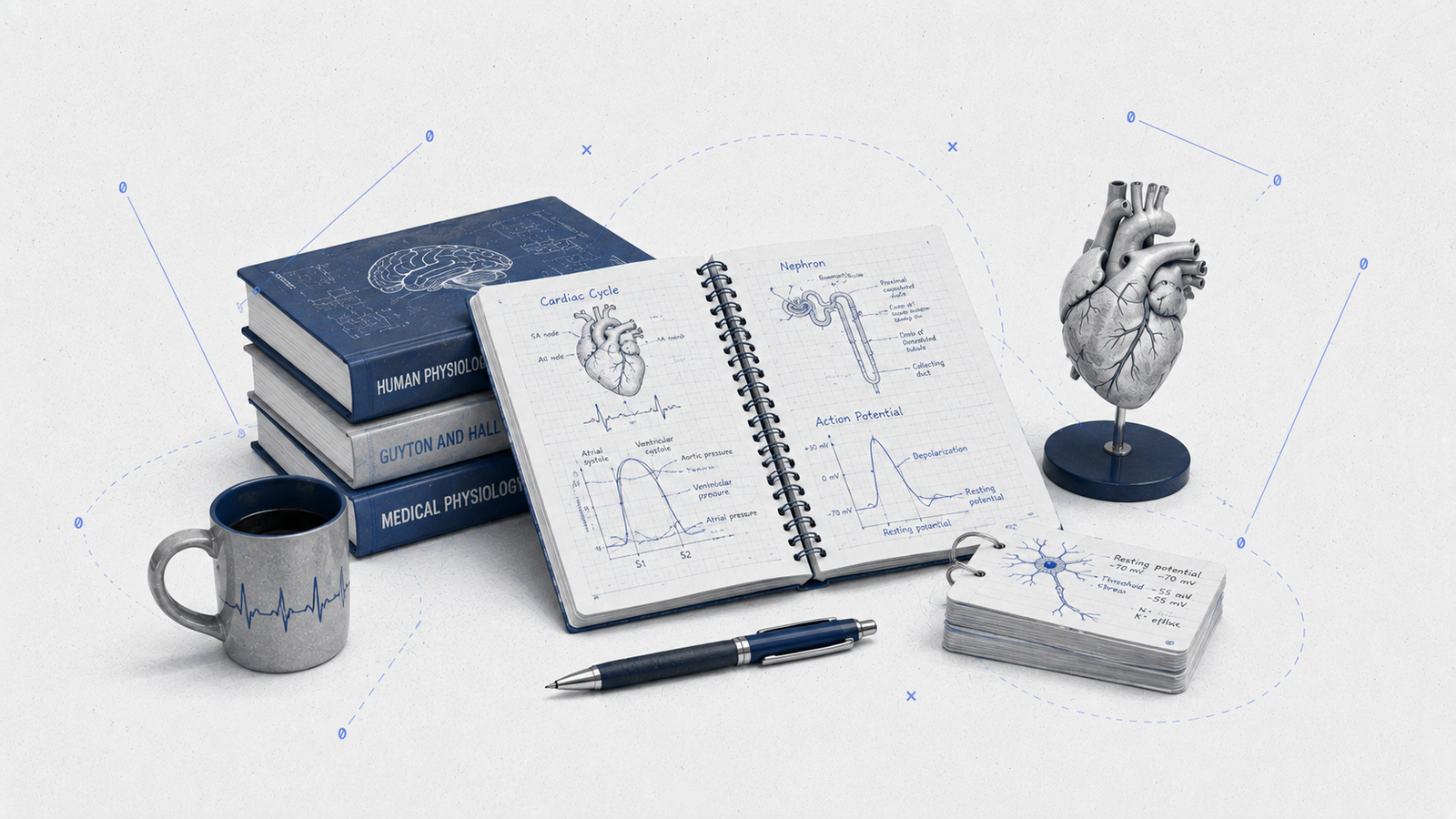
Physiology involves multiple pathways and feedback systems, so visual learning tools help significantly: diagrams for physiological pathways, mnemonics for hormone actions, and color-coded notes (sympathetic vs parasympathetic). These make recall much faster during exams.
7. Maintain a Mistake Log
Keep track of every MCQ you get wrong. Your mistake log should include the incorrect question, the reason for the mistake, and the correct concept explanation. Review the log weekly to prevent repeating the same mistakes.
8. Focus on High-Yield Topics
Not all topics carry equal weight in exams. Prioritize frequently tested areas:
- Cardiac physiology (Frank-Starling law, ECG)
- Renal physiology (GFR regulation, acid-base balance)
- Neurophysiology (reflexes, synaptic transmission)
- Respiratory physiology (V/Q mismatch, lung volumes)
- Endocrine physiology (hormone mechanisms)
- GI physiology (motility, secretion, absorption)
9. Practice Under Exam Conditions
To build exam stamina, attempt timed mock tests, simulate the exam environment, and analyze mistakes thoroughly. Focus not just on score but also on accuracy and time management.
10. Study With Peers
A focused study group can be extremely helpful — sharing mnemonics, explaining difficult concepts to each other, and keeping motivation high. Teaching concepts to others also improves your own understanding.
Bonus Pro Tips
- Create concept maps for endocrine and cardiovascular systems
- Schedule monthly rapid revision sessions
- Follow the “One Touch Rule” — review every marked MCQ until fully understood
- Track NEET PG/INICET recall questions to identify trends
Common Mistakes to Avoid
Passive studying. Reading without active engagement reduces retention. Instead, ask questions, draw diagrams, and explain concepts aloud.
Ignoring integrated questions. Physiology often overlaps with Medicine, Pharmacology, and Pathology. Practice integrated clinical questions regularly.
Poor revision planning. Never let more than two weeks pass without revising core Physiology topics. Use a revision tracker to stay consistent.
Over-reliance on video lectures. Videos are useful, but NEET PG is an MCQ-based exam. Balance video learning with active question practice.
Sample 4-Week Physiology Study Plan
Week 1 — Core Systems
- Cardiovascular
- Respiratory
- Renal
Focus on concepts, concise notes, and 100+ MCQs daily.
Week 2 — Neuro & Endocrine
- Revise notes
- Draw physiological pathways
- Practice MCQs
Week 3 — GI & Miscellaneous
- Gastrointestinal system
- Reproductive physiology
- Cell membrane physiology
Use flashcards and active recall.
Week 4 — High-Yield Revision
- Rapid revision of all systems
- Solve PYQs from NEET PG, INICET, AIIMS
- Attempt two full mock tests
Recommended Resources
Books
- Guyton & Hall — deep conceptual understanding
- Ganong Review of Medical Physiology — concise explanations
- First Aid for USMLE Step 1 — excellent high-yield revision
Video Lectures and Qbanks
- Dr. Anupama Devgan lectures
- Dr. Najeeb physiology lectures
- REFLEX App or Marrow QBank for MCQs
Frequently Asked Questions
How many NEET PG questions come from Physiology?
Typically 15–20 questions relate directly or indirectly to Physiology, and most of these are concept-based rather than pure recall, drawn mainly from high-yield systems like cardiovascular, renal, respiratory, endocrine, neuro, and GI physiology.
Should I memorize Physiology or focus on understanding concepts?
Understanding, not memorization. NEET PG/INICET physiology questions test conceptual understanding and application to clinical scenarios, so visualize feedback mechanisms, understand why graphs behave the way they do, and connect concepts to clinical cases rather than rote-learning facts.
How many MCQs should I solve per Physiology chapter?
Solve 30–50 MCQs per chapter immediately after studying it, reviewing both correct and incorrect answers, with a focus on previous-year questions. Apps like REFLEX make topic-wise PYQ practice easier.
What are the high-yield topics in Physiology?
Cardiac physiology (Frank-Starling law, ECG), renal physiology (GFR regulation, acid-base balance), neurophysiology (reflexes, synaptic transmission), respiratory physiology (V/Q mismatch, lung volumes), endocrine physiology (hormone mechanisms), and GI physiology (motility, secretion, absorption).
Which books are recommended for Physiology preparation?
Guyton & Hall for deep conceptual understanding, Ganong Review of Medical Physiology for concise explanations, and First Aid for USMLE Step 1 for high-yield revision — alongside video lectures and QBank practice such as REFLEX App or Marrow.
Bottom Line
Physiology demands understanding, not memorization. Once the concepts click, it becomes one of the most enjoyable and scoring subjects — I personally struggled with it initially, but after adopting this approach it became my strongest subject. Master the concepts, practice MCQs actively, revise consistently, and integrate physiology with clinical reasoning. You are not just preparing for an exam — you are building the foundation of your future clinical practice, and physiology is truly the language of medicine. Get it right, and every other subject becomes easier.
Good luck — your dream PG seat is waiting for you!

Practise this on Reflex
Turn what you just read into recall with 14 years of tagged PYQs.
About the author
Stay ahead in your preparation
Get expert tips, exam updates, and high-yield insights delivered straight to your inbox.
No spam. Unsubscribe anytime.
More in Subject Notes
View all → Physiology
Oxygen-Hemoglobin Dissociation Curve for NEET PG: Every Shift Explained
Why the oxygen-hemoglobin dissociation curve is sigmoid, what moves it right or left, and how to apply each shift to fetal hemoglobin, stored blood, altitude and carbon monoxide poisoning.
 Physiology
Reflexes Mnemonic for NEET PG: Deep Tendon and Superficial Reflexes
Nerve root values, the classic root-value mnemonic, and how UMN vs LMN lesions change the reflex pattern.
 Microbiology
Malaria Life Cycle for NEET PG: Species, Smear Morphology, Complications and Treatment
How the malaria parasite moves between mosquito and human, what separates the species on a smear, and how diagnosis, complications and treatment follow from the life cycle.
 Pharmacology
Cholinergic Drugs for NEET PG: Classification, Receptors and Organophosphate Poisoning
A working classification of cholinergic drugs, the receptors behind each effect, which drug fits which clinical scenario, and how to answer organophosphate poisoning questions.