How to Prepare for NEET PG/INICET Along with a Job
By Dr. Utsav Bhattacherjee, MBBS, MBA · 2 Oct 2025 · 9 min read
Last updated: 23 Sept 2026

On this page
Preparing for NEET PG/INICET is already a demanding journey. When you add a full-time or part-time job, the challenge becomes even greater.
Many aspirants often ask:
“Is it even possible to prepare for NEET PG/INICET along with a job?”
The answer is yes.
With the right strategy, time management, and smart tools like the REFLEX app for practicing previous-year questions, you can successfully balance both work and preparation.
This guide shares practical strategies that help you maximize productivity, stay motivated, and move closer to your dream PG seat—even while working.
Key Takeaways
- Working aspirants should focus on working smarter, not harder: prioritize high-yield topics, lean heavily on PYQs, and maintain consistency over long study marathons.
- Common challenges include limited study hours, burnout, lack of continuity, revision difficulty, and motivation dips — recognizing them early helps you plan realistic solutions.
- An 80/20 approach works best: focus on high-yield subjects like Pathology, Pharmacology, Medicine, Microbiology, Surgery, OBGY, and PSM, and leave lower-yield topics for later.
- Even 3–4 focused study hours daily, split across early morning, work breaks, and evening revision, can be enough if used efficiently.
- Protecting sleep (6–7 hours), nutrition, and light exercise directly supports productivity and memory retention.
Why Strategy Matters When Preparing With a Job
Balancing work with NEET PG/INICET preparation is not only about working harder — it is about working smarter. If you try to follow the same study routine as full-time aspirants, burnout will arrive quickly.
Instead you should prioritize high-yield topics, focus heavily on previous-year questions (PYQs), use limited study hours efficiently, and maintain consistency. Structured planning and smart tools like the REFLEX app can make a significant difference.
Common Challenges While Preparing With a Job
Working aspirants often face several challenges:
- Limited study hours — energy levels drop after long shifts
- Burnout — juggling work and study is mentally exhausting
- Lack of continuity — irregular study breaks cause memory gaps
- Revision difficulty — large subjects feel overwhelming
- Motivation dips — seeing peers study full-time may trigger self-doubt
Recognizing these challenges early helps you design realistic solutions.
Time Management Tips
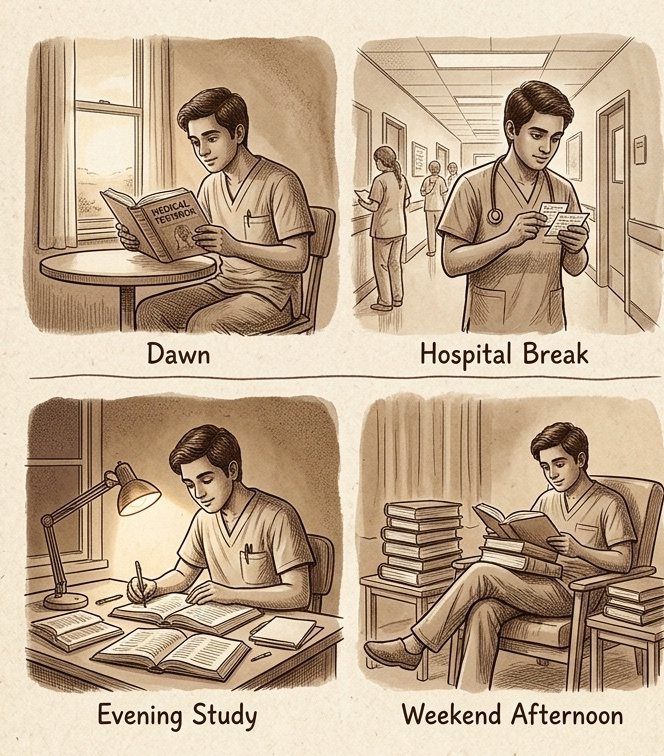
Your biggest asset is time.
Here is how to use it effectively:
Early Morning Study
Your mind is freshest in the morning. Even 1–2 hours of focused study before work can produce excellent results.
Use Breaks Wisely
Lunch breaks or small work gaps are perfect for solving MCQs on the REFLEX app.
Evening Revision
Spend 1–2 hours in the evening revising what you studied earlier.
Weekend Boost
Use weekends for:
- Longer study sessions
- Mock tests
- Revising difficult topics
Consistency always beats occasional long study marathons.
Smart Study Strategy: Focus on High-Yield Topics
When preparing alongside a job, you cannot study every topic in depth. Instead, start with high-yield subjects such as Pathology, Pharmacology, Medicine, Microbiology, Surgery, OBGY, and PSM, identify important chapters within each subject, practice integrated questions combining multiple subjects, and leave lower-yield topics for later stages if time permits. This 80/20 approach ensures you cover most of the exam with focused effort.
Why Practicing PYQs is Essential
Previous Year Questions (PYQs) are one of the most efficient preparation tools. They help you understand the exam pattern, identify frequently repeated concepts, and practice answering questions under time pressure.
Why REFLEX Helps
The REFLEX app makes PYQ practice much easier:
- Topic-wise PYQ practice
- Performance tracking
- Mobile-friendly study during busy schedules
- Daily quizzes to maintain consistency
Instead of wasting time on low-yield materials, focus on exam-oriented preparation.
Staying Motivated While Working
Long work hours can reduce motivation. These strategies help maintain momentum:
- Set micro goals such as completing 50 MCQs daily
- Track progress through analytics tools
- Join study groups for accountability
- Reward yourself after completing study targets
Small wins build long-term confidence.
Choosing the Right Study Resources
When working, avoid resource overload. Remember: you are preparing for an entrance exam, not mastering every textbook. Stick to limited and reliable resources and revise them repeatedly.
Recommended Teachers and Resources
- Anatomy — Dr. Ashwani Kumar
- Physiology — Dr. Anupama Devgan
- Biochemistry — Dr. Rebecca James + First Aid
- Pathology — Dr. Preeti Sharma
- Pharmacology — Dr. Ankit Kumar
- Microbiology — Dr. Preeti Sharma
- PSM — Dr. Kashish Grover
- Forensic Medicine — Dr. Magendran J
- ENT — Dr. Manisha Sinha Budhiraja
- Ophthalmology — Dr. Utsav Bansal
- Medicine — Dr. Deepak Marwah
- Surgery — Dr. Rohan Khandelwal
- OBG — Dr. Sakshi Arora
- Pediatrics — Dr. Singaram
- Orthopedics — Dr. Abbas Ali
- SARP subjects — BTR by Dr. Zainab Vora
For PYQs, practice regularly using the REFLEX app.
Effective Revision Techniques
Revision becomes even more important for working aspirants. Useful methods include:
- Active recall — close the book and recall key points
- Flashcards — quick review of volatile topics
- Mock tests — simulate exam conditions weekly
- 10-minute revision sessions — short daily reviews
These methods help maintain retention even with limited time.
Maintain Your Health
Working and studying together can strain your health. Protect your physical and mental well-being:
- Sleep 6–7 hours daily
- Maintain balanced nutrition
- Take 20-minute walks or light exercise
- Practice mindfulness or meditation
Healthy habits improve both productivity and memory.
Sample Weekly Study Routine
Monday – Friday
- Morning → 1 hour reading high-yield notes
- Lunch break → Solve 20 MCQs on REFLEX
- Evening → 1–2 hours revision or mini-tests
Saturday – Sunday
- 3–4 hours focused study
- Attempt full-length mock test
- Review mistakes and weak areas
Frequently Asked Questions
Can I crack NEET PG/INICET while working full-time?
Yes. Many doctors have successfully cleared the exam while working. The key is smart planning and consistency.
How many hours should I study daily?
Even 3–4 focused hours daily can be enough if used efficiently.
Should I quit my job to prepare?
Not necessarily. If financially feasible and you feel overwhelmed, you may consider it. Otherwise, many aspirants succeed while working.
How important are PYQs?
Extremely important. PYQs highlight the most frequently tested concepts and guide exam-focused preparation.
How do I manage burnout?
Take short breaks, exercise regularly, and set realistic goals. Remember: slow progress is still progress.
How do I avoid FOMO?
Every aspirant's journey is different. Working and preparing simultaneously requires strength and discipline. Trust your path: "Jyada padne se kuch nahi hota, same cheez ko baar baar padne se entrance nikalta."
Final Tips
- Consistency > Intensity
- Focus heavily on PYQs
- Use tools like REFLEX for targeted practice
- Believe in your ability to succeed
Many working doctors have cracked NEET PG/INICET successfully.
Conclusion
Preparing for NEET PG/INICET along with a job may seem extremely difficult at first, but with the right strategy, disciplined time management, and exam-focused preparation, it is completely achievable. Prioritize high-yield topics, practice PYQs regularly, and stay consistent.
Every focused study hour brings you closer to your dream PG seat. Stay determined, stay disciplined, and keep moving forward.

Practise this on Reflex
Turn what you just read into recall with 14 years of tagged PYQs.
About the author
Stay ahead in your preparation
Get expert tips, exam updates, and high-yield insights delivered straight to your inbox.
No spam. Unsubscribe anytime.
More in Exam Guide
View all → Exam Guide
UPSC CMS Exam: Eligibility, Pattern, Syllabus, and How Selection Works
UPSC CMS recruits medical officers for central and Delhi civic services. Here are the eligibility rules, age limit, exam pattern, syllabus, selection stages and how it compares with NEET PG.
 Exam Guide
DNB Full Form in Medical: Course, Admission, and How It Compares With MD/MS
DNB stands for Diplomate of National Board, a postgraduate qualification from NBEMS. Here is how admission, training and the exit exam work, and how DNB compares with MD/MS.
 Exam Guide
INI-CET November 2026: How to Use Your Last 30 Days, Week by Week
 Exam Guide