Clubbing Causes for NEET PG: Grades, Schamroth’s Sign, and the Full List
By Dr. Utsav Bhattacherjee, MBBS, MBA · 24 May 2026 · 2 min read
Last updated: 23 Sept 2026
On this page
Clubbing questions in NEET PG General Medicine tend to come in two forms — identify the grade or test, or match clubbing to its underlying cause across systems. Both are fast, high-value marks once the list is organized properly.
The Four Grades of Clubbing
| Grade | Finding |
|---|---|
| I | Increased fluctuation and softening of the nail bed |
| II | Loss of the normal angle between the nail and the nail fold (Lovibond angle exceeds 180°) |
| III | Increased curvature of the nail — the classic "parrot beak" or drumstick appearance |
| IV | Hypertrophic osteoarthropathy — painful swelling of the long bones |
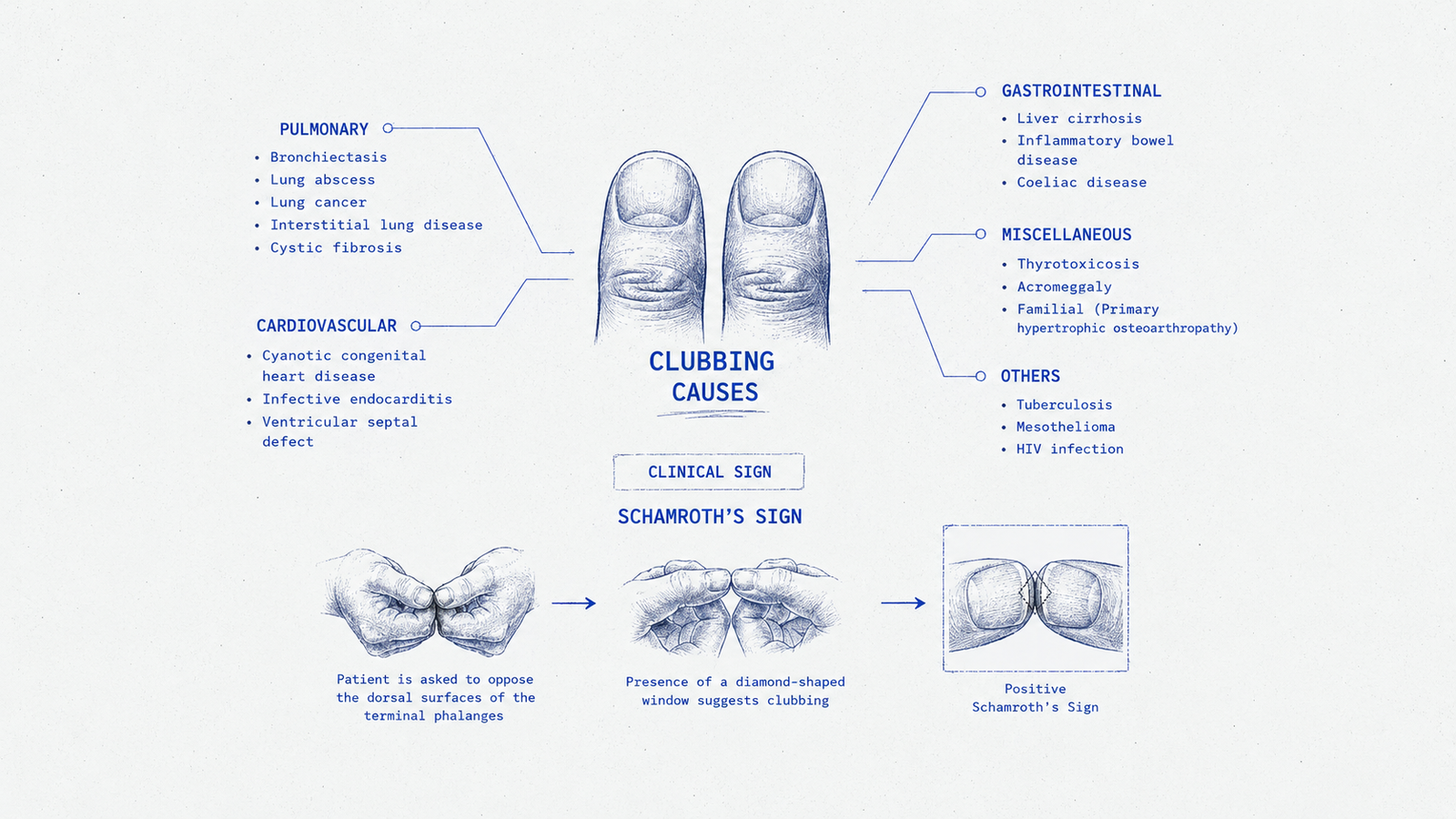
Schamroth’s Window Test
Place the corresponding fingernails of both hands (typically index fingers) back to back. Normally, this creates a small diamond-shaped window between the nail beds. In clubbing, that window disappears, because the increased nail bed angle eliminates the gap. It’s a quick bedside test frequently referenced in clinical vignette questions.
Causes by System
Pulmonary: bronchogenic carcinoma, bronchiectasis, lung abscess, empyema, pulmonary fibrosis, mesothelioma.
Cardiac: cyanotic congenital heart disease, infective endocarditis.
Gastrointestinal: inflammatory bowel disease, cirrhosis, celiac disease.
Others: thyroid acropachy (seen in Graves’ disease).
The Unilateral Clubbing Distractor
Most causes above produce bilateral clubbing. Unilateral clubbing is a specific, high-yield distractor pointing to a localized vascular or mechanical cause — classically an aortic aneurysm compressing local structures, or a Pancoast tumor affecting one side. If a question specifies unilateral clubbing, it’s testing whether you reach for a systemic cause (wrong) or a localized one (right).
Cause-matching questions like this reward organized recall over rote lists — exactly what Reflex’s daily TROCAR Medicine rounds are built to reinforce.
Practise this on Reflex
Turn what you just read into recall with 14 years of tagged PYQs.
FAQ
Frequently asked questions
The questions aspirants ask most about this topic.
The disappearance of the normal diamond-shaped window when two corresponding fingernails are placed back to back — a bedside test for clubbing.
Grade I (increased fluctuation), Grade II (loss of the nail angle), Grade III (parrot-beak curvature), and Grade IV (hypertrophic osteoarthropathy).
Localized causes such as an aortic aneurysm or a Pancoast tumor — distinct from the systemic pulmonary, cardiac, or GI causes that typically produce bilateral clubbing.
In some cases, yes — particularly when the underlying cause (such as an infection or inflammatory condition) is treated early, though long-standing hypertrophic osteoarthropathy is less likely to fully reverse.
About the author
Stay ahead in your preparation
Get expert tips, exam updates, and high-yield insights delivered straight to your inbox.
No spam. Unsubscribe anytime.
More in Medicine
View all → Medicine
Nephrotic Syndrome vs Nephritic Syndrome: The Proteinuria Threshold That Explains Everything Else
 Medicine
Murmur Grading for NEET PG: The Levine Scale, and Why Louder Doesn't Always Mean Worse
 Medicine
Anemia Classification for NEET PG: Morphological Types, Iron Studies, and the Differentials Examiners Actually Test
Anemia questions cut across Medicine, Pathology, Pediatrics and Obstetrics, and most of them hand you a hemogram and expect you to name the type on sight. The morphological classification, the iron studies table, and the smear clues that separate the differentials.
 Medicine
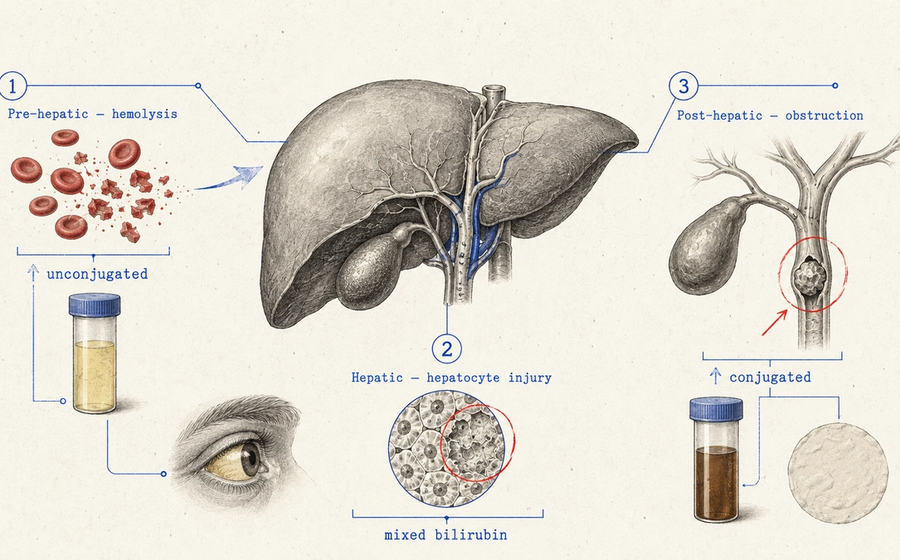
Jaundice Types for NEET PG: Pre-Hepatic, Hepatic, and Post-Hepatic Classification
Jaundice classification for NEET PG — pre-hepatic, hepatic, and post-hepatic types, the lab pattern that tells them apart, and Courvoisier's law explained.