Jaundice Types for NEET PG: Pre-Hepatic, Hepatic, and Post-Hepatic Classification
By Dr. Utsav Bhattacherjee, MBBS, MBA · 29 Jun 2026 · 3 min read
Last updated: 23 Sept 2026
On this page
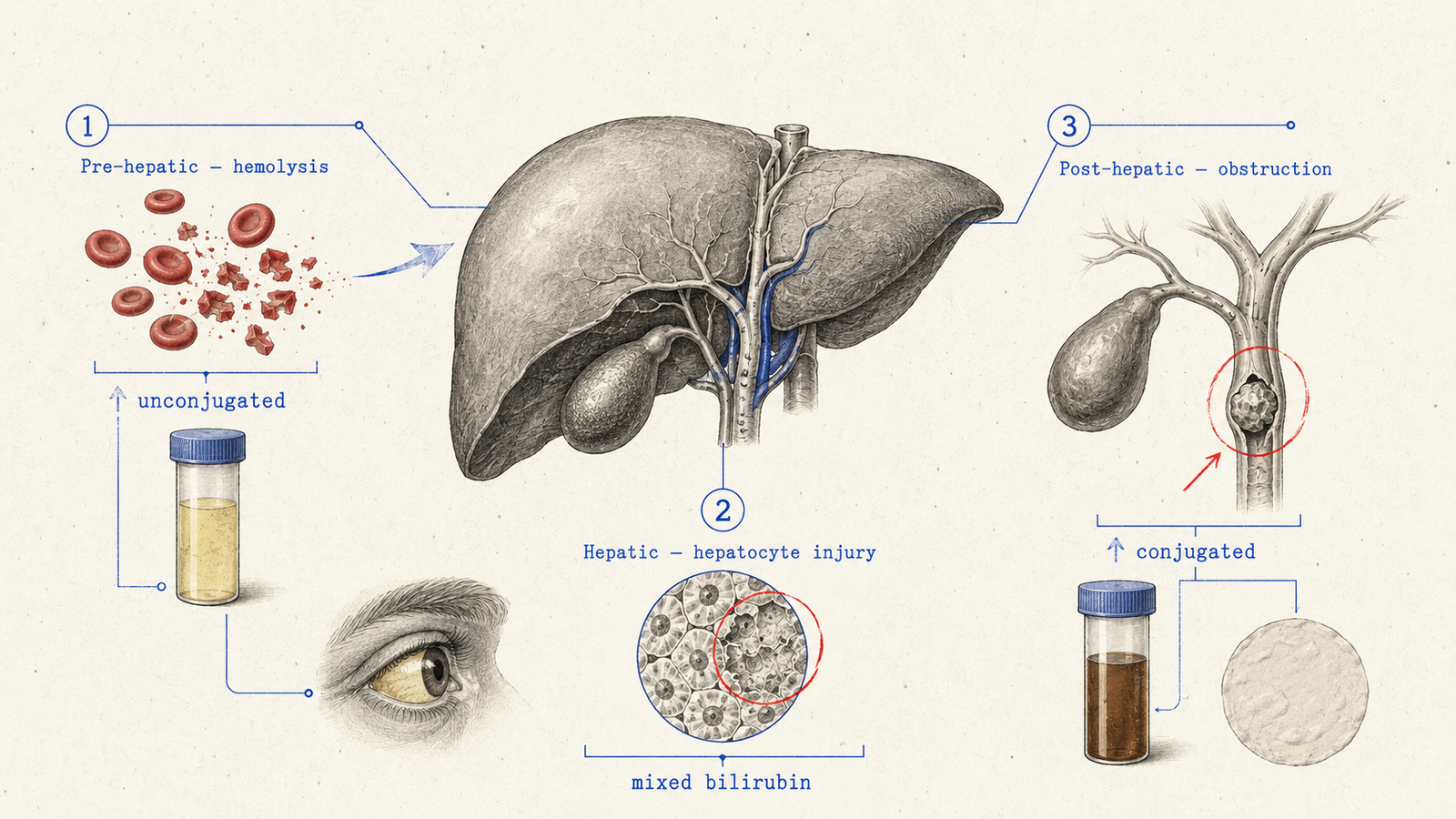
Jaundice questions in NEET PG General Medicine almost never ask you to just define jaundice — they hand you a lab panel (bilirubin fractions, liver enzymes, stool and urine findings) and ask you to identify the type. Getting the three-way classification and its lab signature exactly right is what separates a fast, confident answer from a guess.
The Three Types, by Where the Problem Sits
| Type | Where the defect is | Bilirubin fraction that rises |
|---|---|---|
| Pre-hepatic (hemolytic) | Excess RBC breakdown, before bilirubin reaches the liver | Unconjugated (indirect) |
| Hepatic (hepatocellular) | Liver cell dysfunction — uptake, conjugation, and excretion all affected | Mixed (both) |
| Post-hepatic (obstructive/cholestatic) | Blocked bile flow, after conjugation | Conjugated (direct) |
Pre-Hepatic (Hemolytic) Jaundice
Excessive red blood cell breakdown overwhelms the liver's capacity to conjugate the bilirubin being produced. Since unconjugated bilirubin is not water-soluble, it can't be excreted in urine — a key distinguishing feature.
- Causes: hemolytic anemias (G6PD deficiency, hereditary spherocytosis, sickle cell disease, autoimmune hemolytic anemia), malaria, ineffective erythropoiesis.
- Urine bilirubin: absent (unconjugated bilirubin can't pass into urine).
- Urine urobilinogen: increased (more bilirubin reaching the gut means more gets converted and reabsorbed).
- Stool: normal to dark.
- Liver enzymes: normal — the liver itself isn't damaged, it's just overloaded.
- Pruritus: absent.
Hepatic (Hepatocellular) Jaundice
Here the liver cells themselves are damaged, disrupting bilirubin uptake, conjugation, and excretion all at once — which is why both bilirubin fractions rise together, rather than one dominating cleanly.
- Causes: viral hepatitis (A, B, C, E), alcoholic liver disease, drug-induced liver injury, cirrhosis, autoimmune hepatitis, Wilson's disease.
- Urine bilirubin: present (some conjugated bilirubin leaks into blood and is excreted).
- Stool: normal to pale, depending on severity.
- Liver enzymes: AST/ALT markedly elevated — this is the standout lab clue for hepatic causes. ALP is only mildly to moderately raised.
- Pruritus: variable.
Post-Hepatic (Obstructive) Jaundice
Bile flow is physically blocked after bilirubin has already been conjugated, so conjugated bilirubin backs up into the blood instead of reaching the intestine.
- Causes: gallstones (choledocholithiasis), pancreatic head carcinoma, cholangiocarcinoma, biliary strictures, primary sclerosing cholangitis.
- Urine bilirubin: present and elevated — conjugated bilirubin is water-soluble, so it spills into urine, causing the classic dark urine.
- Urine urobilinogen: decreased or absent — since bile isn't reaching the gut, there's less substrate for gut bacteria to convert into urobilinogen.
- Stool: pale or clay-colored (acholic) — the same blocked bile flow that's missing from the gut is what normally gives stool its brown color.
- Liver enzymes: ALP and GGT markedly elevated; transaminases only mildly raised — the inverse pattern from hepatic jaundice.
- Pruritus: prominent — bile salts accumulate in the skin when they can't drain normally.
The Lab Pattern, Side by Side
| Parameter | Pre-Hepatic | Hepatic | Post-Hepatic |
|---|---|---|---|
| Bilirubin type | Unconjugated | Mixed | Conjugated |
| Urine bilirubin | Absent | Present | Present, elevated |
| Urine urobilinogen | Increased | Normal/variable | Decreased/absent |
| Stool color | Normal to dark | Normal to pale | Pale/clay-colored |
| AST/ALT | Normal | Markedly elevated | Mildly elevated |
| ALP | Normal | Mild-moderate elevation | Markedly elevated |
| Pruritus | Absent | Variable | Present |
The Van den Bergh Reaction
This is the lab test underlying the whole classification. Conjugated bilirubin is water-soluble and reacts immediately with the diazo reagent — a "direct" reaction. Unconjugated bilirubin needs an accelerator (alcohol) to react — an "indirect" reaction. This is exactly why conjugated and unconjugated bilirubin are still commonly called direct and indirect bilirubin in lab reports and exam questions interchangeably.
Courvoisier's Law: The Classic Clinical Correlation
This is one of the highest-yield single facts in this entire topic: in a patient with painless jaundice, a palpable, non-tender gallbladder points away from gallstones as the cause.
The reasoning is anatomical. Chronic gallstone disease causes a fibrotic, scarred gallbladder that can't distend even under pressure. A malignant obstruction — classically pancreatic head carcinoma — causes gradual, painless blockage of a previously healthy, normal gallbladder, which distends freely and becomes palpable. So a palpable gallbladder in painless jaundice is a vote against stones and toward malignancy, which is the opposite of what many students initially assume.
Worth Noting: Neonatal Jaundice Is a Different Framework
The pre-hepatic/hepatic/post-hepatic classification above applies to adults. Neonatal jaundice — physiological versus pathological, based on the timing and rate of bilirubin rise in newborns — uses a separate framework and is typically tested under Pediatrics rather than General Medicine. Don't conflate the two if a question specifies a newborn.
Lab-pattern recognition like this is exactly what Reflex's daily TROCAR General Medicine rounds are built to drill — matching values to mechanism, fast.
Practise this on Reflex
Turn what you just read into recall with 14 years of tagged PYQs.
FAQ
Frequently asked questions
The questions aspirants ask most about this topic.
Pre-hepatic (hemolytic), hepatic (hepatocellular), and post-hepatic (obstructive) — classified by where in the bilirubin pathway the problem occurs.
In painless jaundice, a palpable, non-tender gallbladder suggests a malignant cause (like pancreatic head carcinoma) rather than gallstones, since chronic stone disease typically causes a fibrotic gallbladder that can't distend.
Because bile isn't reaching the intestine, so there's no stercobilin — the pigment that normally gives stool its brown color.
No. Unconjugated bilirubin isn't water-soluble, so it can't be excreted in urine — urine bilirubin stays absent in pure pre-hepatic jaundice, even though urobilinogen rises.
Conjugated (direct) bilirubin is water-soluble and can be excreted in urine and bile. Unconjugated (indirect) bilirubin is not water-soluble and requires liver conjugation before it can be excreted.
About the author
Stay ahead in your preparation
Get expert tips, exam updates, and high-yield insights delivered straight to your inbox.
No spam. Unsubscribe anytime.
More in Medicine
View all → Medicine
Nephrotic Syndrome vs Nephritic Syndrome: The Proteinuria Threshold That Explains Everything Else
 Medicine
Murmur Grading for NEET PG: The Levine Scale, and Why Louder Doesn't Always Mean Worse
 Medicine
Anemia Classification for NEET PG: Morphological Types, Iron Studies, and the Differentials Examiners Actually Test
Anemia questions cut across Medicine, Pathology, Pediatrics and Obstetrics, and most of them hand you a hemogram and expect you to name the type on sight. The morphological classification, the iron studies table, and the smear clues that separate the differentials.
 Medicine
Clubbing Causes for NEET PG: Grades, Schamroth’s Sign, and the Full List
The four grades, Schamroth’s window test, and the complete pulmonary, cardiac and GI cause list.