Partograph for NEET PG: What the Alert Line and Action Line Actually Mean
By Dr. Utsav Bhattacherjee, MBBS, MBA · 9 Sept 2026 · 12 min read
Last updated: 23 Sept 2026
On this page
The partograph exists to answer one question visually, at a glance: is this labor progressing normally, or has it fallen behind? Everything on the chart — the alert line, the action line, the tracked measurements — serves that single purpose, which is why understanding the logic behind the lines matters more than memorizing the chart's layout.
What the Partograph Actually Tracks
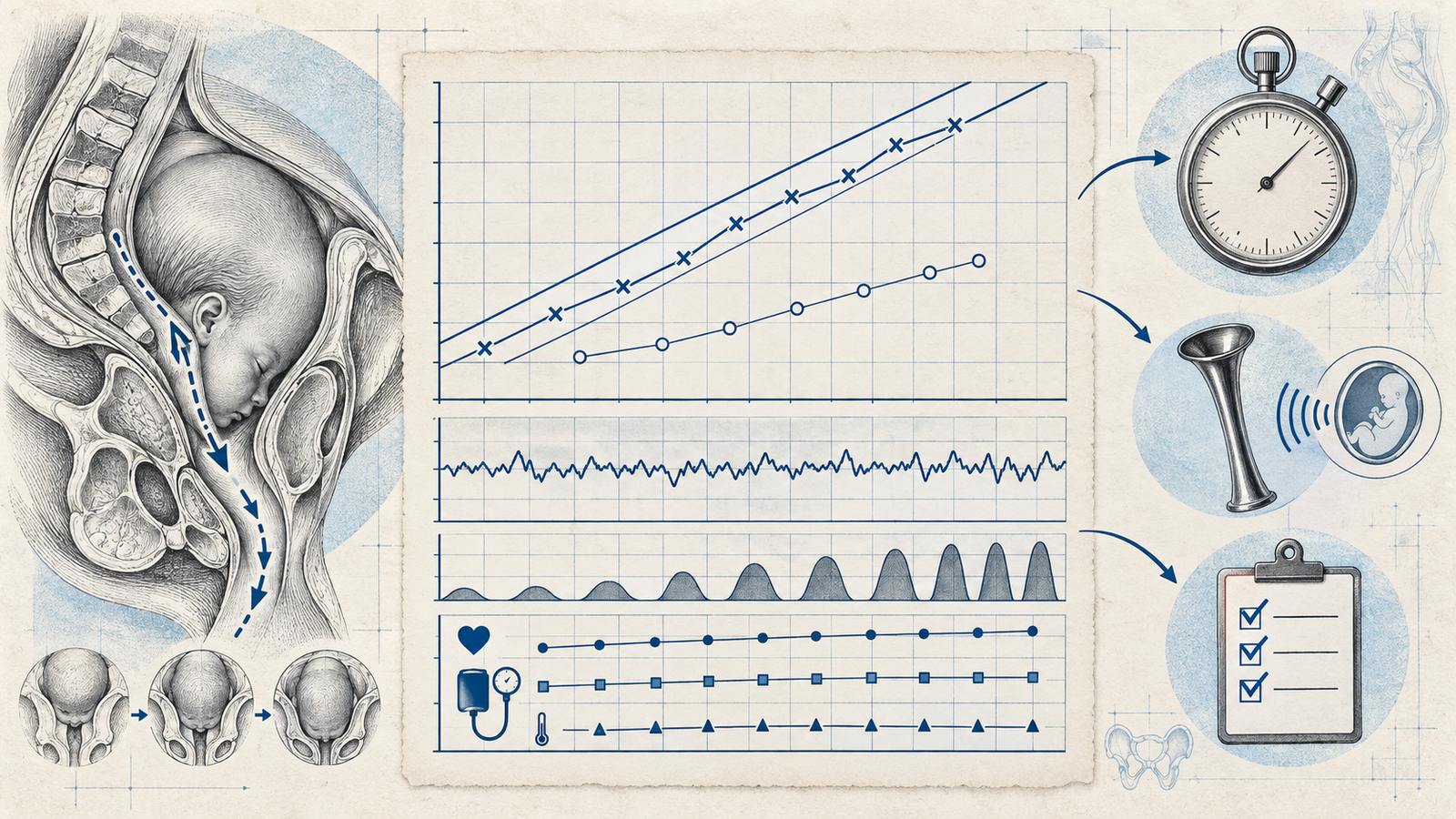
The partograph records several parameters together on one chart, specifically so a clinician can see trends rather than isolated snapshots: cervical dilation (the central measurement, plotted against time), descent of the fetal head (tracked alongside dilation, since the two should progress together), fetal heart rate, uterine contractions (frequency and duration), and maternal vital signs, all recorded on the same timeline.
The Alert Line and Action Line: The Core Innovation
The single most important feature of the partograph is the pair of diagonal lines plotted against expected cervical dilation once the active phase of labor begins (conventionally at 4cm dilation). The alert line represents the expected rate of normal labor progress — conventionally, dilation proceeding at a minimum of 1cm per hour in the active phase. If a woman's actual dilation plots to the right of the alert line, labor is progressing more slowly than expected, though this alone doesn't yet demand intervention — it's a signal to increase monitoring, not an automatic trigger for action.
The action line is drawn four hours to the right of the alert line, and crossing it is a genuine trigger for clinical decision-making — typically prompting active management, which may include oxytocin augmentation or, depending on the full clinical picture, consideration of operative delivery. The four-hour gap between the two lines is deliberate: it gives labor a real window to progress on its own after falling behind the alert line, before intervention becomes necessary, rather than triggering action at the very first sign of slower-than-ideal progress.
Crossing the alert line means: watch more closely. Crossing the action line means: act. Confusing the two — treating an alert-line crossing as an immediate indication for intervention, or waiting past the action line to act — is exactly the kind of misunderstanding a partograph question is built to catch.
A Worked Example
A worked example makes the two lines concrete. A woman enters the active phase at 4cm at 8am. The alert line, built on the 1cm/hour minimum, predicts she should reach 8cm by 12 noon. If her actual dilation is 6cm at 12 noon, she has crossed the alert line — progress is slower than the minimum expected rate, and monitoring should intensify. The action line for this same starting point falls at 4pm. If she is still only 6 or 7cm by 4pm, she has now crossed the action line, and this is the point where active management is genuinely indicated, not simply increased observation.
Notice what this example also shows: a single alert-line crossing at noon did not, by itself, demand action. It was the continued lack of adequate progress over the following four hours — reaching the action line without catching up — that changed the clinical response. A labor that crosses the alert line at noon but accelerates to 9cm by 2pm has used exactly the buffer the four-hour gap was designed to provide, and never reaches the action line at all.
Latent Phase vs Active Phase: Why the Partograph Starts Where It Does
Labor's latent phase — slow, variable early cervical change, roughly up to 4cm dilation — is notoriously unpredictable in duration even in entirely normal labors, which is exactly why the alert and action lines only apply once the active phase begins. Active labor progresses far more predictably, which is what makes plotting an expected rate of dilation against time a meaningful, actionable comparison in the first place.
Why the WHO Modified Partograph Dropped the Latent-Phase Grid
The World Health Organization's modified partograph, now the version most widely taught and used, deliberately removed the latent-phase recording grid that earlier versions included. Early partographs plotted the latent phase alongside the active phase in full detail, but this often meant slow-but-entirely-normal early labors were flagged or intervened upon unnecessarily. The modified version begins formal charting at the start of the active phase specifically to avoid this — a design change that reflects the exact same principle the alert/action line distinction teaches: don't apply an action-oriented framework to a phase of labor that doesn't behave predictably enough to support one.
Prolonged vs Obstructed Labor
Prolonged labor and obstructed labor are related concepts the partograph is built to help distinguish, though they aren't the same thing. Prolonged labor describes labor that is simply taking longer than expected — dilation crossing the alert or action line — without necessarily indicating a mechanical barrier to delivery. Obstructed labor specifically means a mechanical obstruction is preventing descent regardless of contraction strength or duration, and it's a more urgent diagnosis: continuing to await progress in genuinely obstructed labor risks uterine rupture, fetal distress, and other serious complications.
A partograph showing good contractions with no cervical or descent progress at all, rather than merely slow progress, is the pattern that should raise obstruction specifically, not just prolongation, as the working concern.
Why Descent and Contractions Are Tracked Alongside Dilation
Fetal head descent is plotted on the same chart as dilation specifically because the two are expected to move together in normal labor — dilation progressing while descent stalls (or the reverse) is itself a meaningful finding, distinct from either measurement being abnormal in isolation. A labor where dilation is on track but the head simply isn't descending points toward a different category of problem (such as a mechanical issue with the pelvis or fetal position) than a labor where both dilation and descent are lagging together, which more often points toward inadequate uterine contractions.
Uterine contraction frequency and duration are recorded on the partograph specifically because inadequate contractions are one of the most common, and most correctable, causes of labor falling behind the alert line. A pattern of infrequent or short contractions crossing the alert line is a different clinical problem — and calls for a different response, typically oxytocin augmentation — than a pattern of strong, frequent contractions with no progress, which points toward a mechanical problem the uterus cannot contract its way past no matter how well it's contracting.
Reading a partograph well means treating it as a single, integrated picture rather than checking each row in isolation: a slow dilation line paired with normal descent and adequate contractions tells a different story than the same slow dilation line paired with stalled descent and weak contractions, even though the dilation curve alone might look identical in both cases.
Maternal vital signs and fetal heart rate are recorded at set intervals on the same chart specifically so a deviation in either can be read against where labor sits on the dilation curve at that same moment — a fetal heart rate abnormality appearing exactly when dilation has also stalled tells a more complete story than either finding read in isolation.
This is the practical value of charting rather than simply noting numbers in a file: a graph makes a slowing trend visible well before it would be obvious from reading isolated measurements taken hours apart, which is exactly the early-warning function the whole tool exists to provide. The same principle is why the partograph is filled in during labor itself, in real time, rather than reconstructed afterward from notes.
FAQs
What is the difference between the alert line and action line on a partograph?
The alert line represents expected normal labor progress (1cm/hour in active labor); crossing it means increased monitoring. The action line sits four hours to the right, and crossing it is a genuine trigger for clinical intervention.
Why is the action line drawn four hours after the alert line?
The four-hour gap gives labor a genuine window to progress on its own after falling behind expected pace, before intervention becomes necessary — preventing unnecessary intervention on labors that are simply progressing a bit slower but will still complete normally.
Why don't alert and action lines apply during the latent phase?
The latent phase has highly variable duration even in normal labors, so a fixed expected-progress line would flag many normal labors as concerning. The lines only apply once the more predictable active phase begins, conventionally at 4cm.
What is the difference between prolonged and obstructed labor?
Prolonged labor means progress is simply slower than expected. Obstructed labor means a mechanical barrier is preventing descent regardless of contraction quality — a more urgent diagnosis, since continuing to await progress risks uterine rupture and fetal distress.
What does it mean if dilation is progressing normally but descent has stalled?
This pattern points toward a mechanical issue with the pelvis or fetal position, rather than inadequate uterine contractions, which more typically causes both dilation and descent to stall together.
Why did the WHO modified partograph remove the detailed latent-phase grid?
Early partographs plotted the latent phase in the same detail as the active phase, which often led to normal, slow early labors being flagged or intervened upon unnecessarily. The modified version begins formal charting at the active phase specifically to avoid this.
For the same cervix-and-progress reasoning applied to abnormal pregnancy outcomes, see our guide to types of abortion, and for how much of the paper OBG carries overall, our subject-wise weightage breakdown.
Practise this on Reflex
Turn what you just read into recall with 14 years of tagged PYQs.
FAQ
Frequently asked questions
The questions aspirants ask most about this topic.
The alert line represents expected normal labor progress (1cm/hour in active labor); crossing it means increased monitoring. The action line sits four hours to the right, and crossing it is a genuine trigger for clinical intervention.
The four-hour gap gives labor a genuine window to progress on its own after falling behind expected pace, before intervention becomes necessary.
The latent phase has highly variable duration even in normal labors, so a fixed expected-progress line would flag many normal labors as concerning. The lines only apply once the more predictable active phase begins, conventionally at 4cm.
Prolonged labor means progress is simply slower than expected. Obstructed labor means a mechanical barrier is preventing descent regardless of contraction quality — a more urgent diagnosis, since continuing to await progress risks uterine rupture and fetal distress.
This pattern points toward a mechanical issue with the pelvis or fetal position, rather than inadequate uterine contractions, which more typically causes both dilation and descent to stall together.
Early partographs plotted the latent phase in the same detail as the active phase, which often led to normal, slow early labors being flagged or intervened upon unnecessarily. The modified version begins formal charting at the active phase specifically to avoid this.
About the author
Stay ahead in your preparation
Get expert tips, exam updates, and high-yield insights delivered straight to your inbox.
No spam. Unsubscribe anytime.
More in Subject Notes
View all → Obstetrics & Gynaecology
Types of Abortion for NEET PG: Sorted by Cervix Status and What's Actually Been Passed
 Obstetrics & Gynaecology
APGAR Score for NEET PG: Components, Scoring, and What It Predicts
All five components, the exact scoring criteria, and why the 5-minute score matters more than the 1-minute.
 Pediatrics
Kawasaki Disease for NEET PG: The Five Criteria, the 10-Day IVIG Window and the Coronary Risk
What counts as Kawasaki disease, why the 10-day IVIG window matters, how aspirin is used, and how coronary artery involvement is graded and followed.
 Pediatrics
Tetralogy of Fallot for NEET PG: One Septal Shift, Four Defects, and the Tet Spell
One shifted septum explains the four defects of Tetralogy of Fallot, the boot-shaped heart, the fading murmur and the stepwise management of a tet spell.