Types of Abortion for NEET PG: Sorted by Cervix Status and What's Actually Been Passed
By Dr. Utsav Bhattacherjee, MBBS, MBA · 4 Sept 2026 · 10 min read
Last updated: 23 Sept 2026
On this page
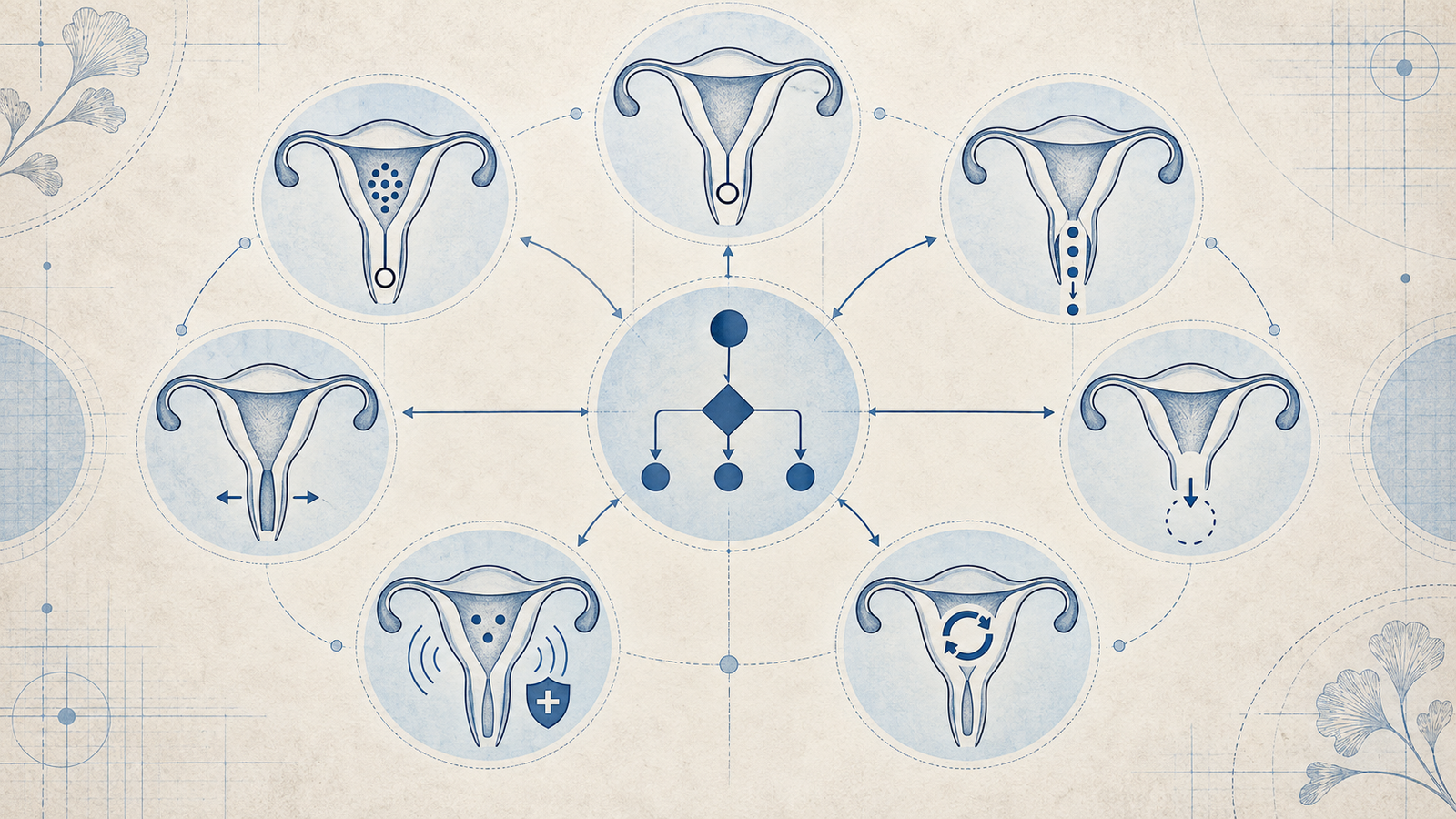
Every type of abortion in this classification is really answering the same two questions: is the cervix open or closed, and has the pregnancy tissue been fully passed, partially passed, or not passed at all? Once you can answer both from a vignette, naming the specific type becomes almost mechanical.
Threatened Abortion
Threatened abortion presents with vaginal bleeding with a closed cervix, in a pregnancy that remains viable on ultrasound — fetal cardiac activity is present. This is the only category in the whole classification where the pregnancy genuinely might continue normally; management is typically expectant, since there's no product of conception to remove and no cervical change indicating the process has become irreversible.
Inevitable Abortion
Inevitable abortion presents with bleeding and a dilated (open) cervix, with the pregnancy still in utero but no longer salvageable — the open cervix is what separates this from threatened abortion, and it's what makes continuation of the pregnancy essentially impossible, regardless of whether fetal cardiac activity is still detectable at this exact moment.
Incomplete Abortion
Incomplete abortion is defined by partial passage of the products of conception — some tissue has passed, but some remains in the uterus, with the cervix typically still open. This retained tissue is clinically significant: it can cause ongoing bleeding and is a real infection risk if not addressed, which is why incomplete abortion typically requires active management (medical or surgical evacuation) rather than simply waiting.
Complete Abortion
Complete abortion means all products of conception have passed, and the cervix has typically closed again by the time of examination. Bleeding and cramping usually subside once passage is complete, and unlike incomplete abortion, there's no retained tissue requiring intervention — confirmation is usually made by ultrasound showing an empty uterus.
Missed Abortion
Missed abortion is the category that most often surprises patients: fetal death has occurred, but the products of conception have not been expelled, and the cervix remains closed. Unlike the other categories, this can present with minimal or no bleeding at all — the diagnosis is often made incidentally on a routine ultrasound showing absent fetal cardiac activity in a patient who felt entirely normal.
Septic Abortion
Septic abortion describes any of the above categories complicated by infection of the uterine contents, presenting with fever, uterine tenderness, and foul-smelling discharge alongside bleeding. It carries genuine risk of progression to sepsis and disseminated intravascular coagulation if not treated promptly — historically associated with unsafe or incomplete illegal abortion procedures, though it can complicate any of the categories above if infection sets in.
The Six Types, Side by Side
| Type | Cervix | Products of Conception | Fetal Viability |
|---|---|---|---|
| Threatened | Closed | None passed | Viable |
| Inevitable | Open | None passed yet | Non-viable outcome expected |
| Incomplete | Open | Partially passed | Non-viable |
| Complete | Closed (re-closed) | Fully passed | Non-viable |
| Missed | Closed | None passed | Non-viable, often asymptomatic |
| Septic | Variable | Variable | Non-viable, with infection |
How Ultrasound Confirms Each Type
Ultrasound findings are what actually convert the clinical picture above into a confirmed diagnosis in most cases, rather than clinical impression alone. In threatened abortion, ultrasound confirms an intrauterine pregnancy with visible fetal cardiac activity. In inevitable and incomplete abortion, ultrasound may show heterogeneous retained tissue within the endometrial cavity, distinguishing incomplete passage from a truly empty uterus.
In complete abortion, ultrasound classically shows a thin, empty endometrial stripe with no retained products — this empty-uterus finding is what actually confirms completeness, since symptoms resolving on their own isn't sufficient evidence that nothing remains inside. In missed abortion, ultrasound is often how the diagnosis is made in the first place: a gestational sac or fetal pole without cardiac activity at a gestational age where activity should be detectable, in a patient who may have no bleeding or cramping to prompt the scan.
This diagnostic role explains why ultrasound has become central to managing early pregnancy bleeding generally — it converts an otherwise purely symptom-based classification into one anchored in a direct anatomical finding, which is part of why modern obstetric practice relies on it so heavily even when the clinical picture alone seems to point clearly toward one category.
Cervical Incompetence: A Related but Distinct Concept
Cervical incompetence (also called cervical insufficiency) deserves separate mention because it's frequently confused with the acute abortion types above, despite working through a genuinely different mechanism and timeline. Where the six types above describe an acute event, cervical incompetence describes a structural weakness of the cervix that leads to painless dilation in the second trimester, typically without the bleeding, cramping, or acute presentation that characterizes threatened, inevitable, or incomplete abortion.
The classic history is a woman who has experienced recurrent second-trimester losses, each one following a similar painless pattern rather than an acute bleeding event. Risk factors include previous cervical trauma (including prior cervical surgery, such as a cone biopsy) and connective tissue disorders affecting cervical strength.
Management differs accordingly: cervical incompetence is classically managed with cervical cerclage — a stitch placed around the cervix, typically in the early second trimester, to provide the mechanical support the cervix itself lacks. This is a preventive, structural intervention rather than a response to an acute event, which is exactly why recognizing cervical incompetence as a distinct entity actually changes management.
Recurrent Pregnancy Loss: A Related Definition Worth Knowing
Separate from the acute classification above, recurrent pregnancy loss is conventionally defined as two or more consecutive pregnancy losses, and it's this definition that triggers a dedicated workup for underlying causes: anatomical uterine abnormalities, antiphospholipid syndrome, chromosomal abnormalities in either partner, and uncontrolled endocrine conditions like thyroid dysfunction or poorly controlled diabetes.
The distinction between recurrent pregnancy loss and cervical incompetence is worth being precise about: cervical incompetence is one specific, structural cause of recurrent loss, identified by its characteristic painless second-trimester pattern, while recurrent pregnancy loss is the broader clinical label triggering investigation into any of several possible causes, of which cervical incompetence is only one.
A useful cross-check worth applying to any vignette in this cluster: if the described bleeding is genuinely painless and the timing is second trimester rather than first, that combination alone should push cervical incompetence to the top of the differential, ahead of the six acute types, even before any ultrasound or examination finding is given in the stem — first-trimester painless bleeding, by contrast, still points toward threatened abortion first, not cervical incompetence, since the timing itself is doing most of the diagnostic work here.
FAQs
What is the difference between threatened and inevitable abortion?
Cervical status. Threatened abortion has a closed cervix and a viable pregnancy that may continue. Inevitable abortion has an open cervix, meaning the pregnancy is no longer salvageable.
How is missed abortion different from the other types?
Missed abortion can present with minimal or no bleeding, since fetal death has occurred but nothing has been expelled and the cervix remains closed. It's often discovered incidentally on routine ultrasound.
Why does incomplete abortion require active management while complete abortion doesn't?
Incomplete abortion leaves retained tissue that can cause ongoing bleeding and infection risk. Complete abortion means all tissue has already passed, so nothing remains to evacuate.
What ultrasound finding confirms a complete abortion?
A thin, empty endometrial stripe with no retained products of conception. This empty-uterus finding is what actually confirms completeness, since symptom resolution alone isn't sufficient evidence.
How is cervical incompetence different from the acute abortion types?
It's a structural cervical weakness causing painless dilation in the second trimester, without the bleeding or cramping seen in threatened, inevitable, or incomplete abortion. It's classically managed with cervical cerclage rather than expectant or evacuation-based approaches.
How many pregnancy losses define recurrent pregnancy loss?
Two or more consecutive losses. This threshold triggers a dedicated workup for underlying causes like anatomical abnormalities, antiphospholipid syndrome, or chromosomal factors.
For the same cervix-and-completeness reasoning applied elsewhere in OBG, see our guide to partograph, and for how much of the paper OBG carries overall, our subject-wise weightage breakdown.
Practise this on Reflex
Turn what you just read into recall with 14 years of tagged PYQs.
FAQ
Frequently asked questions
The questions aspirants ask most about this topic.
Cervical status. Threatened abortion has a closed cervix and a viable pregnancy that may continue. Inevitable abortion has an open (dilated) cervix, meaning the pregnancy is no longer salvageable regardless of current fetal status.
Missed abortion can present with minimal or no bleeding at all, since fetal death has occurred but nothing has been expelled and the cervix remains closed. It's often discovered incidentally on routine ultrasound rather than through a bleeding presentation.
Incomplete abortion leaves retained tissue in the uterus, which can cause ongoing bleeding and carries real infection risk. Complete abortion means all tissue has already passed, so there's nothing retained to evacuate.
A thin, empty endometrial stripe with no retained products of conception. This empty-uterus finding is what actually confirms completeness, since symptom resolution alone isn't sufficient evidence.
It's a structural cervical weakness causing painless dilation in the second trimester, without the bleeding or cramping seen in threatened, inevitable, or incomplete abortion. It's classically managed with cervical cerclage.
Two or more consecutive losses. This threshold, not any single abortion, is what triggers a dedicated workup for underlying causes like anatomical abnormalities, antiphospholipid syndrome, or chromosomal factors.
About the author
Stay ahead in your preparation
Get expert tips, exam updates, and high-yield insights delivered straight to your inbox.
No spam. Unsubscribe anytime.
More in Subject Notes
View all → Obstetrics & Gynaecology
Partograph for NEET PG: What the Alert Line and Action Line Actually Mean
 Obstetrics & Gynaecology
APGAR Score for NEET PG: Components, Scoring, and What It Predicts
All five components, the exact scoring criteria, and why the 5-minute score matters more than the 1-minute.
 Microbiology
Malaria Life Cycle for NEET PG: Species, Smear Morphology, Complications and Treatment
How the malaria parasite moves between mosquito and human, what separates the species on a smear, and how diagnosis, complications and treatment follow from the life cycle.
 Physiology
Oxygen-Hemoglobin Dissociation Curve for NEET PG: Every Shift Explained
Why the oxygen-hemoglobin dissociation curve is sigmoid, what moves it right or left, and how to apply each shift to fetal hemoglobin, stored blood, altitude and carbon monoxide poisoning.