Malignant Hyperthermia for NEET PG: Why Hypercarbia, Not Fever, Is the Sign That Matters First
By Dr. Utsav Bhattacherjee, MBBS, MBA · 9 Sept 2026 · 13 min read
Last updated: 23 Sept 2026
On this page
Malignant hyperthermia questions almost always test the same core insight: this is a genetic disorder of the skeletal muscle itself, triggered by specific drugs, and its earliest reliable sign is not the fever the name suggests. Get that sequence right — genetics, trigger, earliest sign — and the rest of the topic follows logically.
The Genetic Basis
Malignant hyperthermia results from a mutation in the RYR1 gene, which encodes the ryanodine receptor — the channel responsible for releasing calcium from the sarcoplasmic reticulum into muscle cells during normal contraction. Inheritance is autosomal dominant, which is exactly why a positive family history of an anesthetic complication — even one described vaguely by a patient as "a bad reaction to anesthesia" in a relative — is treated as a serious red flag before any procedure requiring general anesthesia.
The Trigger Agents
The two classic trigger categories are volatile inhalational anesthetics (such as halothane, isoflurane, sevoflurane) and the depolarizing muscle relaxant succinylcholine. In a genetically susceptible individual, exposure to either of these triggers the mutated ryanodine receptor to release calcium uncontrollably, setting off the entire crisis. This is why a documented or suspected MH-susceptible patient is managed with a trigger-free anesthetic technique — typically total intravenous anesthesia avoiding both volatile agents and succinylcholine entirely — rather than any special monitoring approach layered on top of a standard technique.
The Clinical Picture: Why Hypercarbia Comes Before Hyperthermia
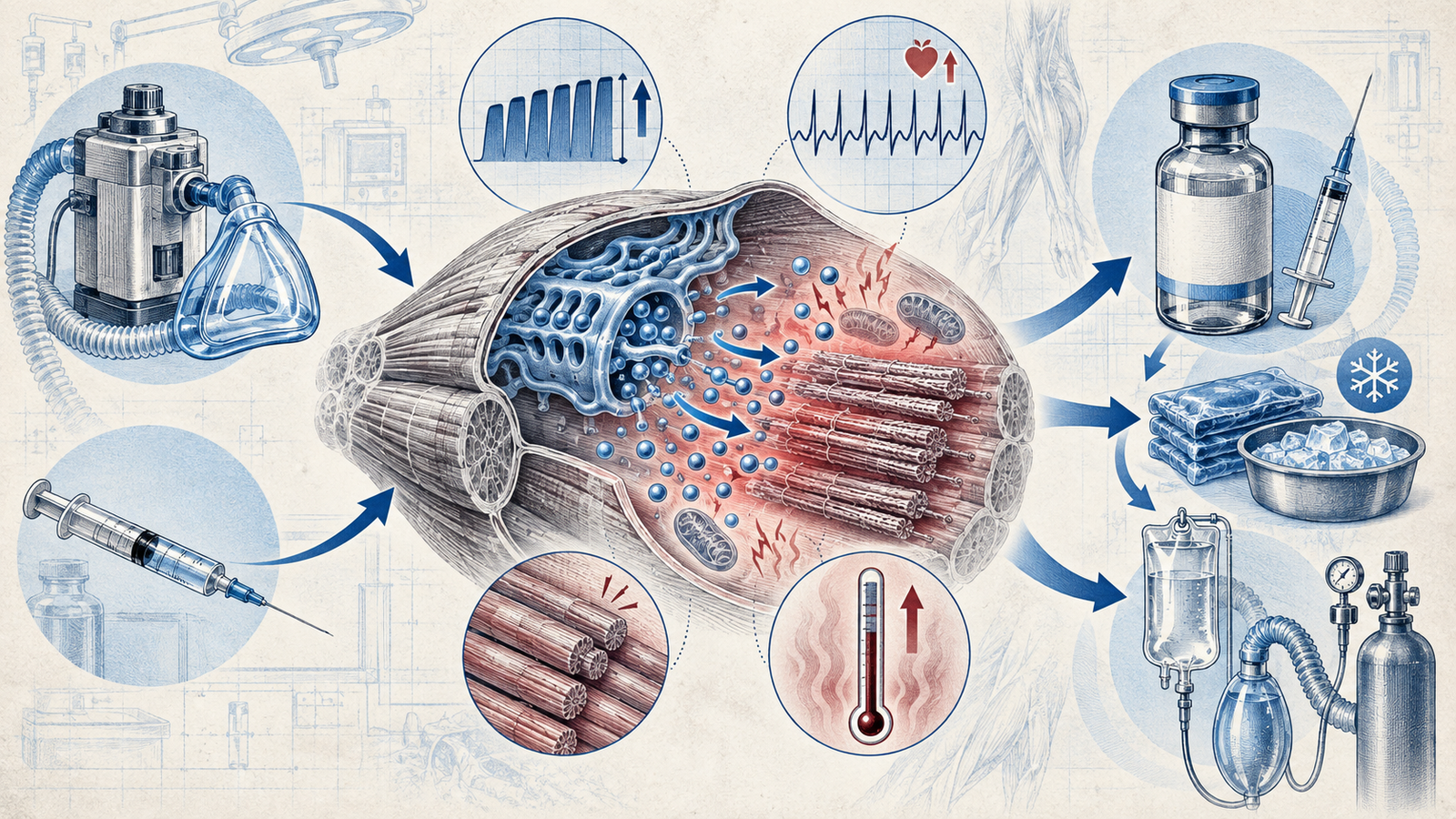
Despite the name, elevated temperature is often a late finding, not the earliest sign. The earliest and most reliable indicator is unexplained hypercarbia — a rising end-tidal CO2 that doesn't correspond to any adjustment in ventilation, reflecting the massive metabolic activity already underway in affected muscle before temperature has had time to climb. Muscle rigidity (masseter spasm is a classically described early clue) and tachycardia typically appear alongside or shortly after the hypercarbia, with fever developing as the crisis progresses rather than announcing it.
A vignette describing rising end-tidal CO2 in an intubated, mechanically ventilated patient — whose ventilator settings haven't changed — during a general anesthetic is describing malignant hyperthermia specifically, well before the patient's temperature has necessarily risen. Waiting for fever to suspect MH means acting later than the disease process itself already has.
The Mechanism, in Full
The mutated ryanodine receptor allows sustained, uncontrolled release of calcium from the sarcoplasmic reticulum into the muscle cell cytoplasm. This calcium drives sustained muscle contraction across affected muscle, and sustained contraction is intensely metabolically expensive — it consumes ATP at a massive rate, generates heat as a byproduct, and produces carbon dioxide and lactic acid far faster than normal metabolism, which is exactly why hypercarbia shows up early and why the eventual temperature rise can be extremely rapid and severe once it does begin.
The Cascade If Left Untreated
Left untreated, the cascade extends well beyond the initial hypercarbia and rigidity. Sustained, uncontrolled muscle contraction eventually causes rhabdomyolysis — breakdown of muscle tissue releasing myoglobin and intracellular contents into circulation. This drives hyperkalemia directly, as potassium normally held inside muscle cells spills into the bloodstream, creating real risk of cardiac arrhythmia on top of the metabolic crisis already underway. The combination of severe acidosis, hyperkalemia, and ongoing heat generation can progress to disseminated intravascular coagulation and multi-organ dysfunction if the trigger isn't withdrawn and dantrolene isn't given promptly.
This full downstream cascade is precisely why the earliest possible recognition matters so much clinically, and why the exam rewards knowing hypercarbia as the first domino rather than waiting for the more dramatic, later findings that share the crisis's name.
Treatment: Dantrolene
The specific antidote is dantrolene, which works by directly inhibiting the ryanodine receptor, blocking further calcium release from the sarcoplasmic reticulum and allowing the muscle to relax. This is a genuinely targeted treatment — it directly addresses the exact molecular defect driving the crisis, rather than just managing downstream symptoms like fever or acidosis. Alongside dantrolene, immediate discontinuation of the triggering agent and supportive measures (cooling, correcting acidosis, treating hyperkalemia) are part of the standard response, but dantrolene is what actually interrupts the underlying process.
Family History, Screening, and a Common Misconception
Because inheritance is autosomal dominant, a first-degree relative with a known or suspected MH episode meaningfully raises a patient's own risk, which is why preoperative history-taking specifically probes for anesthesia complications in family members, not just the patient's own prior anesthetic history. Confirmatory testing (such as the caffeine-halothane contracture test on a muscle biopsy sample) exists for definitive diagnosis in at-risk individuals, but in routine clinical practice, a suggestive family history alone is usually enough to justify a trigger-free anesthetic technique without waiting for definitive genetic or contracture testing.
A patient who has survived one uneventful general anesthetic is not thereby cleared as MH-negative for future procedures — susceptibility depends on the specific agents used and the degree of exposure, so a prior unremarkable anesthetic with a non-triggering technique proves nothing about how that same patient would respond to a genuinely triggering one on a later occasion.
How Rare Is It, Actually
Malignant hyperthermia is genuinely rare, with estimates for clinical episodes ranging roughly from 1 in 5,000 to 1 in 100,000 general anesthetics, varying by population and by how strictly susceptibility is defined. The genetic mutation itself may be somewhat more common than clinical episodes suggest, since a susceptible individual only manifests the crisis on actual exposure to a triggering agent — someone could carry the mutation through multiple anesthetics using non-triggering techniques and never have an episode, which is part of why family history can be genuinely absent even in a first presentation.
Three Conditions That Mimic Malignant Hyperthermia
Several other conditions can mimic parts of the malignant hyperthermia picture, and distinguishing them matters both clinically and on the exam. Thyroid storm also produces fever, tachycardia, and a hypermetabolic state, but it develops over a longer timeframe than MH's rapid intraoperative onset, and it isn't specifically tied to exposure to volatile anesthetics or succinylcholine — a history of poorly controlled hyperthyroidism or a recent thyroid-related stressor points toward storm rather than MH.
Neuroleptic malignant syndrome shares rigidity, hyperthermia, and autonomic instability with malignant hyperthermia, but the trigger and timeline are different: NMS develops over one to three days following exposure to antipsychotic medications (or abrupt withdrawal of dopaminergic drugs), not within minutes of a specific anesthetic trigger. The rigidity in NMS is also classically described as lead-pipe in character, and it responds to dantrolene and bromocriptine rather than to trigger avoidance alone, since there's no anesthetic agent to withdraw from once the reaction has already started.
Serotonin syndrome produces a similar triad of altered mental status, autonomic instability, and neuromuscular abnormality, but the neuromuscular findings differ meaningfully: serotonin syndrome classically produces clonus and hyperreflexia, particularly pronounced in the lower extremities, rather than the sustained rigidity of MH or NMS. The trigger is serotonergic medication exposure or interaction, not anesthetic agents, which is usually clear from the medication history alone.
The shared feature across all three mimics — thyroid storm, NMS, and serotonin syndrome — is that none of them is caused by a primary defect in skeletal muscle calcium handling, and none of them responds to dantrolene as a first-line, mechanism-specific treatment the way malignant hyperthermia does. Trigger timing relative to a specific exposure is usually the fastest way to separate MH from all three: minutes into a general anesthetic points to MH; a longer, non-anesthesia-linked timeline points elsewhere.
Malignant hyperthermia is rare, but the reason it remains a heavily tested topic despite its rarity is that a missed or delayed diagnosis is rapidly fatal, while a correctly and promptly treated case has a good prognosis — the entire value of knowing this topic cold is recognizing the hypercarbia-first pattern quickly enough for dantrolene and trigger discontinuation to actually work.
FAQs
What is the earliest reliable sign of malignant hyperthermia?
Unexplained hypercarbia — a rising end-tidal CO2 with no change in ventilator settings. Fever, despite the name, is often a later finding, appearing after hypercarbia and muscle rigidity have already begun.
What are the two classic trigger agents for malignant hyperthermia?
Volatile inhalational anesthetics (such as halothane, isoflurane, or sevoflurane) and the depolarizing muscle relaxant succinylcholine. Both are avoided in known or suspected MH-susceptible patients.
How does dantrolene actually treat malignant hyperthermia?
It directly inhibits the ryanodine receptor, blocking further uncontrolled calcium release from the sarcoplasmic reticulum and allowing affected muscle to relax — directly addressing the molecular defect rather than just managing downstream symptoms.
What gene is mutated in malignant hyperthermia, and how is it inherited?
The RYR1 gene, encoding the ryanodine receptor. Inheritance is autosomal dominant, which is why a family history of an anesthesia complication is a significant risk factor.
How is neuroleptic malignant syndrome different from malignant hyperthermia?
NMS develops over one to three days after exposure to antipsychotics, not within minutes of an anesthetic trigger. Its rigidity is classically lead-pipe in character, and while it responds to dantrolene, there's no anesthetic agent to discontinue the way there is in MH.
How does serotonin syndrome present differently from malignant hyperthermia?
Serotonin syndrome classically produces clonus and hyperreflexia, particularly in the lower extremities, rather than the sustained muscle rigidity of MH, and it's triggered by serotonergic medications rather than anesthetic agents.
For the same trigger-and-mechanism approach applied to a different anesthesia-adjacent topic, see our guide to types of shock, and for how much of the paper Anesthesia carries overall, our subject-wise weightage breakdown.
Practise this on Reflex
Turn what you just read into recall with 14 years of tagged PYQs.
FAQ
Frequently asked questions
The questions aspirants ask most about this topic.
Unexplained hypercarbia — a rising end-tidal CO2 with no change in ventilator settings. Fever, despite the name, is often a later finding.
Volatile inhalational anesthetics (halothane, isoflurane, sevoflurane) and the depolarizing muscle relaxant succinylcholine.
It directly inhibits the ryanodine receptor, blocking further uncontrolled calcium release and allowing affected muscle to relax — addressing the molecular defect directly.
The RYR1 gene, encoding the ryanodine receptor. Inheritance is autosomal dominant, which is why family history of an anesthesia complication is a significant risk factor.
NMS develops over one to three days after exposure to antipsychotics, not within minutes. Its rigidity is lead-pipe in character, and while it responds to dantrolene, there's no anesthetic agent to discontinue.
Serotonin syndrome classically produces clonus and hyperreflexia, particularly in the lower extremities, rather than the sustained rigidity of MH, and is triggered by serotonergic medications rather than anesthetic agents.
About the author
Stay ahead in your preparation
Get expert tips, exam updates, and high-yield insights delivered straight to your inbox.
No spam. Unsubscribe anytime.
More in Subject Notes
View all → Anesthesia
Anaesthesia for NEET PG 2026: High-Yield Topics, Spinal Complications, and Drug Doses
Anaesthesia is 3 to 6 questions out of 180 — and one of the most repetitive subjects in the paper. Fifteen topics, done properly, reliably cover all of them.
 Pediatrics
Kawasaki Disease for NEET PG: The Five Criteria, the 10-Day IVIG Window and the Coronary Risk
What counts as Kawasaki disease, why the 10-day IVIG window matters, how aspirin is used, and how coronary artery involvement is graded and followed.
 Pediatrics
Tetralogy of Fallot for NEET PG: One Septal Shift, Four Defects, and the Tet Spell
One shifted septum explains the four defects of Tetralogy of Fallot, the boot-shaped heart, the fading murmur and the stepwise management of a tet spell.
 Microbiology
Malaria Life Cycle for NEET PG: Species, Smear Morphology, Complications and Treatment
How the malaria parasite moves between mosquito and human, what separates the species on a smear, and how diagnosis, complications and treatment follow from the life cycle.