Anaesthesia for NEET PG 2026: High-Yield Topics, Spinal Complications, and Drug Doses
By Dr. Utsav Bhattacherjee, MBBS, MBA · 3 Aug 2026 · 18 min read
Last updated: 23 Sept 2026
On this page
Anaesthesia contributes approximately 2–3% of the NEET PG paper — around 3 to 6 questions out of 180. That is a narrow target. The good news is that Anaesthesia has one of the highest PYQ repetition rates of any subject in NEET PG. The same topics appear, in the same formats, cycle after cycle. If you know the right 15 to 20 concepts well, you can reliably get every Anaesthesia question correct.
This guide covers every high-yield Anaesthesia topic with the level of detail NEET PG actually tests. Not a textbook summary — a focused, exam-relevant breakdown of what appears in PYQs and why. For where this subject sits against the rest of the paper, see our subject wise weightage guide; for how to fit it into your overall approach, see the complete NEET PG preparation strategy.
Why Anaesthesia Is Easier Than It Looks
Most aspirants either over-prepare Anaesthesia — spending weeks on a subject worth 2–3% of the paper — or under-prepare it, avoiding it entirely and dropping guaranteed marks. The correct approach is systematic PYQ-based preparation of the 15 core topics listed below, spending approximately 5 to 7 focused study days on the entire subject.
Anaesthesia questions in NEET PG are almost never about clinical judgment — they are about pharmacological facts, mechanism comparisons, and specific clinical scenarios that have a single correct answer. Pattern recognition after PYQ practice is highly reliable here.
Before diving into topics, use the NEET PG 2026 score calculator to understand how much these 3 to 6 questions are actually worth to your rank. Getting all Anaesthesia questions correct versus none is a score swing of 12 to 24 marks — potentially 1,000 or more rank positions in the competitive range.
The 15 Most-Tested Anaesthesia Topics in NEET PG PYQs
Based on analysis of 14 years of NEET PG papers:
| Rank | Topic | Frequency | Format |
|---|---|---|---|
| 1 | Malignant hyperthermia — triggers, mechanism, treatment | Very High | Clinical scenario MCQ |
| 2 | Spinal anaesthesia — layers pierced, drugs, complications | Very High | Direct factual + clinical |
| 3 | Local anaesthetic — classification, mechanism, max doses | Very High | Pharmacology MCQ |
| 4 | NMS vs malignant hyperthermia — comparison | High | Differentiation MCQ |
| 5 | Stages of general anaesthesia (Guedel's) | High | Direct factual |
| 6 | MAC values of inhalational agents | High | Comparison MCQ |
| 7 | Adrenaline in local anaesthetics — reasons and exceptions | High | Pharmacology reasoning |
| 8 | Muscle relaxants — depolarising vs non-depolarising | High | Classification MCQ |
| 9 | Suxamethonium — mechanism, adverse effects, contraindications | High | Pharmacology MCQ |
| 10 | Epidural anaesthesia — indications, technique, differences from spinal | Moderate | Procedural MCQ |
| 11 | Neuroleptic malignant syndrome | Moderate | Clinical scenario |
| 12 | Bupivacaine cardiotoxicity | Moderate | Direct factual |
| 13 | Ketamine — unique properties and uses | Moderate | Pharmacology MCQ |
| 14 | Propofol — uses, PRIS, contraindications | Moderate | Clinical MCQ |
| 15 | Pre-medication drugs and their rationale | Low-Moderate | Pharmacology MCQ |
Topic 1: Spinal Anaesthesia
Layers Pierced (skin to subarachnoid space)
This is the single most-tested anatomical fact in Anaesthesia. Seven layers are pierced when performing a spinal anaesthetic:
- Skin
- Subcutaneous tissue
- Supraspinous ligament
- Interspinous ligament
- Ligamentum flavum
- Epidural space (and epidural fat / venous plexus)
- Dura mater and arachnoid mater (often counted together in exam questions)
Memory aid: "Silly Surgeons in Labs Eat Dead Animals" — Skin, Subcutaneous tissue, Interspinous ligament, Ligamentum flavum, Epidural space, Dura mater, Arachnoid mater.
PYQ pattern: questions ask either for the complete list in order, or specifically which ligament is felt as a sudden loss of resistance — the ligamentum flavum.
Level of Spinal Anaesthesia
Spinal is performed between L3–L4 or L4–L5 in adults, below the conus medullaris, which ends at L1–L2 in adults. In children the spinal cord extends to L2–L3, so spinal is performed at L4–L5.
Drugs Used in Spinal Anaesthesia
| Drug | Type | Onset | Duration | Key Use |
|---|---|---|---|---|
| Bupivacaine 0.5% heavy | Hyperbaric LA | Slow | Long (2–4 hrs) | Most common agent |
| Lignocaine (hyperbaric) | LA | Fast | Short (1–2 hrs) | Short procedures |
| Fentanyl | Opioid adjuvant | Fast | Adds 2–4 hrs | Combined with LA |
| Morphine | Opioid adjuvant | Slow | 12–24 hrs | Post-op analgesia |
| Clonidine | Alpha-2 agonist | — | Extends duration | Adjuvant |
A "heavy" or hyperbaric solution has a higher specific gravity than CSF, so it sinks with gravity and its spread is position-dependent.
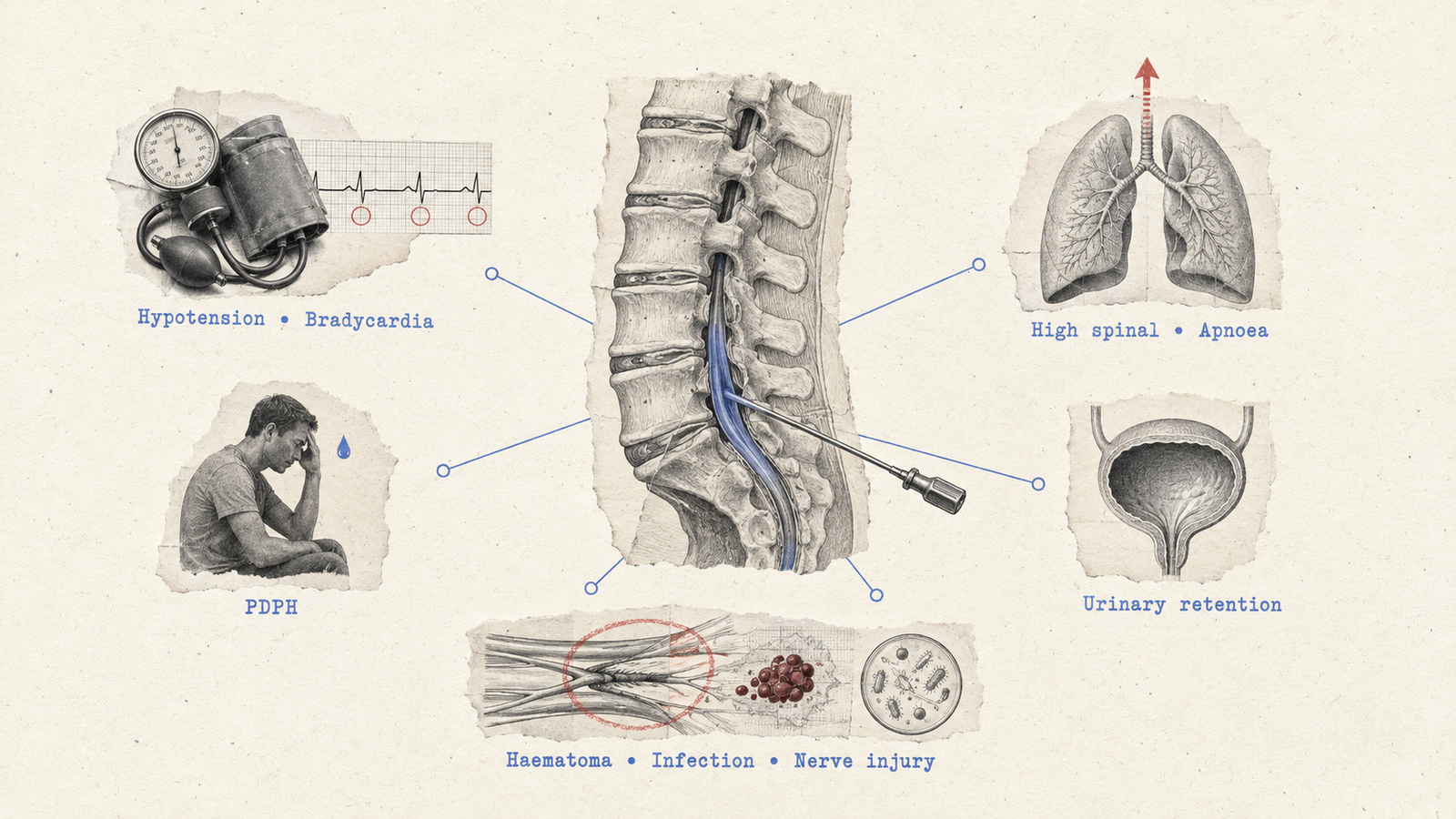
Complications of Spinal Anaesthesia
This is the highest-yield topic area for clinical scenario questions.
Immediate complications:
| Complication | Mechanism | Management |
|---|---|---|
| Hypotension | Sympathetic block causing vasodilation | IV fluids, vasopressors (ephedrine first-line), left lateral tilt in pregnancy |
| Bradycardia | Block of cardiac accelerator fibres (T1–T4) | Atropine, ephedrine |
| High or total spinal | Drug spreads to brainstem | Immediate intubation, vasopressors, CPR if needed |
| Urinary retention | Sacral parasympathetic block | Catheterisation |
| Nausea and vomiting | Hypotension plus vagal response | Treat the hypotension first |
Delayed complications:
| Complication | Onset | Features | Management |
|---|---|---|---|
| Post-dural puncture headache (PDPH) | 24–48 hours | Positional — worse sitting or standing, better lying flat; frontal or occipital | Bed rest, hydration, caffeine; epidural blood patch if persistent |
| Neurological complications | Variable | Transient neurological symptoms, cauda equina syndrome | Rare; supportive |
| Meningitis | Days | Bacterial or chemical | Antibiotics |
| Backache | Days | Common, usually resolves | Conservative |
PDPH is a PYQ favourite. The positional nature — relieved by lying flat — is the diagnostic key. It occurs because of persistent CSF leak through the dural hole, causing traction on the meninges when upright.
Factors that make PDPH more likely:
- Larger needle size
- Cutting (Quincke) needles rather than pencil-point (Whitacre, Sprotte) needles
- Younger patients and females
- Multiple attempts
Spinal anaesthesia recovery time: motor block resolves before sensory block. Sensory block at the surgical site resolves in 1.5 to 3 hours for most agents. Full sensory and motor recovery occurs within 2 to 4 hours for a standard bupivacaine spinal. Urinary function usually takes longest to return, at 2 to 6 hours, which is why catheterisation may be needed for longer procedures.
Topic 2: Local Anaesthetics
Classification
Esters, metabolised by plasma cholinesterase:
- Cocaine — the only vasoconstricting LA, because it inhibits noradrenaline reuptake
- Procaine
- Chloroprocaine — shortest duration, fastest hydrolysis
- Tetracaine / amethocaine — topical and spinal use
- Benzocaine — topical only
Amides, metabolised by hepatic enzymes and therefore slower:
- Lignocaine / lidocaine — the most versatile; LA and antiarrhythmic
- Bupivacaine — longest duration, most cardiotoxic
- Ropivacaine — less cardiotoxic than bupivacaine, preferred in obstetrics
- Levobupivacaine — S-enantiomer of bupivacaine, less cardiotoxic
- Prilocaine — causes methaemoglobinaemia
- Mepivacaine
Memory aid: amides have an extra "i" in the name — bupivAcaIne, lIgnocaIne, ropIvacaIne.
Mechanism of Action
Local anaesthetics block sodium channels from inside the channel, binding preferentially to the inactivated state and only once the channel has opened. They are weak bases with a pKa above 7.4. The unionised form crosses the nerve membrane; the ionised form, once inside the cell, blocks the channel.
This is why local anaesthetic works poorly in inflamed or infected tissue: the acidic pH leaves more drug in the ionised form outside the cell, so less crosses the membrane.
Order of Nerve Blockade
The smallest-diameter and unmyelinated fibres are blocked first: pain (C fibres), then temperature, then touch, then pressure, and motor last.
NEET PG key point: autonomic (sympathetic) block occurs first, which is why hypotension appears before the surgical site is anaesthetised. Motor function recovers last.
Maximum Safe Doses
This is tested directly, usually in clinical scenario format.
| Agent | Without Adrenaline | With Adrenaline | Key Notes |
|---|---|---|---|
| Lignocaine | 3 mg/kg | 7 mg/kg | Standard LA; also antiarrhythmic |
| Bupivacaine | 2 mg/kg | 2.5 mg/kg | Most cardiotoxic; adrenaline adds little |
| Ropivacaine | 3 mg/kg | 4 mg/kg | Less cardiotoxic than bupivacaine |
| Prilocaine | 6 mg/kg | 8.5 mg/kg | Highest plain dose; methaemoglobinaemia risk |
| Cocaine | 1.5–3 mg/kg | Not added — already vasoconstricts | Only intrinsically vasoconstrictive LA |
Worked calculation, the format PYQs use: a patient weighs 70 kg. Maximum safe dose of plain lignocaine is 3 mg/kg, so 210 mg. Lignocaine 2% is 20 mg/mL. Maximum volume is 210 ÷ 20 = 10.5 mL.
Why Adrenaline Is Added
Adrenaline is added to local anaesthetics to cause local vasoconstriction, which reduces systemic absorption, lowers the peak plasma concentration and therefore the toxicity risk. It also prolongs the duration of action — especially for shorter-acting agents like lignocaine — reduces bleeding in the surgical field, and acts as a marker of accidental intravascular injection, producing tachycardia.
Where adrenaline must not be added:
- Ring blocks of digits, penis or pinna — end arteries, with risk of ischaemia and gangrene
- Intravenous regional anaesthesia (Bier's block) — systemic release when the tourniquet is deflated
- Patients on MAO inhibitors or tricyclics — hypertensive crisis
- Patients with severe hypertension or cardiac arrhythmias
Topic 3: Malignant Hyperthermia
Malignant hyperthermia is a pharmacogenetic disorder of skeletal muscle characterised by uncontrolled calcium release from the sarcoplasmic reticulum following exposure to a triggering agent. It is an emergency with high mortality if untreated.
Genetic basis: mutation in the ryanodine receptor gene (RYR1) on chromosome 19q13, inherited in an autosomal dominant pattern.
Triggering Agents
Remember the triggers as "SHE": Suxamethonium (succinylcholine), Halogenated inhalational agents (halothane, sevoflurane, desflurane, isoflurane, enflurane), and Exercise and heat in susceptible individuals.
Safe in MH-susceptible patients: all intravenous agents (propofol, ketamine, thiopentone), all non-depolarising muscle relaxants (vecuronium, rocuronium, atracurium), all local anaesthetics, and nitrous oxide.
Clinical Features
| Feature | Explanation |
|---|---|
| Hypercapnia (rising EtCO2) | Earliest and most sensitive sign — increased metabolism |
| Tachycardia | Earliest cardiovascular sign |
| Masseter muscle spasm | Jaw rigidity after suxamethonium |
| Muscle rigidity | Generalised |
| Hyperthermia | Core temperature rising more than 2°C per hour — a late sign |
| Metabolic acidosis | Increased CO2 production and lactate accumulation |
| Rhabdomyolysis | Myoglobinaemia, myoglobinuria, dark urine |
| Hyperkalaemia | From muscle breakdown; can cause cardiac arrest |
NEET PG key point: the earliest sign is a rise in end-tidal CO2, not hyperthermia — which is a late sign despite giving the condition its name.
Management
Stop, cool, dantrolene.
- Stop all triggering agents immediately
- Call for help — this is a team emergency
- Switch to total intravenous anaesthesia with propofol
- Hyperventilate with 100% oxygen at high flow, at least 10 L/min
- Give dantrolene, the only specific antidote — 2.5 mg/kg IV bolus, repeated every 5 minutes up to 10 mg/kg total; it blocks the ryanodine receptor and stops calcium release from the sarcoplasmic reticulum. Continue oral dantrolene for 24–48 hours to prevent recurrence
- Cool actively with cold IV saline, ice packs and cooling blankets
- Treat hyperkalaemia with calcium gluconate, sodium bicarbonate and insulin-dextrose
- Correct acidosis with sodium bicarbonate
- Maintain urine output with fluids and furosemide to prevent myoglobin-induced acute kidney injury
- Monitor for DIC, arrhythmias and renal failure
Topic 4: NMS vs Malignant Hyperthermia
This distinction appears in virtually every NEET PG cycle in some form. Know every row.
| Feature | Malignant Hyperthermia | Neuroleptic Malignant Syndrome |
|---|---|---|
| Setting | During or shortly after general anaesthesia | Days to weeks after starting an antipsychotic |
| Triggers | Suxamethonium, halogenated volatile agents | Dopamine antagonists — haloperidol, chlorpromazine, metoclopramide, droperidol |
| Mechanism | Excess calcium release from SR via RYR1 mutation | Dopamine D2 receptor blockade in striatum and hypothalamus |
| Inheritance | Autosomal dominant (RYR1, chromosome 19) | Not inherited — idiosyncratic drug reaction |
| Onset | Minutes to hours | Hours to days |
| Muscle rigidity | Lead-pipe or cogwheel | Lead-pipe |
| Hyperthermia | Severe, may exceed 40–42°C | Severe, 38.5–40°C |
| Earliest sign | Rising EtCO2 | Altered mental status and rigidity |
| Creatine kinase | Markedly elevated | Markedly elevated |
| Specific antidote | Dantrolene, 2.5 mg/kg IV | Bromocriptine, plus dantrolene |
| Other treatment | Stop volatile agent, TIVA, cooling, oxygen | Stop the antipsychotic, benzodiazepines |
| Diagnosis | Caffeine-halothane contracture test on muscle biopsy | Clinical — no specific test |
Memory tip: in MH the drug *causes* muscle to release calcium. In NMS the drug *blocks* dopamine receptors in the striatum, producing rigidity. MH uses dantrolene alone; NMS uses bromocriptine to restore dopaminergic tone, plus dantrolene.
Topic 5: Stages of General Anaesthesia (Guedel's Classification)
| Stage | Name | Clinical Features | Significance |
|---|---|---|---|
| 1 | Analgesia / induction | Conscious; analgesia without amnesia, then with amnesia; reflexes intact | Nitrous oxide works in Stage 1 only |
| 2 | Excitement / delirium | Unconscious but reflexes exaggerated; irregular breathing, breath-holding, vomiting, laryngospasm risk | The danger zone — avoid stimulation; pass through rapidly |
| 3 | Surgical anaesthesia | Regular breathing, loss of reflexes; divided into 4 planes | Target stage for surgery |
| 4 | Medullary depression | Respiration and vasomotor centre cease | Anaesthetic overdose — death |
Planes within Stage 3:
| Plane | Respiration | Eye Signs | Muscle Tone | Reflexes |
|---|---|---|---|---|
| 1 | Regular | Eyeball moves; lacrimation | Mild loss | Pharyngeal reflex lost |
| 2 | Regular | Eyeball fixed centrally | Moderate loss | Corneal reflex lost |
| 3 | Intercostal paralysis begins | Fixed, dilated pupil | More loss | Laryngeal reflex lost |
| 4 | Complete intercostal paralysis | Fixed, dilated pupil | Total flaccidity | All reflexes lost |
PYQ pattern: questions ask what is lost at which plane, or which sign indicates overdose — fixed dilated pupils with cessation of respiration means Stage 4.
Topic 6: Inhalational Agents and MAC Values
MAC, the minimum alveolar concentration, is the alveolar concentration that prevents movement in 50% of patients in response to a standard surgical stimulus. Lower MAC means more potent.
| Agent | MAC (%) | Properties |
|---|---|---|
| Halothane | 0.75 | Most potent traditional agent; hepatotoxic; sensitises heart to catecholamines; MH trigger |
| Isoflurane | 1.15 | Preferred for neuroanaesthesia; coronary steal; pungent, so poor for induction |
| Sevoflurane | 2.0 | Best for inhalational induction, least pungent; paediatric use; produces Compound A with soda lime at low flow |
| Desflurane | 6.0 | Highest MAC, least potent; fastest recovery; very pungent, cannot be used for induction |
| Nitrous oxide | 105 | MAC above 100% means it cannot produce surgical anaesthesia alone; adjuvant only; supports combustion |
PYQ patterns: best for inhalational induction in children is sevoflurane; most potent is halothane; fastest recovery is desflurane; cannot produce surgical anaesthesia alone is nitrous oxide; causes coronary steal is isoflurane.
Topic 7: Muscle Relaxants
| Feature | Depolarising (suxamethonium) | Non-depolarising |
|---|---|---|
| Mechanism | Mimics ACh at the NMJ, causing sustained depolarisation | Competitive antagonism of ACh at the NMJ |
| Fasciculations | Yes — characteristic | No |
| Train of four | No fade | Fade |
| Tetanic stimulation | No fade | Fade |
| Post-tetanic facilitation | Absent | Present |
| Reversal | Cannot be reversed pharmacologically | Neostigmine, or sugammadex for rocuronium and vecuronium |
| MH trigger | Yes | No |
Suxamethonium
Fastest onset of any muscle relaxant at 30–60 seconds and the shortest duration at 5–10 minutes, which makes it the drug of choice for rapid sequence intubation. It is metabolised by plasma cholinesterase.
Adverse effects, all of them examined:
| Adverse Effect | Mechanism |
|---|---|
| Hyperkalaemia | Potassium efflux during depolarisation — normally a 0.5 mEq/L rise, dangerous in burns, crush injury and denervation |
| Bradycardia | Muscarinic effect, especially with repeat doses |
| Raised intraocular pressure | Contraction of extraocular muscles |
| Raised intragastric pressure | Aspiration risk |
| Malignant hyperthermia | Trigger |
| Suxamethonium apnoea | Pseudocholinesterase deficiency |
| Myalgia | Post-operative muscle pain from fasciculations |
Contraindications: burns after the first 48 hours and up to two years; crush injuries; spinal cord injury and upper motor neurone lesions; denervation injuries; MH susceptibility; pseudocholinesterase deficiency; open eye injuries.
Non-Depolarising Agents
| Drug | Duration | Reversal | Key Feature |
|---|---|---|---|
| Rocuronium | Intermediate | Sugammadex or neostigmine | Fastest-onset non-depolariser; RSI alternative when suxamethonium is contraindicated |
| Vecuronium | Intermediate | Neostigmine | Least cardiovascular effect |
| Atracurium | Intermediate | Neostigmine | Hofmann elimination — safe in hepatic and renal failure |
| Cisatracurium | Intermediate | Neostigmine | Purified isomer of atracurium; less histamine release |
| Pancuronium | Long | Neostigmine | Vagolytic — causes tachycardia |
| Mivacurium | Short | Plasma cholinesterase | Shortest non-depolariser |
Topic 8: Ketamine
Ketamine is the most pharmacologically distinctive general anaesthetic and carries its own set of NEET PG questions. It is an NMDA receptor antagonist producing dissociative anaesthesia — a dissociation between the thalamo-neocortical and limbic systems.
| Property | Details |
|---|---|
| Cardiovascular | Stimulates the cardiovascular system — raises BP, heart rate and cardiac output; useful in shocked patients |
| Airway | Bronchodilator; safe in asthmatics |
| ICP and IOP | Raises both — contraindicated in head injury and open eye injury |
| Analgesia | Profound, even at sub-anaesthetic doses |
| Consciousness | Apparent wakefulness while disconnected from the environment |
| Emergence | Emergence delirium with hallucinations — prevented by benzodiazepine premedication |
| Muscle tone | Maintained or increased, unlike other agents |
| Secretions | Increased — premedicate with glycopyrrolate or atropine |
High-yield uses: haemodynamically compromised patients, battlefield anaesthesia, paediatric procedural sedation, asthmatics, and dissociative analgesia. Contraindications: hypertension, ischaemic heart disease, raised ICP, open eye injury, psychiatric disorders and eclampsia.
Topic 9: Propofol
| Feature | Detail |
|---|---|
| Formulation | White emulsion of egg lecithin and soybean oil |
| Mechanism | GABA-A receptor agonist |
| Onset and offset | Rapid — ideal for TIVA and day-case surgery |
| Cardiovascular | Drops blood pressure significantly through vasodilation and mild negative inotropy |
| Antiemetic | Intrinsically antiemetic — useful where PONV is a concern |
| Analgesia | None |
| Pain on injection | Common — mix with lignocaine or use a large vein |
| Propofol infusion syndrome | High-dose prolonged infusion causing metabolic acidosis, rhabdomyolysis, cardiac and renal failure; seen in the critically ill |
| Contraindications | Soy or egg allergy (relative); mitochondrial disease |
High-Yield Anaesthesia PYQ Checklist
Use this as your revision list. Every item has appeared in NEET PG PYQs. Work through it alongside the NEET PG 3-month study plan if you are in the final stretch.
- Layers pierced in spinal anaesthesia, in order
- Earliest sign of malignant hyperthermia — rising EtCO2
- Specific antidote for MH and its dose — dantrolene 2.5 mg/kg
- NMS vs MH — triggers, mechanism, treatment
- Maximum safe dose of lignocaine without adrenaline — 3 mg/kg
- Maximum safe dose of lignocaine with adrenaline — 7 mg/kg
- Why adrenaline is not added in ring blocks
- The only vasoconstricting local anaesthetic — cocaine
- Local anaesthetics metabolised by plasma cholinesterase — the esters
- The LA causing methaemoglobinaemia — prilocaine
- The most cardiotoxic LA — bupivacaine
- MAC values: lowest is halothane, highest is nitrous oxide
- Best agent for inhalational induction — sevoflurane
- Guedel Stage 2 and why it is dangerous
- Sign of anaesthetic overdose — fixed dilated pupils with respiratory arrest
- Suxamethonium contraindications — burns, crush injury, MH susceptibility
- Cause of suxamethonium apnoea — pseudocholinesterase deficiency
- The drug undergoing Hofmann elimination — atracurium, safe in liver and kidney failure
- Fastest non-depolarising relaxant for RSI — rocuronium, reversed with sugammadex
- Ketamine raises ICP and IOP — contraindicated in head injury and open eye injury
- Ketamine as a cardiovascular stimulant — use in shocked patients
- Propofol infusion syndrome — features and risk factors
- Post-dural puncture headache — positional, treated with an epidural blood patch
Practise this on Reflex
Turn what you just read into recall with 14 years of tagged PYQs.
FAQ
Frequently asked questions
The questions aspirants ask most about this topic.
Malignant hyperthermia, spinal anaesthesia (layers and complications), local anaesthetic pharmacology, and the NMS versus malignant hyperthermia comparison appear in virtually every NEET PG cycle. These four topic clusters account for roughly 60–70% of all Anaesthesia marks.
A rise in end-tidal CO2 is the earliest and most sensitive sign — not hyperthermia, which is a late sign despite naming the condition. Masseter spasm after suxamethonium is an early warning specific to that drug.
Dantrolene. The loading dose is 2.5 mg/kg IV, repeated every 5 minutes up to a total of 10 mg/kg. It blocks the ryanodine receptor (RYR1) and prevents uncontrolled calcium release from the sarcoplasmic reticulum.
Spinal injects local anaesthetic directly into the subarachnoid space as a single shot, giving dense, rapid-onset blockade of limited duration. Epidural places a catheter outside the dura, allowing repeated or continuous dosing with larger volumes of more dilute solution. Spinal is faster and more predictable; epidural is titratable and suits labour analgesia and post-operative pain.
It depends on the agent. Plain bupivacaine gives 2 to 4 hours of surgical anaesthesia and lignocaine 1 to 2 hours. Fentanyl as an adjuvant adds 2 to 4 hours of sensory analgesia. Full motor recovery takes 2 to 4 hours, and urinary function may remain impaired for 2 to 6 hours.
Patients with burns after the first 48 hours and up to two years, crush injuries, spinal cord injuries, denervation injuries, upper motor neurone lesions, malignant hyperthermia susceptibility, pseudocholinesterase deficiency, open eye injuries, or severe hyperkalaemia. Rocuronium reversed with sugammadex is the alternative for rapid sequence intubation.
About the author
Stay ahead in your preparation
Get expert tips, exam updates, and high-yield insights delivered straight to your inbox.
No spam. Unsubscribe anytime.
More in Subject Notes
View all → Anesthesia
Malignant Hyperthermia for NEET PG: Why Hypercarbia, Not Fever, Is the Sign That Matters First
 Surgery
Burns for NEET PG: The Rule of Nines, Burn Depth and the Parkland Formula Worked Step by Step
 Radiology
FAST Scan for NEET PG: The Four Windows, eFAST, and What a Positive Result Means
 Dermatology