Failure to Thrive for NEET PG: The Organic vs Non-Organic Branch That Decides the Workup
By Dr. Utsav Bhattacherjee, MBBS, MBA · 21 Sept 2026 · 13 min read
Last updated: 23 Sept 2026
On this page
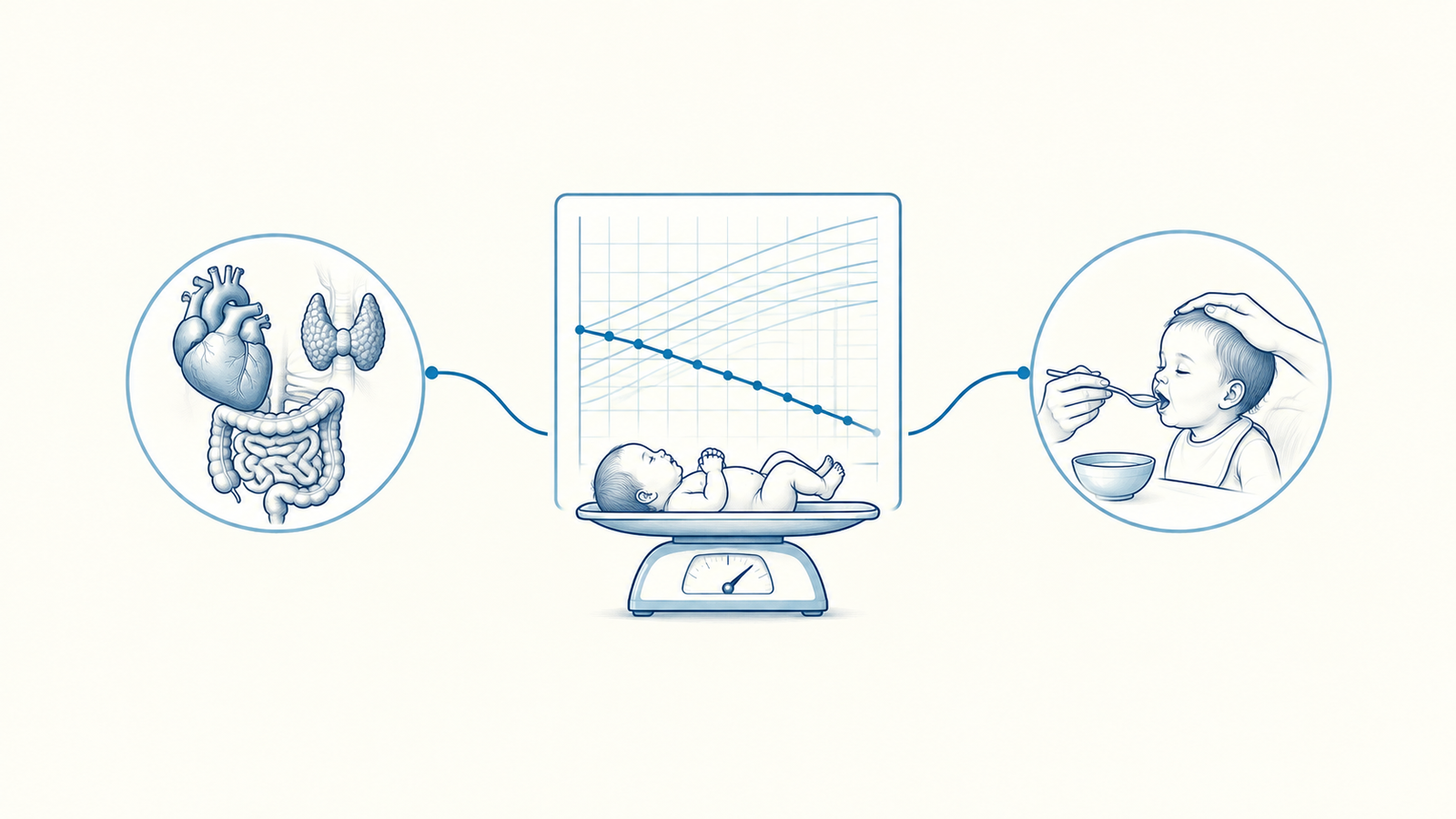
Failure to thrive questions are built around one branching decision that determines everything else: is this organic (a genuine underlying disease) or non-organic (adequate calories aren't reaching or being retained by the child for a psychosocial or feeding reason)? Get that branch right, and the rest of the workup follows logically rather than requiring memorization of an unstructured list of causes.
What Failure to Thrive Actually Means
Failure to thrive describes inadequate physical growth in a child, most commonly defined by weight falling below the third or fifth percentile for age on standard growth charts, or a child's growth trajectory crossing downward across two or more major percentile lines after previously tracking steadily. The key insight is that this is a description of a growth pattern, not a diagnosis in itself — it's the starting point for a workup, not the endpoint.
Organic vs Non-Organic: The Core Distinction
Non-organic failure to thrive is more common overall and results from inadequate caloric intake despite the child having no underlying medical illness preventing normal growth — psychosocial factors, feeding difficulties, poverty, parental mental health struggles, or a genuine lack of nutritional knowledge can all reduce the calories a child actually receives or retains. Organic failure to thrive results from an underlying medical condition — malabsorption, chronic infection, congenital heart disease, renal disease, or an endocrine disorder — that prevents adequate growth despite sufficient caloric intake being offered.
In practice, many real cases involve elements of both categories rather than sitting cleanly in one, but the distinction still matters for how the workup proceeds: a thorough non-organic-pattern history and feeding assessment before extensive laboratory investigation is the generally recommended approach, since the majority of cases turn out to be primarily non-organic, and an expensive, invasive workup pursued first can delay addressing a straightforward feeding or psychosocial issue.
Red Flags That Point Toward an Organic Cause
Certain findings shift the working diagnosis toward organic failure to thrive specifically, and recognizing them is what actually justifies moving beyond a feeding and psychosocial assessment. Vomiting, chronic diarrhea, or other persistent GI symptoms suggest malabsorption or a structural GI problem. Recurrent respiratory infections or a heart murmur raise concern for underlying cardiac or pulmonary disease. Dysmorphic features or developmental delay alongside poor growth suggest a genetic or chromosomal condition.
A normal appetite and adequate caloric intake by history, despite poor growth, is itself a red flag — it argues against a simple intake problem and toward a condition preventing the child from utilizing calories normally, such as malabsorption or an endocrine disorder.
Organic Causes, Organized by System
Gastrointestinal causes include malabsorption syndromes such as celiac disease, cystic fibrosis (with pancreatic insufficiency), and chronic liver disease, all of which allow adequate intake but prevent effective absorption or utilization of nutrients. Cardiac causes center on congenital heart disease, where increased metabolic demand from the heart's own workload, combined with feeding difficulty from fatigue during feeds, together outpace caloric intake.
Renal causes include chronic kidney disease and renal tubular acidosis, both of which impair growth through a combination of metabolic derangement and reduced appetite. Endocrine causes include hypothyroidism and growth hormone deficiency, where growth itself is directly impaired at a hormonal level despite normal intake and normal organ function elsewhere.
Growth Chart Nuances Worth Knowing
Premature infants require correction for gestational age when plotting growth, typically until around 24 months of age — plotting a premature infant's growth against their chronological age rather than their corrected age can create a false impression of failure to thrive in an infant who is actually growing appropriately for their true developmental starting point.
Catch-up growth, once an underlying cause (organic or non-organic) is identified and addressed, is generally expected to follow a predictable trajectory back toward the child's original growth curve — a lack of expected catch-up growth despite appropriate intervention is itself a signal that the working diagnosis or the intervention needs to be reconsidered, not simply that more time is needed.
The Actual Workup Sequence
A structured approach begins with a detailed feeding history — what, how much, and how often the child is actually offered and actually consumes, ideally corroborated by a feeding observation rather than relying on caregiver report alone, since caregiver estimates of intake are frequently inaccurate in both directions. A full physical exam looking specifically for the red flags above follows next. Only once this history and exam suggest an organic cause, or the child fails to respond to an adequate feeding intervention over a reasonable trial period, does extensive laboratory or imaging workup become the appropriate next step, rather than the default first move.
Why Non-Organic Doesn't Mean Less Serious
It's worth actively correcting a natural but mistaken assumption: labeling a case as non-organic failure to thrive does not mean the situation is minor or requires less urgent attention. Inadequate caloric intake in early childhood, regardless of its underlying cause, carries real risk to physical growth and neurodevelopment if not addressed promptly, and non-organic failure to thrive sometimes reflects a genuinely serious underlying psychosocial situation — neglect, severe caregiver mental illness, or extreme poverty — that requires intervention just as urgently as an organic diagnosis would, simply through a different set of services and specialists.
Calculating Caloric Requirements for Catch-Up Growth
Once a nutritional intervention is underway, catch-up growth requires more calories per kilogram than a normally growing child of the same age needs, since the child must both meet ongoing maintenance needs and generate the surplus required for accelerated weight gain. A commonly used approach calculates the calories needed for catch-up growth by using the recommended daily allowance for the child's age, multiplied by their ideal weight for height rather than their actual current weight, then divided by their actual current weight — a calculation that produces a meaningfully higher calories-per-kilogram target than standard maintenance requirements would suggest, reflecting the genuine extra energy cost of active catch-up growth on top of ordinary daily needs.
Failure to Thrive vs Constitutional Growth Delay
Constitutional growth delay is worth distinguishing clearly from failure to thrive, since both present as a child tracking below expected size, but they differ fundamentally in trajectory and underlying process. A child with constitutional growth delay follows their own consistent growth curve, just at a lower percentile than average, without crossing downward across percentile lines over time, and typically has a family history of delayed but ultimately normal adult stature (a parent who was a late bloomer).
Failure to thrive, by contrast, is defined by a downward-crossing trajectory or falling below an absolute threshold, representing an active growth problem rather than a normal variant. A child steadily tracking along the fifth percentile since birth, with a parent who describes a similar childhood pattern, is not describing failure to thrive at all, even though both children might appear equally small on a single measurement taken in isolation.
This distinction matters practically because the two call for entirely different responses: constitutional growth delay generally needs reassurance and continued routine monitoring, while genuine failure to thrive needs active investigation and intervention regardless of which branch, organic or non-organic, it ultimately falls into.
Reading a failure to thrive vignette efficiently means scanning for the organic red flags first — GI symptoms, cardiac or respiratory findings, dysmorphism, developmental delay, or a normal reported intake despite poor growth. Their absence, combined with a history suggesting inadequate actual caloric intake, points toward a non-organic pattern and a feeding-focused intervention as the appropriate next step rather than an extensive investigative workup.
For the same growth-tracking approach applied to a related pediatric topic, see our guide to APGAR score, and for how much of the paper Pediatrics carries overall, our subject-wise weightage breakdown.
Practise this on Reflex
Turn what you just read into recall with 14 years of tagged PYQs.
FAQ
Frequently asked questions
The questions aspirants ask most about this topic.
Weight falling below the third or fifth percentile for age, or growth crossing downward across two or more major percentile lines after previously tracking a steady growth curve.
Organic failure to thrive results from an underlying medical condition preventing growth despite adequate calorie intake. Non-organic failure to thrive results from inadequate calories actually reaching or being retained by the child.
Non-organic causes are more common overall, so a thorough history and feeding assessment first avoids an expensive, invasive workup pursued before addressing a more likely and more straightforward underlying issue.
A heart murmur, recurrent respiratory infections, dysmorphic features, or developmental delay alongside poor growth. Normal appetite despite poor growth is also a red flag pointing toward malabsorption or an endocrine cause.
Premature infants require correction for gestational age, typically until around 24 months. Plotting growth against chronological age instead of corrected age can create a false impression of failure to thrive.
No. It can reflect a genuinely serious underlying psychosocial situation requiring urgent intervention, and inadequate caloric intake carries real risk to growth and neurodevelopment regardless of the underlying cause.
About the author
Stay ahead in your preparation
Get expert tips, exam updates, and high-yield insights delivered straight to your inbox.
No spam. Unsubscribe anytime.
More in Subject Notes
View all → Pediatrics
Immunization Schedule for NEET PG: The Complete Age-Wise Breakdown
The National Immunization Schedule by age — birth, 6–14 weeks, 9 months, and the boosters examiners test.
 Surgery
Burns for NEET PG: The Rule of Nines, Burn Depth and the Parkland Formula Worked Step by Step
 Radiology
FAST Scan for NEET PG: The Four Windows, eFAST, and What a Positive Result Means
 Dermatology