Psychiatry for NEET PG 2026: ECT, Antipsychotics, Lithium Toxicity, and High-Yield Topics
By Dr. Utsav Bhattacherjee, MBBS, MBA · 3 Aug 2026 · 19 min read
Last updated: 23 Sept 2026
On this page
Psychiatry contributes 3 to 5 percent of the NEET PG paper — approximately 5 to 9 questions out of 180. These questions follow predictable patterns: drug mechanisms and adverse effects, diagnostic criteria, ECT indications, and clinical scenario-based distinctions between disorders. Aspirants who approach Psychiatry systematically through PYQ analysis routinely score 80 to 100 percent accuracy in this subject.
Unlike subjects where new research shifts what gets tested, Psychiatry PYQs are stable. The same ECT indications, the same lithium toxicity features, the same extrapyramidal side effect profiles appear cycle after cycle. This guide covers every high-yield topic with the depth NEET PG actually demands. For where this sits against the rest of the paper, see the subject wise weightage for Psychiatry.
Before starting subject revision, use the NEET PG 2026 score calculator to understand how your current Psychiatry accuracy contributes to your projected rank. Getting every Psychiatry question correct versus getting none correct is a score swing of 20 to 36 marks — and at competitive rank ranges, that difference can move you 1,000 to 2,000 positions.
Psychiatry sits inside the Medicine cluster, alongside Dermatology for NEET PG 2026 — both are frequently asked as Medicine-style clinical stems. And neuroleptic malignant syndrome, covered below, is examined just as often from the anaesthetic side, so read it against Anaesthesia for NEET PG 2026 where it appears as the malignant hyperthermia comparison.
The 16 Most-Tested Psychiatry Topics in NEET PG PYQs
| Rank | Topic | Frequency | Question Format |
|---|---|---|---|
| 1 | ECT — indications, contraindications, technique | Very High | Clinical scenario + direct factual |
| 2 | Antipsychotic adverse effects — EPS and tardive dyskinesia | Very High | Drug adverse effect MCQ |
| 3 | Lithium — indications, toxicity, monitoring | Very High | Pharmacology MCQ |
| 4 | Antipsychotic classification — typical vs atypical | Very High | Classification + drug-receptor MCQ |
| 5 | Schizophrenia — diagnostic criteria | High | Diagnostic MCQ |
| 6 | Depression — diagnostic criteria, drug choice | High | Clinical + pharmacology MCQ |
| 7 | OCD — drug of choice, treatment sequence | High | Pharmacology MCQ |
| 8 | Clozapine — agranulocytosis, monitoring | High | Drug safety MCQ |
| 9 | Antidepressant classification — SSRIs, TCAs, MAOIs | High | Classification MCQ |
| 10 | SSRI — mechanism, adverse effects, interactions | Moderate | Pharmacology MCQ |
| 11 | Benzodiazepine — mechanism, uses, withdrawal | Moderate | Pharmacology MCQ |
| 12 | Alcohol dependence — delirium tremens, treatment | Moderate | Clinical scenario |
| 13 | Bipolar disorder — mood stabilisers, drug choice | Moderate | Pharmacology MCQ |
| 14 | Personality disorders — classification, features | Moderate | Diagnostic MCQ |
| 15 | Substance use disorders — CAGE, ICD criteria | Low-Moderate | Direct factual |
| 16 | PTSD and anxiety disorders — criteria and treatment | Low-Moderate | Diagnostic + pharmacology |
Topic 1: Electroconvulsive Therapy
ECT is the most consistently tested topic in NEET PG Psychiatry. It appears in every cycle, sometimes in multiple questions.
Electroconvulsive therapy delivers a controlled electrical stimulus to the brain to induce a generalised tonic-clonic seizure under general anaesthesia and muscle relaxation. It is the most rapidly effective biological treatment in psychiatry — response occurs within 1 to 2 weeks, against 4 to 6 weeks for antidepressants.
Indications
Strong indications, where ECT is the treatment of choice:
| Indication | Why ECT Is Preferred |
|---|---|
| Severe depression with suicidal risk | Fastest response; removes the suicide window during the medication lag |
| Catatonia of any cause | Very high response rate; faster than lorazepam alone in severe cases |
| Psychotic depression | Antidepressant plus antipsychotic is less effective than ECT |
| Depression with refusal to eat or drink | Life-threatening; ECT is the fastest intervention |
| Treatment-resistant depression | Failure of two or more adequate antidepressant trials |
| Mania unresponsive to medication | When lithium, valproate and antipsychotics have failed |
| Neuroleptic malignant syndrome | When pharmacological treatment fails |
| Severe postpartum depression or psychosis | When medication cannot be used |
Relative indications include depression in pregnancy where antidepressants are contraindicated, Parkinson's disease with severe depression — ECT also improves motor symptoms — and schizophrenia as augmentation, particularly for affective symptoms.
Contraindications
There are no absolute contraindications in modern practice with proper anaesthetic management. Significant relative contraindications:
| Contraindication | Reason |
|---|---|
| Raised intracranial pressure | ECT transiently raises ICP — herniation risk |
| Recent myocardial infarction (under 3 months) | ECT causes cardiovascular stress |
| Intracranial space-occupying lesion | Herniation risk from the ICP rise |
| Recent cerebral haemorrhage | Risk of re-bleed |
| Phaeochromocytoma | The catecholamine surge can be fatal |
| Aortic aneurysm | ECT-induced hypertension |
| Severe anaesthetic risk | Patient cannot safely undergo general anaesthesia |
| Retinal detachment | Risk of worsening |
Technique
Pre-ECT workup covers informed consent from the patient or guardian, full blood count, ECG, chest X-ray, serum electrolytes — hypokalaemia lowers the seizure threshold and is dangerous — blood glucose, brain imaging if a space-occupying lesion is suspected, and an anaesthetic fitness assessment.
Electrode placement is bilateral (bitemporal) as standard and more effective for severe depression; right unilateral produces fewer cognitive side effects but may need a higher dose; bifrontal sits between the two.
For anaesthesia, the muscle relaxant is suxamethonium, a short-acting depolarising agent. Induction uses methohexitone traditionally, with propofol, thiopentone and etomidate also used. Atropine is given beforehand to prevent bradycardia and reduce secretions, with 100 percent oxygen before and after.
The therapeutic seizure requires a minimum EEG seizure duration of 25 seconds. The stimulus itself lasts 0.5 to 2 seconds as a brief-pulse square wave. The clinical motor seizure may appear shorter because of muscle relaxation, which is why EEG monitoring is required.
A standard course is 6 to 12 sessions given two to three times per week, with response expected by session 4 to 6. Maintenance ECT uses monthly sessions to prevent relapse.
Adverse Effects
| Adverse Effect | Details |
|---|---|
| Memory impairment | Most common; retrograde more than anterograde; usually reversible |
| Post-ictal confusion | Resolves within 30 to 60 minutes |
| Headache | Common, transient |
| Muscle aches | From suxamethonium fasciculations |
| Cardiovascular effects | Transient hypertension and arrhythmias around the stimulus |
| Prolonged seizure | Over 3 minutes becomes status epilepticus — treat with IV diazepam |
| Missed seizure | No seizure occurs — increase stimulus intensity |
| Tardive seizure | A seizure occurring hours after the session |
PYQ patterns: the muscle relaxant in ECT is suxamethonium; the minimum EEG seizure duration is 25 seconds; the most common adverse effect is memory impairment; the drug given beforehand to prevent bradycardia is atropine.
Topic 2: Antipsychotic Drugs
Typical (First-Generation) Antipsychotics
| Drug | Potency | Key Feature |
|---|---|---|
| Chlorpromazine | Low | Prototype; most sedating; alpha blockade |
| Thioridazine | Low | Highest risk of retinal pigmentation |
| Trifluoperazine | High | High EPS risk |
| Haloperidol | High | Most studied; highest EPS; available IV and depot |
| Fluphenazine | High | Available as decanoate depot; high EPS risk |
| Droperidol | High | Antiemetic; IV use; QTc prolongation |
Atypical (Second-Generation) Antipsychotics
| Drug | Receptor Profile | Unique Feature |
|---|---|---|
| Clozapine | D4 over D2, plus 5HT2A | Only drug for treatment-resistant schizophrenia; 1–2% agranulocytosis risk |
| Risperidone | D2 plus 5HT2A | Most EPS of the atypicals at high dose; raises prolactin |
| Olanzapine | D2, 5HT2A, H1, M1 | Most weight gain and metabolic syndrome; minimal EPS |
| Quetiapine | D2, 5HT2A, H1 | Most sedating atypical; also used in bipolar depression |
| Aripiprazole | Partial D2 agonist | Least weight gain and metabolic effect; most activating |
| Ziprasidone | D2 plus 5HT2A | QTc prolongation; little weight gain |
| Amisulpride | D2 and D3 | No 5HT blockade; highest prolactin elevation |
| Paliperidone | Active metabolite of risperidone | 9-hydroxyrisperidone |
Extrapyramidal Side Effects
The most tested antipsychotic adverse effect cluster. Know each type, its timing and its treatment.
| EPS Type | Onset | Features | Treatment |
|---|---|---|---|
| Acute dystonia | Hours to days | Involuntary spasms — torticollis, oculogyric crisis, opisthotonus | Anticholinergics (benztropine, procyclidine) IV or IM immediately |
| Akathisia | Days to weeks | Subjective restlessness; inability to sit still | Propranolol first-line; benzodiazepines; anticholinergics are less effective |
| Parkinsonism | Weeks | Tremor, rigidity, akinesia, postural instability | Anticholinergics (benztropine, trihexyphenidyl) |
| Tardive dyskinesia | Months to years | Orofacial dyskinesias — lip smacking, tongue protrusion, choreiform movements | Stop the offending drug where possible; valbenazine, deutetrabenazine |
Key distinctions: acute dystonia responds to anticholinergics, fastest by IM injection. Akathisia responds to propranolol, not anticholinergics. Tardive dyskinesia is treated with VMAT2 inhibitors, and anticholinergics make it worse.
Tardive Dyskinesia
A delayed-onset hyperkinetic movement disorder caused by prolonged dopamine receptor blockade, leading to receptor upregulation and supersensitivity. By definition onset follows at least 3 months of antipsychotic exposure, or 1 month in patients over 60.
Movements are orofacial dyskinesias — lip smacking, chewing, tongue protrusion — with limb choreic and trunk movements. Risk factors are older age, female sex, higher dose, longer duration, typical rather than atypical agents, prior EPS, and mood disorders.
Treatment is prevention first: the lowest effective dose and atypical agents. Switching to clozapine or quetiapine helps, as these carry the lowest EPS risk. VMAT2 inhibitors — valbenazine and deutetrabenazine — deplete presynaptic dopamine and are the approved treatments. Tetrabenazine is the older agent, with a risk of depression. Clonazepam is an adjunct.
Clozapine
Clozapine is used specifically for treatment-resistant schizophrenia — failure of adequate trials of at least two antipsychotics at adequate dose and duration. Its profile combines high D4 affinity, moderate D2 blockade and strong 5HT2A, H1, M1 and alpha-1 blockade, which explains both its efficacy and its side effects.
| Adverse Effect | Frequency | Monitoring |
|---|---|---|
| Agranulocytosis | 1–2% | Weekly WBC for 6 months, then fortnightly |
| Metabolic syndrome | Very common | Weight, glucose, lipids |
| Hypersalivation | Very common | Hyoscine or clonidine |
| Seizures | Dose-dependent | Keep below 600 mg; add valproate if needed |
| Myocarditis and cardiomyopathy | Rare but fatal | Troponin and CRP in the first month |
| Sedation | Very common | Give the main dose at night |
| Hypotension | Common | Slow titration |
| Constipation | Common | Bowel monitoring, laxatives |
Topic 3: Lithium
Indications and Monitoring
Lithium is first-line for acute mania and for bipolar prophylaxis, where it has the most evidence. It is effective in bipolar depression, used to augment antidepressants in treatment-resistant depression, and used for cluster headache prophylaxis.
It has a narrow therapeutic index, so monitoring is not optional.
| Parameter | Frequency | Reason |
|---|---|---|
| Serum lithium | Every 3–6 months when stable | Therapeutic range 0.6–1.2 mEq/L; 1.0–1.2 in acute mania |
| Renal function | Every 6 months | Renally excreted and nephrotoxic |
| Thyroid function | Every 6 months | Causes hypothyroidism in around 40% on long-term treatment |
| Calcium | Every 6 months | Causes hyperparathyroidism |
| ECG | Baseline then annually | T-wave flattening or inversion at therapeutic levels |
The serum sample is drawn 12 hours after the last dose, as a trough level.
Lithium Toxicity
| Severity | Serum Level | Clinical Features |
|---|---|---|
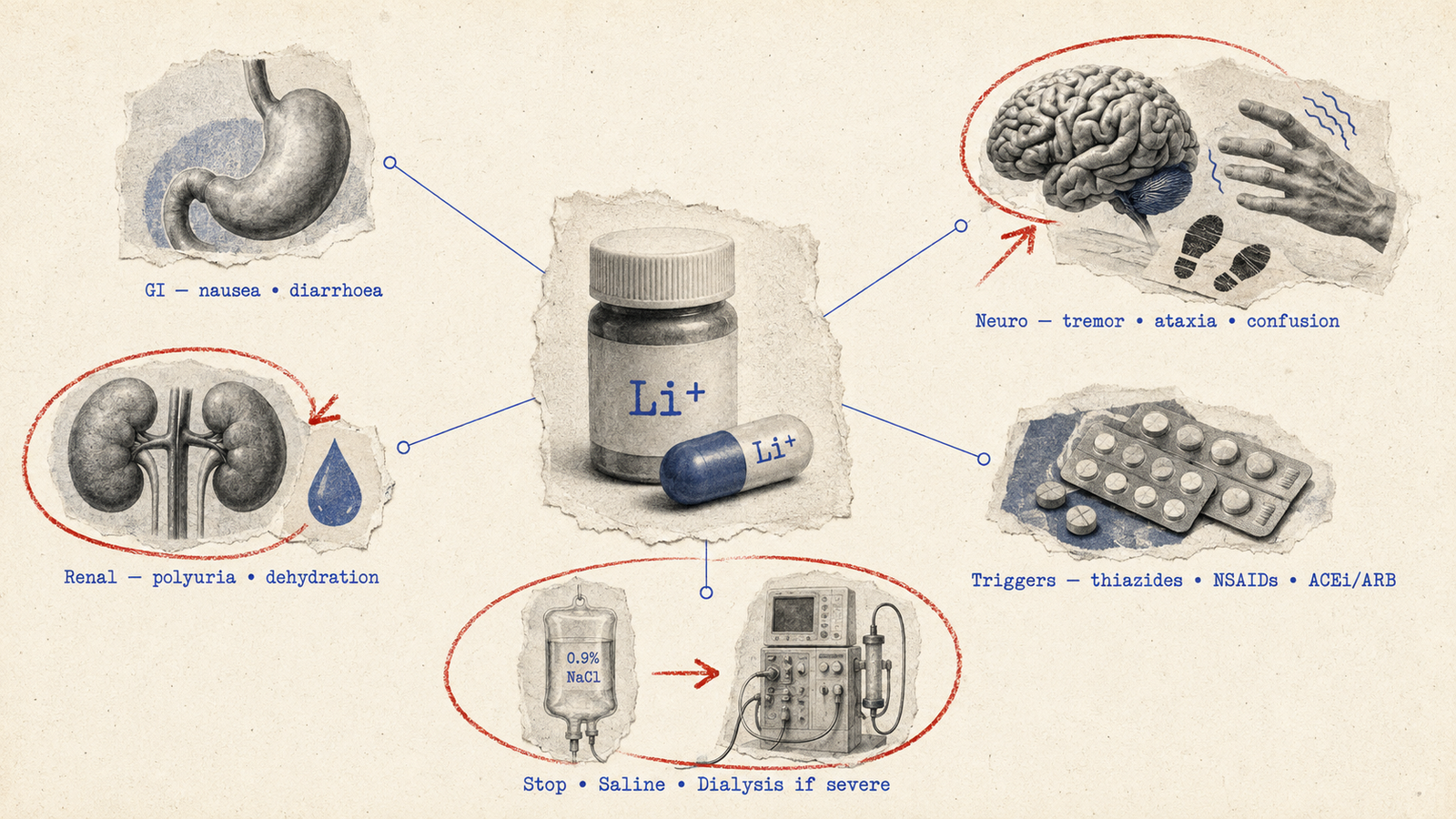
| Mild | 1.5–2.0 mEq/L | Nausea, vomiting, diarrhoea, coarse tremor, thirst, polyuria, drowsiness |
| Moderate | 2.0–2.5 mEq/L | Confusion, ataxia, slurred speech, muscle twitching, blurred vision, lethargy |
| Severe | Above 2.5 mEq/L | Seizures, coma, arrhythmias with QTc prolongation, neurotoxicity |
Precipitants — remember "DENT": Dehydration, Electrolyte imbalance (low sodium), NSAIDs, Thiazides. A low-sodium state makes renal tubules retain lithium in place of sodium. ACE inhibitors and renal failure also reduce clearance.
Management: stop lithium immediately, give IV normal saline since sodium loading promotes excretion, maintain urine output, and monitor cardiac rhythm. Haemodialysis is indicated when the level exceeds 4 mEq/L with any symptoms, or exceeds 2.5 mEq/L with renal failure or persistent neurological features. There is no specific antidote — haemodialysis is the definitive treatment.
PYQ patterns: the most important interaction is with thiazide diuretics; severe toxicity is treated with haemodialysis.
Topic 4: Diagnostic Criteria
Schizophrenia
Duration is at least one month, with at least two core symptoms from: hallucinations (most commonly auditory), delusions, disorganised thinking, disorganised or abnormal psychomotor behaviour including catatonia, and negative symptoms — flat affect, alogia, avolition, anhedonia, asociality.
Schneider's first-rank symptoms remain high-yield: auditory hallucinations as running commentary, third-person discussion or thought echo; thought insertion, withdrawal and broadcasting; somatic passivity and made feelings, impulses or actions; and delusional perception.
Treatment-resistant schizophrenia is defined as failure of two or more adequate antipsychotic trials of different classes, each at therapeutic dose for at least 6 weeks — at which point the answer is clozapine.
Depression
Three core symptoms are required for at least two weeks: depressed mood, markedly diminished interest or pleasure, and increased fatigue or reduced energy. Additional features include reduced concentration, worthlessness or guilt, hopelessness, disturbed sleep, disturbed appetite or weight, psychomotor change and suicidal ideation.
Mania
Duration is at least 7 days, or any duration if hospitalisation is required. The core feature is persistently elevated, expansive or irritable mood together with increased activity or energy. Associated features — three required with euphoric mood, four with irritable mood — include decreased need for sleep (feeling rested on less, not insomnia), pressure of speech, flight of ideas, grandiosity, distractibility, increased goal-directed activity and reckless behaviour.
Acute mania is treated with lithium for classic euphoric presentations, valproate especially for dysphoric or mixed features, atypical antipsychotics for faster onset than lithium, haloperidol in severe agitation, and ECT where medication fails.
OCD
Obsessions are intrusive, unwanted, recurrent thoughts, images or urges, recognised as one's own but experienced as ego-dystonic. Compulsions are repetitive behaviours or mental acts performed in response to obsessions or rigid rules. The disorder must be time-consuming — over an hour a day — or cause significant distress or impairment.
Drug treatment is fluvoxamine as the first-choice SRI in Indian practice, clomipramine as the most potent antiobsessional agent and first-line in many international guidelines, and the other SSRIs — fluoxetine, sertraline, paroxetine — all effective.
OCD responds to serotonin reuptake inhibitors specifically, not to antidepressants generally. Doses are higher than for depression and response takes 8 to 12 weeks. For treatment-resistant OCD, an antipsychotic is added to the SRI.
Topic 5: Antidepressants
SSRIs — fluoxetine, sertraline, paroxetine, fluvoxamine, citalopram, escitalopram. First-line for depression, OCD, panic disorder, social anxiety, PTSD and GAD. Sexual dysfunction is the most troublesome adverse effect. Fluoxetine has the longest half-life, over 7 days including its active metabolite, so it causes the least withdrawal; paroxetine has the shortest and causes the most.
SNRIs — venlafaxine, desvenlafaxine, duloxetine. Effective for depression with neuropathic pain. Venlafaxine raises blood pressure at high dose. Duloxetine is used in diabetic neuropathy, fibromyalgia and stress urinary incontinence.
TCAs — amitriptyline, imipramine, clomipramine, nortriptyline, desipramine. Multiple receptor blockade means multiple side effects, and they are dangerous in overdose through cardiac arrhythmias with QRS prolongation and anticholinergic crisis. Amitriptyline is the most sedating and anticholinergic; nortriptyline is the best tolerated; imipramine was the first discovered and is also used for enuresis.
MAOIs — phenelzine and tranylcypromine are irreversible; moclobemide is reversible. Irreversible MAOIs with tyramine-rich food cause a hypertensive crisis. Combining them with SSRIs causes serotonin syndrome and requires a two-week washout.
Others — mirtazapine is the most appetite-stimulating and causes no sexual dysfunction; bupropion is a noradrenaline-dopamine reuptake inhibitor also used for smoking cessation, with no sexual dysfunction but a lowered seizure threshold; trazodone is sedating and carries a rare risk of priapism; agomelatine normalises circadian rhythm and needs LFT monitoring; vortioxetine is multimodal and improves cognition.
| Feature | Serotonin Syndrome | Hypertensive Crisis (Cheese Reaction) |
|---|---|---|
| Cause | SSRIs with MAOIs; tramadol or linezolid with SSRIs | MAOIs with tyramine-rich food |
| Mechanism | Excess serotonin | Tyramine, normally metabolised by MAO, releases catecholamines |
| Features | Altered mental status, autonomic instability, neuromuscular abnormality with clonus and hyperreflexia | Severe hypertension, pounding headache, cerebrovascular risk |
| Treatment | Stop the agents; cyproheptadine; benzodiazepines; supportive care | Phentolamine; avoid beta-blockers |
Topic 6: Benzodiazepines
Benzodiazepines bind the GABA-A receptor at a site distinct from the GABA binding site and increase the *frequency* of chloride channel opening — barbiturates increase the *duration*. The result is increased chloride conductance, hyperpolarisation and inhibition.
| Indication | Preferred Agent |
|---|---|
| Acute anxiety or panic | Alprazolam, lorazepam |
| Alcohol withdrawal and delirium tremens | Diazepam; lorazepam in liver disease |
| Status epilepticus | IV diazepam or lorazepam |
| Acute catatonia | IV lorazepam first-line; ECT if no response |
| Pre-anaesthetic medication | Midazolam |
| Short-term insomnia | Temazepam, nitrazepam |
Prolonged use produces physical dependence. Withdrawal causes anxiety, insomnia, tremor, diaphoresis and, in severe cases, seizures. Treatment is gradual tapering, switching to a long-acting agent to cover the taper.
Topic 7: Alcohol Dependence
The CAGE questionnaire asks whether the patient has felt they should Cut down, been Annoyed by criticism of their drinking, felt Guilty about it, or needed an Eye-opener first thing in the morning. A score of 2 or more is clinically significant, with 71 percent sensitivity and 90 percent specificity.
Delirium tremens begins 48 to 96 hours after the last drink — not immediately. Features are confusion, disorientation and agitation; autonomic instability with tachycardia, hypertension, diaphoresis and fever; visual and tactile hallucinations, classically of insects or animals crawling; seizures; and tremor.
Treatment is benzodiazepines first-line — diazepam, or lorazepam and oxazepam in liver disease since they have no active metabolites. Thiamine is given before glucose to prevent Wernicke's encephalopathy, alongside IV fluids and electrolyte correction.
| Component | Feature |
|---|---|
| Wernicke's encephalopathy | Acute triad of confusion, ophthalmoplegia and ataxia from thiamine deficiency |
| Korsakoff's psychosis | Chronic anterograde amnesia with confabulation, other cognition relatively preserved |
| Treatment | IV or IM thiamine, given before any glucose |
Topic 8: Personality Disorders
| Cluster | Character | Disorders |
|---|---|---|
| A — odd or eccentric | Odd, suspicious, isolated | Paranoid, schizoid, schizotypal |
| B — dramatic or emotional | Emotional, dramatic, impulsive | Antisocial, borderline, histrionic, narcissistic |
| C — anxious or fearful | Fearful, anxious, rigid | Avoidant, dependent, obsessive-compulsive |
Borderline personality disorder is the most tested: impulsivity, self-harm, unstable relationships, fear of abandonment, identity disturbance and affective instability. Dialectical behaviour therapy is the only evidence-based psychotherapy for it.
Antisocial personality disorder cannot be diagnosed before 18 and requires conduct disorder before 15. Schizotypal personality disorder involves magical thinking and odd beliefs on the schizophrenia spectrum, and is a high-risk state for schizophrenia.
High-Yield Psychiatry PYQ Checklist
Work through this alongside the NEET PG 3-month study plan, and test the recall under time pressure with a HAMMER weekly grand test.
- ECT's most important indication — severe depression with suicidal risk
- ECT muscle relaxant — suxamethonium
- ECT induction agent — methohexitone or propofol
- Minimum EEG seizure duration for ECT — 25 seconds
- Most common ECT side effect — memory impairment
- Drug given before ECT — atropine, to prevent bradycardia
- Clozapine — treatment-resistant schizophrenia, with agranulocytosis monitoring
- Clozapine monitoring — weekly WBC for the first 6 months
- Acute dystonia — IV or IM anticholinergics
- Akathisia — propranolol, not anticholinergics
- Tardive dyskinesia — valbenazine or tetrabenazine
- Anticholinergics worsen tardive dyskinesia
- Lithium monitoring — level, renal function, thyroid function and calcium every 6 months
- Lithium sampling — 12 hours post-dose, trough
- Lithium toxic level — above 1.5 mEq/L
- Lithium with thiazides or NSAIDs — raises the level
- Haemodialysis — above 4 mEq/L, or above 2.5 with symptoms
- Lithium side effects — hypothyroidism, hyperparathyroidism, diabetes insipidus, weight gain
- Depression core triad — depressed mood, anhedonia, fatigue, for 2 weeks
- OCD drug of choice — fluvoxamine in India, clomipramine globally
- OCD response time — 8 to 12 weeks
- Serotonin syndrome — SSRIs with MAOIs; treat with cyproheptadine
- MAOIs with tyramine — hypertensive crisis
- CAGE — a score of 2 or more is significant
- Delirium tremens onset — 48 to 96 hours after the last drink
- Delirium tremens treatment — diazepam; lorazepam in liver disease
- Thiamine before glucose in alcoholics
- Wernicke's triad — confusion, ophthalmoplegia, ataxia
- Korsakoff's — anterograde amnesia with confabulation
- Borderline personality disorder — dialectical behaviour therapy
- Bupropion — NDRI, no sexual dysfunction, smoking cessation
- Mirtazapine — appetite stimulating, no sexual dysfunction
Practise this on Reflex
Turn what you just read into recall with 14 years of tagged PYQs.
FAQ
Frequently asked questions
The questions aspirants ask most about this topic.
Clozapine is the only antipsychotic with proven efficacy in treatment-resistant schizophrenia, defined as failure of adequate trials of at least two antipsychotics. It requires regular WBC monitoring because of a 1 to 2 percent risk of agranulocytosis, and it is the only antipsychotic associated with reduced suicide risk in schizophrenia.
Severe depression with suicidal risk, psychotic depression, catatonia, treatment-resistant depression, mania unresponsive to medication, neuroleptic malignant syndrome where pharmacotherapy fails, and severe postpartum depression where medication is contraindicated. ECT acts faster than any medication, with response in 1 to 2 weeks. The muscle relaxant is suxamethonium and a minimum EEG seizure of 25 seconds is required.
Stop lithium immediately and give IV normal saline, since sodium loading promotes renal excretion. Maintain urine output and monitor cardiac rhythm. Haemodialysis is indicated when the serum level exceeds 4 mEq/L regardless of symptoms, or exceeds 2.5 mEq/L with renal failure or significant neurological features. There is no specific antidote.
Serotonin reuptake inhibitors specifically — fluvoxamine is the usual first choice in Indian practice, and clomipramine is considered the most potent antiobsessional agent globally. Doses are higher than for depression and response takes 8 to 12 weeks rather than 4 to 6. For treatment-resistant OCD, an antipsychotic such as risperidone or aripiprazole is added to the SRI.
Both are drug-induced hyperthermia syndromes with different mechanisms. Serotonin syndrome comes from excess serotonergic activity — SSRIs with MAOIs, or tramadol with SSRIs — and presents with altered mental status, autonomic instability and neuromuscular abnormality with clonus and hyperreflexia; treatment is cyproheptadine. NMS comes from dopamine D2 blockade by antipsychotics and presents with hyperthermia, lead-pipe rigidity, autonomic instability and altered consciousness; treatment is dantrolene and bromocriptine.
It depends on the type. Acute dystonia responds to intramuscular or intravenous anticholinergics such as benztropine. Akathisia responds to propranolol, not anticholinergics. Drug-induced parkinsonism responds to anticholinergics. Tardive dyskinesia is treated with VMAT2 inhibitors such as valbenazine or deutetrabenazine — and is made worse by anticholinergics, which is the distinction most often tested.
About the author
Stay ahead in your preparation
Get expert tips, exam updates, and high-yield insights delivered straight to your inbox.
No spam. Unsubscribe anytime.
More in Subject Notes
View all → Psychiatry
Schizophrenia for NEET PG: First-Rank Symptoms, Positive vs Negative Features, and the Subtypes
 Surgery
Burns for NEET PG: The Rule of Nines, Burn Depth and the Parkland Formula Worked Step by Step
 Radiology
FAST Scan for NEET PG: The Four Windows, eFAST, and What a Positive Result Means
 Dermatology